Tuesday, 29 October 2019

The Earth Does Not Speak in Prose

Reading Dark Mountain by Kit Boyd

A conversation with Paul Kingsnorth for the just published tenth anniversary edition of Dark Mountain about writing in times of catastrophe, decolonising language and how you build a culture that can speak with the land.

In 2008, Paul Kingsnorth was working on two seismic texts. One was a small red pamphlet, engineered with fellow ex-journalist Dougald Hine, that laid down the tracks for what would become The Dark Mountain Project; the other was a post-apocalyptic novel written in a ‘shadow tongue’, the first in a trilogy of books that follows the fate of a man on the brink of collapse in different millennia. Both make strong demands on the reader. Uncivilisation challenges a world view conventionally shaped by progress, technology and human exceptionalism; The Wake, our linguistic skills and capacity to step into the mindset of someone whose land, culture and sense of being in control is taken away by a force outside their known boundaries.  

In 2019, I am sitting opposite the writer who has for the last decade wrestled with these crises in essays, fiction and poetry; who has shaped anthologies, directed festivals and writing courses and brought together a collection of writers and artists to pay attention to the ecological and social collapse we all inevitably face. realise that despite having worked alongside each other during these years, we have never spoken about our mutual craft, and that now is the moment. We are in a coffee shop in the bookish town of Hay-on-Wye. It’s midsummer, a golden day in the Golden Valley. In his just-published non-fiction work, Savage Gods, he challenges himself: on his quest to find a place to belong on the Earth, and on his true worth as a wielder of words. Finally he is thrown the gauntlet by the mischievous god Loki, who, swiping a beer from his fridge, tells him to ‘shut up’ entirely.   

Luckily for you and me, this only refers to writing...  


CHARLOTTE DU CANN  Looking back at the decade, from the time of the manifesto to now, what strikes you as most significant in terms of the zeitgeist? 

PAUL KINGSNORTH  Perhaps the most significant fact about the last decade is how much was said in the manifesto that has become pretty much widely accepted. In terms of the culture, it was quite a wild thing to be saying: that it is not possible to stop the collapse and that we need to write about the situation for real. 

Now the kind of things we were publishing in the first books you can find in the New York Times and the Guardian; in the fact that Extinction Rebellion are called Extinction Rebellion. Most people are saying: we are in the catastrophe now, ecologically speaking. Which is a shame because it would have been nice if we had been entirely wrong.  

CDC The manifesto threw down a gauntlet for writers and artists to respond to this catastrophe. How successful do you think that has been? 

PK Funnily enough, I think that might be the least successful part of Dark Mountain. I had this idea originally that I could found a writer's group like C.S. Lewis and Tolkien, sitting around in the pub talking about orcs, and we would have a little journal. It was Dougald’s idea to publish a manifesto so people would know what we were talking about, and he knew all about crowdfunding, which was new at the time.  

For me it was a literary project partly because I wanted to get away from being an activist. I largely failed to do that, because I couldn't stop writing about the failure of activism and detach myself from the political conversation. Like George Orwell, I was being constantly pulled between: 'I want to be a literary writer’ and ‘I've got to get involved in the world I'm in’. 

CDC In these ten years, the responses to the manifesto have attracted a certain kind of writing that you wouldn’t necessarily call literary... 

PK The difference between Uncivilisation and, say, the modernist manifestos which partly inspired it, is that we weren't suggesting people should write in a certain way. We were talking about tackling a certain set of themes, particularly demolishing the myth of progress and stepping outside our humanness, taking the crisis seriously and understanding where we are.  

The most significant thing turned out to be the non-fiction and maybe the events, and  the creation of a group of people who share that perspective.  

CDC Maybe the function of writing now is that it can address a territory that activism never really looks at, which is the existential crisis that we're in.  

PK In some ways it's not a time for literature. What we call literature is completely inadequate, particularly metropolitan, middle-class British literature that is utterly unconcerned with the great existential issues of our time. That's one of the things that motivated me to write Savage Gods: what kind of writing would you produce in this time if you took this seriously? It's not just a question about subject matter, it's a question about form. And it's also a question about why you would even write anything.  

CDC So where does that leave the role of the writer, do you suppose? 

PK When we wrote the manifesto, I believed very strongly in the writer as an agent of change. And I’m not sure I do anymore. That’s part of the crisis that led me to Savage Gods: writing about losing faith in the written word. And that’s because for me, direct experience is becoming more and more important than experience filtered through writing.  

I don’t have the same belief that I had ten years ago in the idea that a literary movement of people could produce world-changing stuff.  Partly because society is so big and so complex, and when I look back at the manifesto now, I was approaching literature from quite an activist-y mindset. You know, We will use writing to change the future! 

CDC I really enjoyed the references in Savage Gods to people who would definitely be considered writers of literature, such as Yeats or Kavanagh or DH Lawrence. Those writers appear like touchstones, like a lineage. Would you describe it like that? 

PK I didn’t really consciously think about that when I was younger, but I do now. Who would be in my lineage? Yeats would be in my lineage, and Ted Hughes, Jeffers and DH Lawrence, Emily Bronte, Wordsworth, and basically all the great dark Romantics. But also others like Orwell, Chesterton, Huxley. There’s a certain strain of English radicalism that appeals to me which is quite particular. Now that I’ve said that, I’ll contradict it by talking about lots of American writers… 

CDC  Robinson Jeffers is not very English… 

PK Yes, there’s that great American wilderness tradition: Jeffers, but also Thoreau, Edward Abbey. And other writers like Wendell Berry… There’s something about American writing about nature and place which appeals to me much more than the kind of polite, middle-class, Oxbridge-y English nature writing which I find tiresome. I would much rather read someone with this great eagle’s perspective on the world. 

CDC  That is dictated by the land itself, I think. 

PK I think it is. Because it’s a very small, very old part of the country here in Britain. Whereas in America you can still stride out, and maybe get killed by a bear, and have a non-human experience at scale. 

So if I had a lineage, there’s a certain English radical Romantic tradition and there’s an American wild landscape tradition. And then also politically, I think of someone like, say, Subcomandante Marcos of the Zapatistas, who was a massive influence on me. Someone who came out of the city and decided to learn about what it meant to be indigenous, to belong to a place and become a revolutionary leader of a very different kind. Firstly, one who’s directed by the people themselves. And secondly, one who’s coming from a sense of place and culture, which is not a kind of unchanging, reactionary sort of everything-was-viable-in-the-old-days-and-we’ll-keep-it-like-that notion. Quite the opposite: the Zapatistas want change. But it’s entirely untheoretical.  

CDC There seems to be a thread throughout all these writers from Marcos to Wendell Berry: that their work comes out of knowing places, it doesn’t come out of the mind. 

PK Yes, this something I come back to again and again in all of my writing. The fact that the global machine which is destroying the Earth flourishes by destroying all cultures, all peoples, all places -- like grubbing up an orchard. As it ploughs through the world everybody is pulled into the engine to feed the growth machine. And so the process of rooting becomes a radical act but also a difficult one. Because what does that mean when everyone is moving around, if I don’t belong anywhere? 

The best places I’ve been in the world in my view have been the most rooted places, where cultures are very old and people have a strong kind of solidity to them, like old trees. And they know their land, and they know it’s where their ancestors are buried and where they’re going to be buried. Compare that to the kind of weird rootlessness of the modern West, of which I’m a part, and there’s no comparison, in terms of the way that people live well. 

Most of us aren’t living like that. I’m not living like that. And there are more and more people moving around all the time, and migrating and being displaced, some of them voluntarily and some of them not. That’s what we’re all doing all the time, internally and externally. How do you get from here to there is the question. 

CDC And it’s not just a matter of finding your place. It’s a matter of having a relationship with that place, whether you ‘own’ it or not. 

PK The reality is that people need to belong across space and time. We need to have a sense of who we are as a people, whatever that means to us, and who our ancestors are. Otherwise we’re just individualists. We need a sense of being part of something across time. And we also need a sense of being able to say ‘This is my home.’ It doesn’t have to be where you’ve come from, but it’s the place you are, where you’ve said, ‘This is where I’ve put my feet down.’ 

If you look at that from a non-human perspective, it starts to make a lot more sense. Because you’re not just saying, ‘Where is my human culture? Who are my people?’, arguing about all that endless identity stuff that everybody kills each other about all day. You’re saying, ‘I don’t even necessarily need to be from the place I’m in, but I can pay attention’, to what Aldo Leopold called the biotic community of the place you’re in. 

So I don’t come from where I live at the moment, but as a family we have managed to find a couple of acres to put down roots in and paid lots of attention to everything that lives there. And the community is not just the people.  

As you say, you put your feet down in a place, and then you look around and you see what lives here and find out what it needs. You can do that anywhere. It seems to me that if there’s an imperative for writers, it is to ask: ‘What does it mean to be human, in a landscape, at this time? And what can you do to serve the wider community of everything that lives in it?’ 

CDC And that’s a task as well. 

PK There’s always an enormous pulling inside you as a writer. In a pre-modern culture, creators would create as part of a tradition bigger than themselves. So a storyteller will tell a story that’s part of their culture; or if you’re a religious teacher, you’ve got a big tradition that you’re working in. We’re people with no tradition, because that’s what modernity has done. It’s made us all into little individuals. So the story we tell, we have to come up with ourselves. And then we’re endlessly in pain, because we’re always driven to try and work everything out. Because we’re not supported by ancestry, we’re not supported by a culture. The bargain of modernity is we have no tradition to hold us back, but we also have no tradition to support us. So all the storytellers have to come up with their own vision which is why writers end up shooting themselves, or drinking themselves to death… 

CDC Or rediscovering old myths, old texts… 

PK Yes. And what Dark Mountain ended up doing quite a lot of: talking about myths, folk tales and religious stories. Almost unconsciously, Dark Mountain ended up as a place where you could start looking for old stories. One of the things we got wrong in the manifesto was this notion that we need a new story, when we needed to rediscover the old ones. Martin Shaw was one of the people who really made me focus on that, because he said, ‘Look, the stories are already here, it’s just that we don’t know them anymore.’ 

CDC There’s something else contained in these old stories which no new narrative would probably say, which is that you have to go through a process of transformation or on an underworld journey in order to be properly human. So where do you feel that those stories have a place now?  

PK  The underworld journey and the alchemical transformation is the story at the heart of every religion I’ve ever come across. An individual has to be broken open in some way, has to go through the fire and come out the other side. That’s what our culture is doing at the moment. And all of the official stories that we tell ourselves don’t involve undergoing the underworld journey. The green narrative that we can fix everything and it will be alright, is now actually giving way to a more traditional structure in which we all have to go through the fire, and then we’ll come out completely transformed into something else. 

But we don’t like that as a culture. We don’t like transformation. 

CDC It hurts and you end up in a state of crisis. 

PK And you have to go through that… The other thing that religions teach is that you get wisdom through suffering. It isn’t popular but life is suffering and how you manage it and what you learn from it must be the lesson of life.  We have created a culture which tells us that  progress will prevent us from suffering. We like that story because no-one wants to suffer but it's not working, it’s just delayed lots of suffering that we’re going to have to go through now. 

So the heart of the story that interests me now is what it means to go to the Underworld and come back marked, but with some wisdom. You know, Odin has to be hung on the tree for nine nights, and then he has to lose his eye, before he gets the vision that’s given to him in the runes.  

CDC There’s a story cited by Derrida via Plato about the invention of writing. Thoth, the Egyptian god of medicine and magic, tells the king he has created a method that will help the people remember and be wise. But the king tells him: the people will put all their wisdom in the writing and forget to hold it themselves. Eventually he agrees, with the warning that henceforth writing will be both a poison and a remedy. He calls it the pharmakon.  

It seems to me that writers often embody the medicine of the pharmakon themselves and that your journey as a writer, and in Savage Gods in particular, relates to the holding of these contradictory forces. 

PK Yes, the question at the heart of that book is: how much in these words is so divorced from the thing they’re pointing at that they are useless or damaging?  

In the book I talk about being torn between this notion of sitting around a campfire with my tribe and wanting to be part of that long lineage tradition. And then wanting to sit up on the mountain and look down at the campfire and go, ‘Look at all those idiots just being comfortable around their fire instead of coming out here and exploring what might be possible.’ 

That’s the human condition. We’re all around the campfire and on the mountain. As a writer, you’re never going to be content with either. And that’s OK, so long as you can hold that as your work.  

I’m very content in my personal life. But existentially and culturally and ecologically, no. If you do the kind of writing that happens in Dark Mountain, if you don’t think the world is going in the right direction, or the culture has got it right, or the stuff that surrounds us is the stuff that we should be surrounded by, you have to carry that contradiction all the time. And I’m better at carrying contradictions now than I was ten years ago. You just have to carry it and not be eaten by it. 

CDC The writer, within the frame of the story, is also a rememberer of a certain kind of wisdom,  whether it’s remembering how to be with the land or remembering the old stories, bringing them back into the field of attention or acting as a bridge to the non-human world. 

PK That’s the big story for me now. How can you possibly tell the story of the world that isn’t human? How do you build a culture which sees the world as a living, sacred community of which you are part? Because you can either do that, or burn. And out of the ashes of this whole machine will have to come a re-attending.  

CDC And do you think words are part of that? 

PK I had a conversation with the writer Charles Foster recently at the launch of Savage Gods, and the conclusion we both came to is that if words have a value that’s the value they have. Can words come out of a bigger tradition that carries them, that is not just about you as a person, torn between your various desires, but as part of a grand, living tradition? 

What happens if you go to a place and try and write it? In a way that carries the stories of that place, that sees that place as a living, functional network that’s watching you at the same time as you watch it. How would you write if you were trying to write that? And the answer is: entirely differently. And I don’t know whether you can do it in prose.  

CDC A lot of poets get close to it. 

PK I wonder if it’s still something that poetry does that prose almost can’t do. I did an event in New York in 2017 with Amitav Ghosh, who wrote The Great Derangement. And we had a conversation about what would it look like if you were trying to write the non-human world. And he said in some of the old Indian stories it’s totally natural to have the land speaking. It’s true of the old fairy tales of Europe as well: you get speaking trees, you get magical things happening in woods. And it’s all completely standard. It’s just assumed that if you go into the forest, everything’s alive and weird things are going to happen. So, it’s not magical realism, it’s just realism. 

CDC One of the things that’s so difficult is that the planet doesn’t speak rationally, so you have to learn another language. 

PK I think it probably doesn’t speak in modern English prose, if it speaks any human language. It certainly doesn’t speak in the kind of literary prose that I thought I had to write. The act of paying attention somehow creates a different kind of writing – analytically, intellectually. It’s all experiential. 

Most humans throughout history have not spoken or communicated in literary, analytical prose with each other. Or rational, modern conceptual language… Every language is obviously very particular, and we’re talking a slightly bleached version of English that’s become the language of the global machine. You talk to Irish people, and they say that the words that you would use to represent a certain feeling or a sense of place or time, are very different from those the English came and imposed upon the people.  

And that’s why empires, including the British Empire, want to wipe out indigenous languages: you people speak English, because that’s the rational, modern language of industry, the language of the civilised people. You get rid of all of the words that allow you to relate to your places and your culture and your ancestors, because that’s the way we destroy a people. We take their language away.   

CDC So how do we decolonise, to use a very modern term, our own words?  

PK For those of us who are English, or who speak English, it’s almost a harder task, because, you know, if you’re Irish you can at least relearn your original language, whereas what’s our original language? 

CDC In some ways with The Wake you went back to something like this… 

PK Well, one of the things I was trying to do was to explore one version of the original language of the people of that place. Regional languages might be another answer, all the dialects that have been wiped out all across England, by this southeast BBC English that I was brought up to think was the way you were supposed to speak if you wanted to get on.  

CDC But when we are stuck in this imperial language, we also fail to see that other, particularly indigenous, people outside Europe have a different way of looking at reality. 

PK Absolutely. Because that’s what language is. It’s a way of looking at reality. So if everybody speaks the same language, they all look at reality in the same way. That’s the purpose of it, that’s why it’s an imperial language. You eliminate all of those different ways of seeing and relating and you say everyone should speak this one, which happens to be the language of mechanism and progress and machine-thinking and individuality…  

It’s very Orwellian: if you can create a language which you can impose upon people, it will be literally impossible for them to think incorrect thoughts because the words aren’t there. That’s the theory behind newspeak.  
  
The minute there’s an orthodoxy of language and an orthodoxy of thought, which we all feel we have to stay within otherwise we’re going to get punished, or cancelled, then that’s the end of expression, that’s the end of any attempt to explore outside the boundaries. It’s what every orthodoxy from fascism to communism to theocracy tries to impose on the people to purify the culture, by forcing out anyone who thinks or speaks incorrectly. 

CDC You’ve just completed the final book of the trilogy, and then you’re going to take some time off… 

PK Until the end of the year, I’m not writing anything, not one word. I’ve just written this novel set a thousand years in the future called Alexandria... 

CDC After the library? 

PK Yes. At least partly… the great repository of all human knowledge. And the project of that book, at least part of which is also written in another language, is exactly this question of what does language look like when it comes from a non-human place, and how does the Earth speak when it’s sentient? So it is ambitious and possibly insane, and disastrous, but it was fun to write and to push yourself forward a thousand years to what the world could be like… 

CDC There still is a world? 

PK There’s still a world. I was really taken with that question about landscape that speaks, sentient landscape, how people have relationships with and communicate with things that aren’t human, that’s really central to the book. The narrative of the human body and how it relates to the body of the Earth.  

If you were looking to the next ten years of Dark Mountain I would say that’s the big question. If the Earth doesn’t speak in prose, what does it speak in? How can you hear it? And how can you possibly represent it in words. How do you get this burden of machine English off your shoulders and start to plunge into something messier? Almost like taking the language back a thousand years, or forward a thousand years… 

CDC Which is what you’ve done… 

PK So, if you want to see things differently, you have to have different words to see them through, or different words to express. This language, as it’s currently spoken, certainly written in prose, is not remotely adequate to represent what you can actually see and feel when you go into a forest – it’s the opposite of indigeneity. 

CDC The roots must be there though. Orwell advised writers to use Anglo-Saxon words, and avoid the abstract Roman or Greek ones, because they are based on things that you can touch.  

PK They have to be there, yes. All the languages must have been earthy and indigenous and rooted once. This culture was just as indigenous and rooted as any other one before it became modern. So the question is: how do you get through to it, how do you get through to the root of things? 


This interview was originally published in Dark Mountain: Issue 16 - REFUGE. Copies are now available from the Dark Mountain online shop.


Friday, 16 August 2019

Sea Change

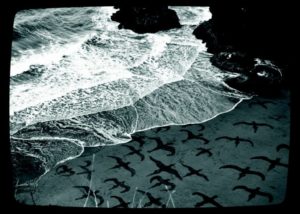
In the Calm / In the Surge / Somewhere between Paradise and Desolation' by Leya Tess,

After a lull in posting, this a piece I wrote recently for the new series I'm editing over at Dark Mountain's online edition. The series looks at the changing fate of the world's oceans and how we can respond as artists, writers and feeling human beings. During the last month we've been exploring the beauty and the crises of the sea through fiction, art, photography, poetry and memoir. Here is my introduction from the edge of the North Sea.

‘But we love the sea!’ the woman in the back row cried. We are in the Museum of East Anglian Life at a Transition event called, What if … the sea keeps rising? I want to put my hand up and ask about the rivers. Why did the government withdraw its funds for the river defences of the Ore, the Deben, the Alde, the Blyth? But the question does not happen. There are a lot of official words going on. The woman from the Environment Agency in London is staring into her computer and talking about plans and scenarios and how some moves are less controversial than others, as we all gaze at the aerial shot of the sinuous and green waterlands of coastal Suffolk that we call home. 

We love the sea. But here is climate change at our backs, warming the oceans, spoiling all our plans. Here is the tide coming in, erasing our castles in the sand. The houses that are falling down the cliffs at Easton Bavents, the disappearing cod we always took for granted with their stomachs full of microbeads, their livers full of mercury. I know, like everyone else, that something wasn’t quite right about this seaside holiday, this get-what-you-want, go-where-you-please, eat-cake-every-day holiday that lasted for a hundred years. It wasn’t all fun. It rained, you got bored and read too many books. The family quarrelled. The show on the pier was a shabby affair. And sometimes as you stood looking at the horizon, blueness all around, you felt something vital was missing. 

Now in 2012, the holiday is over. I am no longer eating fish down at the harbour; I no longer cook raie au beurre noir in my frying pan, or lay wild fennel fronds underneath the flatfish from the sandbars of Sole Bay.  I know too much about the boats that scour the coastlines of the world. I know why oil tankers string across the horizon like a neon necklace at night. I’ve stood with protesting communities on Walberswick beach after the floods and the threat of nuclear expansion at Sizewell.  I know a lot of facts but I don't know what to do with them.  

Dragnet

In 2019, as the cruise and container ships of the pleasuredome steam ever homeward,  that missing information rises like a tsunami and overwhelms us: ocean acidification, ocean current disruption, melting ice, dead zones, increasing oil spills. The bleaching of 90% of the world’s coral reefs, the disappearance of 90% of large fish, the poisoning of mangroves by shrimp farms, the destruction of sea beds for shellfish; jellyfish blooms, algae blooms,  mussels cooking in their shells in California, orcas starving in Canada, seabird populations crashing in the Hebrides, whales washing up in their hundreds in New Zealand: mutilated sharks, massacred dolphins, diseased wild salmon, the last vaquita caught in a illegal net in the Bay of Cortez, bycatch of Chinese medicine makers in search of the swimbladder of the endangered totoaba. A delicacy and cure, they say, for depleted sexual potency in men.

 The facts pile up as the consequences of our voracious appetites are thrown up like rotten seaweed on the shore. The bones of drowned migrants gather on the Mediterranean seabed. The lost forms of albatross chicks litter the beach in a remote island in the Pacific. People peer under the surface through television goggles, watch starfish bloom on Arctic seabeds and sharks hunt among the kelp forests of Africa. We gasp. The rainbow watery world is beautiful, savage and remote. The presence of plastic in the deep blue shocks us momentarily – but everything we touch in our terrestrial lives is covered in it. Every action in our houses, each machine we use, each product we buy from sandwich to shoe, each child that is produced, pours more toxins, more refuse, more sewage into the blue. We are tangled up in this predatory culture, like a turtle in a dragnet. Inside we flail hopelessly.

Where do we go from here?   

Dark ocean

At night when the wind is in the east I can hear the North Sea heaving and sighing on the shingle, and sometimes there is a tang of salt that drifts across the marshes. It's not a clear brochure-blue sea, it's mostly a gunmetal grey, whose silvery shine can take you by surprise on a winter’s day. But it holds mysteries beneath its workaday exterior. The sanderlings at its edge are not a fixed territory like the country of limestone, chalk or clay. 

In 1992 the writer, W.G. Sebald famously walked along this shoreline from Lowestoft to Dunwich. I sometimes sit in the Sailor's Reading room where he once wrote, in the cold months, watched over by long-gone fishermen in sepia photographs, the model boats they crafted preserved behind glass, the clock ticking behind me. We are in a sandy place, where time shifts and unmoors you, and you can glimpse the past and future of things. 

Sebald was reminded of the horrors of history as he walked along the crumbling cliffs and heathland of coastal Suffolk, the Yazidi circle we are all stuck in, doomed to repeat the cruelty of Empires. He gazed out across the German Ocean (as he called it) from Gun Hill and watched the warships of Britain and Spain battle for Sole Bay. He was always looking backwards; we are always looking forwards, equally in horror.

A fret creeps over the fields and covers the land, a lone curlew calls. Undersea, a country called Doggerland is tugging at our dreams. The men look at you with seaglass eyes out of the photographs, the men singing in the back room at the Eel’s Foot, mending the nets down at Blackshore. Without realising it, you forget which century you are in. 

Long shore drift

Maybe the sea is a mood, in the way mountains are an attitude of mind, or the forest an encounter. You climb towards the summit, you slip among the trees and disappear; by the sea you let go, expand yourself to the horizon. You enter the waves and the feeling of everything changes. You emerge a different person, no longer invisible. 

The sea’s mood pulls you, body and soul, into times of happiness. You can see it the way the women lie like elephant seals on the shingle, in giant nests of windbreak  and thermos. In the breaking waves, the children play like sea otters. Out beyond the groynes, an old man trawls the choppy water, and emerges shaggy and dripping, invisible trident in hand. Inside we are all happy, in a way it is hard to define. Here in the great salty commons, in our half-naked creaturehood, we find ourselves level. In the streets behind the promenade, our heads are bowed, we are on a mission with shopping lists in our hands, each of us tightly defined by class and property. Here we are a colony of seals, a pod of dolphins on a hot day, calling to each other in a delight.


from 'Triptych for Whalebone & Crabshell' by Sharon Chin

Once I dreamed that I crossed the line of death. I covered my face in ashes to fool the border guards. I saw a blue star surrounded by gold and wanted to go there – but before I left I felt myself pulled back into the deep, deep blue of the ocean and a giant crab embraced me, and it was the most powerful experience of love I have ever felt. And then she opened her claws and let me go. It was the Earth saying goodbye.

Sometimes in these summer mornings when I swim out, when I feel I cannot face the people in the streets, or any of these facts that you and I know, I let old Mother Carey embrace me, I float like a starfish on the edge of this island of rock and sand and wave. I feel the sound of the shore, the birds wheeling and clouds above me, breeze on my face. The world opens, and suddenly I am in all oceans, in all time…

So maybe this is a praise song, a shanty prose, to lull us back into a place we can share, in all oceans, in all time. We love the sea, and on a good day, a  hot blue day like today, the sea loves us swimming in her, with our finny legs and our laughter.  

Ultramarine

We’re always in search of a new story, of moving forward, of getting there. But what if the story we need is one we have always known but just need to remember? Not a linear narrative but a state of being, where we can hold the dark ocean as well as the light that plays on its surface, where we can weather the tsunami and still love the elements that give us life? What if what the world needs is not more facts but people with their salty bodies and souls intact, their eyes and imaginations wide open? 

When you face the future there needs to be space for what the great plant metaphysician, Dale Pendell, calls a Ground State Calibration. You need to find the existential basis for all your actions that lie deep inside your being. If we don't want a future dominated by the same feudal forces, catalogued in The Rings of Saturn, there have to be different coordinates in our ordinary lives. We have to locate another star by which to navigate, and find real kinship with this blue planet. We have to know what kind of creatures we are and what is being asked from us in return.

 What if we started again here, by the sea, where the memory of our physical happiness comes to us on a summer’s day? I always thought ground state meant you needed to have your feet planted on terra firma – but what if it means being at home in another state entirely? Something  more shifting and fluid. A state where we can remember our creaturehood, our place in the pod, the feeling we are beloved by the life that surrounds and holds us, its beauty and complexity? 

 Over the next few weeks we will be looking at our relationship with the sea and its capacity to change us, through the lens of storytellers, artists, poets and a marine biologist. We will travel from the Atlantic to the Pacific, stand on the deck of a boat, on the rocky shoreline, glide over coral and eelgrass meadows. But first, a song by Antony and the Johnsons, made for the film Chasing Extinction, and a glimpse into the lives of plankton, the miraculous lifeform that is the basis for all life in the sea and sky.  


MAIN IMAGE: 'In the Calm / In the Surge / Somewhere between Paradise and Desolation' by Leya Tess, Ink on Nautical Chart, from the exhibition 'We Built a Home Out of the Things We Gathered' OR Gallery, Vancouver (Photo by Dennis Ha). Colonial place names on a nautical chart are not always very accurate. Calm Channel is anything but calm in a northwesterly. Surge Narrows can be as still as a mirror at slack tide. Published as one of the maps in Dark Mountain: Issue 14. 

 Leya Tess works as an artist and sea kayak expedition guide on the islands off the coast of British Columbia. Her drawing practice considers the assumed power of colonial perspectives and the fluidity of ecological cycles. leyatess.com 

 SECOND IMAGE: from 'Triptych for Whalebone and Crabshell' by Sharon Chin Watercolour and ink on paper. Illustration for a story by Zedeck Siew prompted by the plight of Rohingya people fleeing from Burma in boats in 2015. In Malay myth, the Pusat Tasek, a massive hole at the bottom of the ocean inhabited by a giant crab. When it leaves it home, it causes  the rise and fall of tides. (from Dark Mountain: Issue 9). 

Sharon Chin is a writer and artist working living in Port Dickson, Malaysia, She is working on a series of illustrated journalism pieces about water issues in Malaysia. sharonchin.com   

Wednesday, 20 February 2019

In Search of a Lexicon for the Deep Core

Still from 'Over Your Cities Grass Will Grow', documentary about Anselm Kiefer by Sophie Fiennes

the words
the bread
the child who reaches for the truths beyond the door
the yearning to begin again together
animals keen inside the parliament of the world
the people in the room the people in the street the people
hold everything dear
–Gareth Evans ( title poem for Hold Everything Dear: Dispatches on Survival and Resistance by John Berger)


'There are two ways to grow a movement,' said Sophy. ' You push outwards and expand the number of people involved. Or you go inward and deepen the core.'

It's December and from Sophy's kitchen table I can watch the sun as it appears above the dark curve of the Devon hills. It's Day Three of a convergence known as Deep Dive, an exploration into 'Deep Adaptation' sparked by the emergence of Extinction Rebellion. Sophy is one of the organisers and I'm asking her about the intent for gathering.

It's a beautiful morning, just before the winter solstice, and tonight I will face my death, looking into the face of an eagle. I don't know this yet. You might say not knowing is the MO for all explorations – except that having an intent gives you a thread to guide you there and back. You can go into a territory to see what is there, or you can go into the territory to find something you and the world cannot live without.

That's a different journey.

Encounter

This winter I took a break from editing to write about the role of mythos in times of collapse, a book based on the four tasks of Psyche, and a performance based on a piece called The Red Thread.  It's a reworking of the myth of the Labyrinth at Knossos, where the labyrinth is not a prison but a dancing floor. Where the young men and women from the city are not sacrificed to feed the Minotaur incarcerated at its centre, but instead encounter an initiatory force that will reveal the mystery of life and death in the darkness of an underground chamber.

Two things I know about entering the core: intent is what keeps you from being blown apart at a solstice moment, as the seeds burst their jackets underground, as life quickens amongst the dead, and the dead parts of you fall away into the earth. The second is that artists and writers are the ones who can hand you the thread.

In progressive circles there has been an urgent call-out for a new story, now that climate change and species extinction have taken all the happy endings away and the wicked stepmothers and magicians have taken over the castle. 'Creatives' have been challenged to come up with a positive narrative that will break the spell of neo-liberal economics and get us out of the maze. Writers however are reluctant evangelists and propaganda-makers: they flourish in the territory of the existential, where their ancient skills of travelling into other dimensions are highly prized.

Because it's not the storyline, the fabula,  we should be looking at here. Writers – those who guide us in the non-linear worlds of the imagination – are more interested in the sujet, (the plot in Russian formalism) which is to say the way of telling the story. Although it looks like the story - this and that happened in linear time - is the point of everything, its real function is to be a container for a structural non-linear refit, once known as metamorphosis. The story is the sugar that holds our attention and the sujet is the medicine. The difficulty is for us as modern people is to look at what the sujet is demanding of us as a people, without everyone splitting off into their own personal narratives.

Threshing floor

There were words spilling everywhere around the room; on giant pieces of paper and small blackboards, altars and tables, we tabled our Deep Adaptation R words (Resilience, Relinquishment, Restoration), shared our thoughts on breakdown and extinction, our imagined stories about the future. We looked at how to swerve past blocks of denial, how to wail and rage inside a 'grief mandala', exchanged experiences in 'open space' and mapping sessions, hosted an open 'mic' and a ritual in the dark at the brink of the year. When it felt like everything was going horribly wrong, we held a constellation and danced to Le Freak by Chic. Occasionally I filled up the tea urns and trundled a wheelbarrow full of tealights around the winter garden and breathed in the wet winter air.

In a council meeting we spoke for the beings who were not in the room. Choosing from a collection of photographs and objects each person stepped into places and situations we did not know: we spoke from the deserts of Africa, the cotton fields of India, the streets of the East End of London, as ancient women and small children, as refugees facing floods and forest fires and war, as sharks and rocks and maize plants that have fed a whole continent of people for millennia. The walls of the hall buckled open.

The Encounter demands we let the outside in. We want to run away to the hills, back to the safety of our small room, our meditation chamber. But the threshing breaks you open to liberate the seed you hold inside you for the future. and throws the chaff of your life into the wind. If you are from an urbanised, industrial culture, this process winnows pretty much everything you have been told matters. At the same time everything that has been left out – which is the living breathing earth, the sun and all the cosmos, all the invisible people and skeletons hidden in your family's and culture's closets – rushes in. Afterwards you are assailed by dreams, by memories, by bodily dysfunctions, you feel you are losing your grip, your friends look at you askance. For some this is a moment from which they reel, for others months, or years.

However the Encounter comes, one thing is clear: change is not something you tell governments or other people to do; you have to undergo change to make space for the world to enter. The 40 or so cultural activists gathered in these school rooms have all been through the wringer one way or another: some have built practices, some have created art or taught, others live in the forest, or at the edges – all of us have accepted that collapse is underway and have a capacity to 'stay with the trouble'. We've been in this room before; when the frequency has gone pear-shaped, when the men talk too loudly or the women cry too much.  We know the feedback loop is a key component of all non-linear systems and there are consequences to the actions taken by ourselves, our relations, our nation which we now have an obligation to rectify.

Still from 'Over Your Cities Grass Will Grow


Ariadne

Here is the story we know. The hero kills the bull-headed monster with the help of the princess. She is abandoned, she kills herself, she becomes a constellation. The hero goes round the world killing more monsters, abducting more women, founding cities. We live in the wake of his black-sailed ship.

Here is the story we don't know and perhaps can find hidden underneath this one. There is no hero or princess or monster.  There is a woman who can guide you down into the labyrinth which is not a maze or a prison, but a map. There is a kind of death at its centre, but also a revelation. She wear a skirt like a beehive. She is a dancing mistress (of sorts). Her name is Ariadne.

The bull we have always known – he was the first we painted on the cave wall and fashioned in stone: as auroch, bison, buffalo. When we stand beside him we can feel him in the dark, his warm breath, his creaturehood, his presence. We don't want to be anywhere else, even though we are mostly mute, enthralled and also terrified.

After you have been trampled by his hooves and the chaff blown away, you emerge and dance around the circle of the threshing floor, holding the arms of your companions. This was a dance once called geranos, the Dance of the Cranes, that took place each spring on the sacred island of Delos. The hero Theseus had taken the Minoan mysteries and transferred them to the Greek god Apollo, who henceforth would be in charge of prophecy and all female snake-charmers in the ancient Aegean. It is said that the first languages were written using the shape of the birds' feet: crane, ibis, heron.

The Cretan hieroglyphs however, unlike the Egyptian, were never deciphered. Maybe our fate would have been different if our cultures had not been shaped around the glory-seeking of Athens and funereal gloom of Memphis, but instead we had lavished our attention on young men springing on the back of bulls, on blue and gold dolphins leaping, and a dance that imitates a foraging honeybee communicating with her sisters.

There is a deal you make with life and this underworld encounter can tell you what that is. It's a deal we made a long time ago with the beasts and with the plants, only our civilisations buried it in sand to power their own interests.

I'm not sure how we can remember this deal together. The links between us, like many grassroots relationships, are fragile: few people here are dependant on each other in their ordinary lives: we are not related, or beholden in any way. We may rally around a cause but we find it hard to meet on a stage that goes beyond the material and political. We might say 'ancestors' shyly in the circle – but  we don't name them. Our metaphysical knowledge is mostly something we have found individually in books, or in moments of deep reflection. And we will need, god knows, more than a poem by Mary Oliver or Rumi to hold the centre and not fragment when push comes to shove, not lose our hard-won coherence and fly off into some small panic room, prowled by monsters.

We need our dancing feet on the ground.

Rehearsal

There is nothing wrong with the conviviality and feasting, with the meetings and demonstrations, or even loving the story and wanting to know how it ends. But only if we know that the feelings these gatherings engender is the sugar, not the medicine, and that the medicine, sour, bitter as it tastes on our tongues, has to be taken and assimilated, or the world will not come into right balance. On a windy corner on the South Bank, after giving a lecture on the gift economy, Charles Eisenstein exhales deeply as we talk, a group of UK Transitioners, eager to share our goodwill stories about powerdown and community:

'We are playing,' he says, interrupting our optimistic dialogue. 'Because we still have a choice. We can still walk away. Nothing will happen until it becomes real.'

The year is 2012 and the Occupy tents at St Paul's have been evacuated. London is preparing for the great corporate show of the Olympics. The reality we know from a hundred documentaries about ecological crisis is still hard to see, surrounded as we are by the city's lavish restaurants and glass towers, African fusion bands and pleasure boats. The Wave demonstration has flowed over the capital's bridges, to be followed by a decade of climate marches, anti-austerity and student protests, to be held by Extinction Rebellion with their rainbow-coloured flags as it comes to a close. Though it feels like nothing has happened, the allure that has distracted us for aeons is lessening, the maze is losing its hold. As our position becomes more stark, the language that deepens the core begins to appear at the edges. It does not reveal itself in data or statistics, or political rhetoric, or Freudian analysis. It speaks in a language that once crossed every boundary on Earth, that artists and writers remember and still speak, or sing, or move, or show, or paint, if only in fragments.

It's up to us to recognise them.

Photograph taken at solar eclipse at Serpent Mound, Ohio by Ilyse Krivel[/caption]

Mythos

Something happens as we sit by a fire and chant for an hour, or we decide to take a step into the darkness of the kur or kiva, when our dancing feet take up the shapes of spirals and lemniscates: something deep and ancient stirs our bone-memory of being here, the ancestors begin to listen, the animals come nearer in our dreams, we are no longer alone. A door opens to the future we did not even know was there. The words vanish. Words are for looking at what happened afterwards and telling. The encounter with life is a full-body immersion and exchange.

And maybe that is why after all the words we wrote on the walls, on blackboards in the classrooms, on flip chart paper, on coloured labels hung on trees, the excitement of all the talking over lunch or tea, what I remember most is stepping into the Land of the Dead with Deepak close behind me. We stood there in the stony alcove, with its boughs and bones, as the night wind blew through the apple orchard, and the small candles guttered. And we looked over to the people by the fire, who seemed to be a long way off, even though you could hear them singing and the fire crackling. Some part of me didn't want to go back. And then I realised: the ancestors could hear us when we gathered in that spirit.

I chose these myths (or perhaps they chose themselves) in times of increasing restriction because they provide a technê – tools and method and instruction manual – for how to negotiate our place and relationship with the Earth, beyond the story told by our civilisation's power-possessors and priests. They can help us uncivilise ourselves: break out of the labyrinth of our rational minds and navigate the wild oceans and forests of a non-linear planet. The female myths are about tasks, about rigour and courage, and about calling and receiving help in times of crisis. The three R's of Deep Adaptation are tasks, they demand we leave a lot of our identity and cleverness behind, our comfort zones, our egoic insults, the traumas we cling to like antiquated gas masks, long after the war is over.

These ancestral steps help us move dramaturgically into different positions: to realise that our insistence on woundedness is a way of avoiding responsibility and breaking out of our separateness. We are not going to make it on our own. We feel stuck, faced with the impossible, and need to find a way out: a pile of jumbled seeds, a labyrinth of dead ends and false passageways. With the myth in hand, you can make a move: you step into others' shoes, you alter the role, you go through the door, get yourself off the hook and then the world. The artist teaches the steps, holds the space, takes up the chant, asks the questions. This is the moment when a kindly ant appears, or someone hands you a ball of thread, or a jar of honey, or two beings fashioned from the dirt under the fingernails of a god slip through the keyholes of the Underworld undetected.

Our task is to recognise them.


A Dance Down the Dark Mountain and A Conversation at the End of the World (As We Know It) with Charlotte Du Cann and Dougie Strang takes place at Winterwerft Theatre Festival, Frankfurt am Main on 16th/17th February and at Unfix Festival in Glasgow on 28th/31st March. 

Coming Down the Mountain: Resilience, Relinquishment and Restoration in a Time of Endings - a five day course with Charlotte Du Cann and Dougald Hine is hosted by Schumacher College, Devon on 6th–10th May.

Essay originally published by Dark Mountain online

Monday, 10 December 2018

Disappearing Acts


We are living in an age of loss: the sixth mass extinction. Following this year's shocking report that the planet has lost half its wildlife in the past 40 years, and the 2018 Remembrance Day for Lost Species, I wrote this piece on art and disappearance for Dark Mountain's 'The Vanishing' section. Here we look not only to extinction – the deaths of entire species – but to the quieter extirpations and losses that are steadily stripping our world of its complexity and beauty. How do we, as writers and artists, stay human during such times? .


What does it mean to disappear? It's a cold night and I am shivering outside the Café de Paris in London. I'm standing behind Trevor, hoping that his TV producer status will get me in, when Karen Binns, doorkeeper to this hippest of '90s dance nights, lets me through. It's over for you, she laughs, which in her Brooklyn back-to-front street talk, means it's happening for me. As it turns out it was prophetic both ways. Because the last time I saw her was at a family gathering a year later, as I was about to leave the city.

She's out of here, she announced to the chattering table. Everyone just carried on talking.
It's two minutes to twelve, she said.

What does any of this have to do with extinction you might ask? Bear with me. To know how to deal with disappearance, you have to know about your own. To know that when you go, there is a world of difference between being ignored and being seen.


For a few weeks now. I've been wondering what to write about extinction. Does the world need another elegant essay on nature in peril, another rant about palm oil deforestation? Is there a way to look at the disappearance of species without descending into melancholy and apocalyptic data? Could I get that annoying wistfulness out of my voice, avoid the righteous tragic tone of the activist, or repeat the litany of scientific facts about ecological catastrophe which you and I already know?

The Witch of St Kilda by Kaite Tume,
embroidery on linen from 'Extinct Icons
and Ritual Burials' (Issue 13)
I am not a biologist, or a conservationist, an undercover agent on the front line of wildlife destruction, but I have witnessed The Vanishing in my own way: I have stood by my window overlooking a ragged Suffolk garden and marshland for over a decade now and seen the insects disappear, the old hawthorns and ashes cut down, how the thrush and little owl no longer call from the hedge, how the green woodpecker no longer comes to forage for ants, the hedgehog to sleep in the woodpile, or the hares and lapwings appear in the fields. Each departure has registered in my body, in a place it is hard to name, like listening to an orchestra with the wind section missing.

Loss of species is one of the key strands within the work of Dark Mountain: from Nick Hunt's story Loss Soup (in Issue 1) to Michael Cipra's Who  Cries for the Archduke? (in Issue 13), from Feral Theatre's performance about the Tasmanian tiger to Andreas Kornwall's 'Life Cairn for Lost Species'. But perhaps its most significant act has been the curation of a space in which writers and artists, readers and participants can communicate this collapse without fighting their corner: we all know something is going down. That the clock stands before midnight.

That if a vanishing is required it is our civilisation's story of human centrality.


'Extinction Cabinet' by Nicholas Kahn
& Richard Selesnick. From ‘Truppe Fledermaus:
100 Stories of the Drowning World' (Issue 9)

WHAT HAPPENS WHEN THE CRYING STOPS?

You are supposed to feel grief, but grief is not what I feel when I hear a chainsaw outside, or read about Icelandic fishermen killing a blue whale. I do not mourn non-violently when I hear about the Chinese trading jaguar teeth, rhino horns and pangolin scales, or the British slaughtering mountain hares and golden eagles (in order to slaughter more grouse), or Maltese and Cypriot hunters killing millions of migrating songbirds - all those men with knives and guns and axes proving their 'masculinity' (and the women who stand by them and beget their children). In spite of knowing better, I find myself shouting, It's over for you! - and not in the way Karen Binns once meant it.

When the fury subsides, or I return home having argued with the tree cutters, what is left is a retraction, a lessening in the core of my self, countered by a refusal to feel dispirited, or to fuel the darkness of our civilisation, to let the Empire take my heart. But I do not grieve. Grief takes you inward to your own bereavement, to project the loss of small edens or family upon a beleaguered Earth. There is a power in grief, as all writers, particularly those who write about nature, know (where would Helen Macdonald's H is for Hawk have been without her dead father, or Robert Macfarlane's Wild Places without Roger Deakin?). Absence has as strong a pull as presence. Your capacity to see straight and communicate directly with the non-human world however is impaired. Our great sorrow is not what the Earth wants from us, any more than a dying person ever wants our tears. They want you to show it mattered they were here. It's not about us after all. Human beings are not becoming extinct.

Remembrance Day for Lost Species; Memorial to
the Passenger Pigeon by Emily Laurens,
Photo Keely Clark: (Issue 7)
Once the fury subsides, I stand in front of the window with a conflicted heart. You have to temper that anger into words and keep beholding the beauty of the world that is still here. You know it's not the whole story. You know that for each terrible action against life, for all the numbness and indifference of millions, there are thousands who are standing up for the wild things, defying hunts, investigating the trade of shark fins and elephant tusks, defending the redwoods and the common lands, restoring the Californian condor and the African deserts.

I see I am left with a nervousness, a nervousness that senses the decline in some part of the web, a weakening in the links between insect and bird, plankton and fish, between plant and the human imagination. And so I act in whatever way I can to bridge the gap: I put my hand on the severed trunk of the tree; I carry the dead otter from the road and bury her in the marsh; I write in defence of the feeding grounds for the red-listed curlew on neighbouring AONB farmland now threatened with extraction. But most of all I try to find out how to shift our logger-headed perception, our ways of seeing and imagining the world from where we all stand, seemingly stuck in a parasitic culture that refuses to become symbiotic.

In many ways artists fulfil the function of the old medicine people and storytellers: they keep the bridge open to the living Earth and show how we can give back to a planet that has given us everything we know. Their act is to see and not falter, to reflect what is happening and speak to those inchoate places inside us. It is not an easy position to hold, because destruction is not easy to watch. But through their work we can look without turning away, because they themselves faced the disappearance and did not escape in their minds, or give in to rage or powerlessness. They bore witness and let the walls that separate us from the fate of the planet fall down inside them.

We follow their track.

HOLDING THE BASE LINE

When the world shifts and we don't notice, something happens: we move away from what is known as the ancestral or original instruction, our way of keeping the Earth intact. We don't notice that hills that were once forested become bare scrubland, or that it's become normal to see a handful of butterflies when only a decade ago there were hundreds. The writer, George Monbiot's response to this 'shifting baseline syndrome' in his book Feral  was to imagine a reinvigorated Earth and foster a culture of rewilding, the restoration of territories in which wild animals and plants could thrive again and flourish.

So what if, instead of drifting with the tide, we resist it? What happens if we remember how it was at one time and refuse to forget? That we hold what is and was dear in our neighbourhoods in connection with the forests and oceans everywhere?

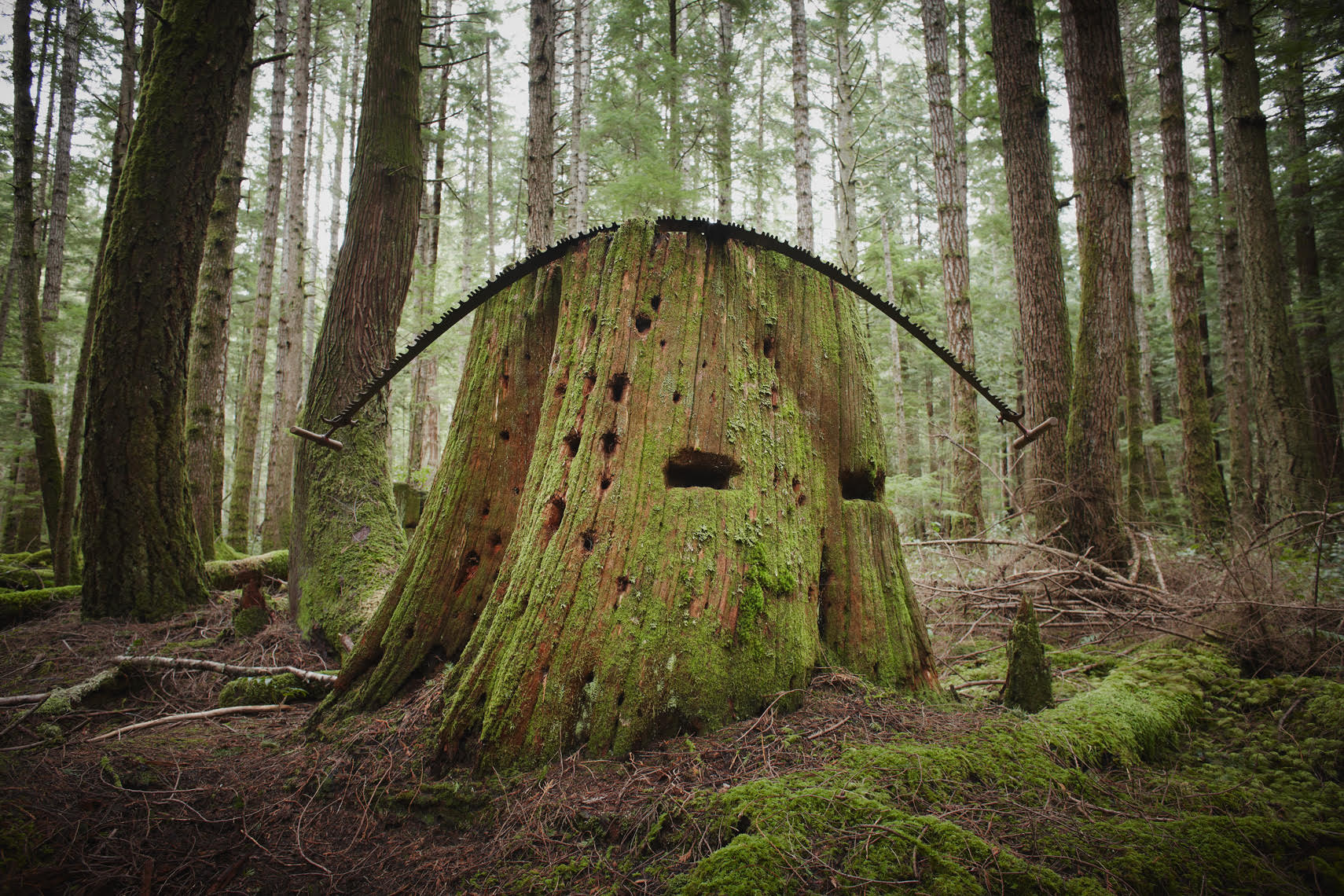
David Ellingsen is a Canadian artist whose photographic work centres on the loss of the natural world and the reintegration of the 'intricate relationships between land, ocean, flora, fauna and atmosphere ... back into our technological, urbanised culture'. His sharp graphic eye ranges from observing the changing sky over a year, to the body of an orca cut up on the British Columbian shore. to a juxtapostion of a human skull filled with the skulls of other creatures. 'At The Edge of the Answer No 2' (see above) was the opening image in our latest issue TERRA, from his series Solastagia.

The Last Stand by David Ellingsen

Installation 3, Lance-tooth Crosscut Saw by David Ellingsen.
Western Red Cedar, Pigment ink on cotton rag

'This project, The Last Stand, was photographed on my family’s land here in Canada – in fact it was my great grandfather and great uncle who cut down these very trees over 80 years ago. The vast old growth forests of British Columbia have mostly vanished, with only 1% remaining, a situation reflected in the great forests around the globe. Disappearance and loss are a consistent theme running through my work and I remain compelled by an unrelenting, creative urgency as the ecological crisis deepens. In fact, after decades of warning from our civilisations’ brightest minds, I feel it my duty to do so.

It is my hope that creative work which encourages emotional connection with the issues and engagement with the grieving process (that rightfully accompanies this diminishment of life) will help us move through the seemingly ‘frozen’ state our civilisation is in and into a period of rapid acceptance and mobilisation to repair what we still can.' DE

SEEING THOUGH THE DARK GLASS

There is a point at which you get 'woke'. It is a terrifying moment, as the cocooned world you knew cracks open. But it is also a moment of kinship - not only with our fellow creatures, but with our ancestors who left depictions of this relationship on the walls of Neolithic caves, or shards of ancient Pueblo pottery.

The current intellectual discussion about ecosystems and carbon emissions speaks to our rational minds but does not connect with our physical, kinetic intelligence, our creaturehood, the places where we feel kin with the rest of life. For that we need physical encounter in order to engage and act.

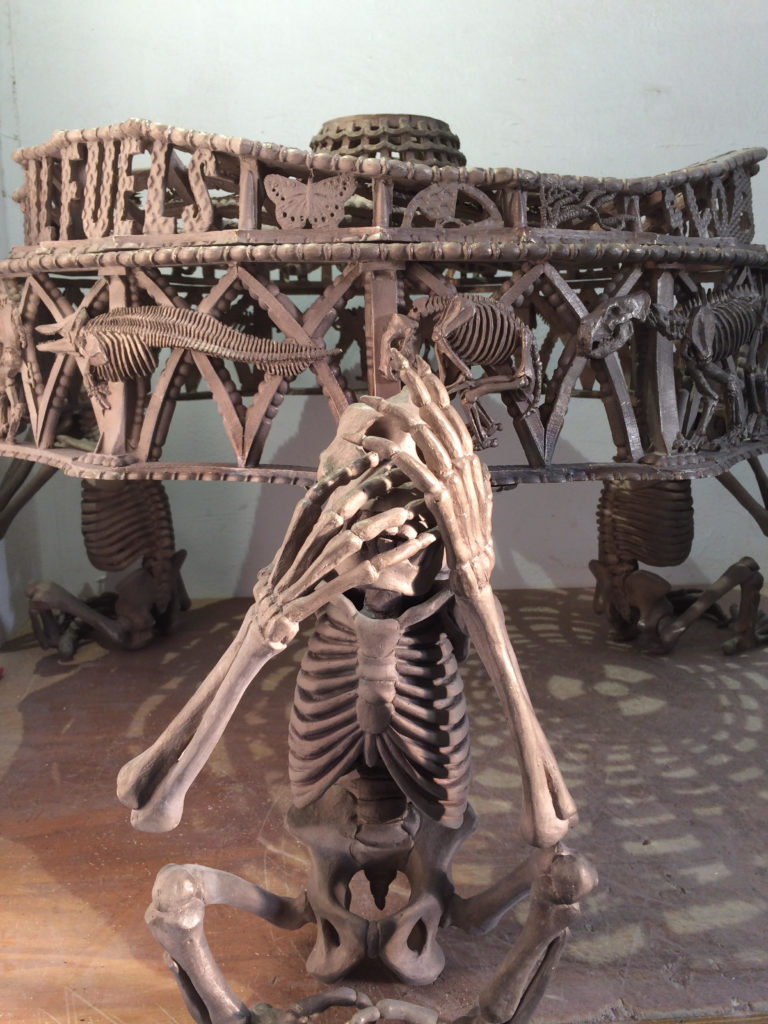
The sculptor Stephen Melton brings a visceral attention to the fate of the natural world at our hands: to native sharks mutilated for their fins (see above in 'Thanet Fish') to the illegal pet trade to the destruction of the Indonesian rainforest, with carved and often entwined and adorned figures of animals, birds and fish.

Dreamland by Stephen Melton

Dreamland by Stephen Melton. Work in progress that contains the forms of lost or disappeared creatures including orangutans, hedgehog, killer whale, rhino, cane toad, polar bear, sperm whale, tiger, sea turtles, coral, giant anteater, orange bellied parrot, carrier pigeon, pangolin and moths, Below: detail with bat.


'We live in such a visual world today; a world in which we are bombarded by images through digital and social media. Often, if the image hasn’t been constructed using the "click-bait" brief, it is often overlooked.

Sometimes I choose to work with an aesthetic that is beautiful, familiar and fun, which can be seen in my current work in progress ‘Dreamland’ – an intricately cast carousel in bronze. However, I then subvert the aesthetic by presenting my concerns about social behaviour and our attitudes towards our natural world.

I hope that using beauty to attract the audience will then engage them in the visual paradox the work presents. Using global fonts, the headlines of our most prominent socio-ecological problems today adorn the whole structure, in a similar manner of the carousels of the past. Hand-carved and subsequently cast skeletons of animals weave around the attraction, in an ominous manner. Each species has been chosen because of their current fragile existence due to humanity's impact on the world.

Like sheep, many of us follow unquestionably patterns of human behaviour without any understanding of the consequences, repeating mistakes of our past. A decaying ride that we are unable to alight.' SM

HONOURING

In 2001, the UK filmmaker Nick Brandt went to Kenya and began a photographic odyssey: to capture on film the disappearing great fauna of southern Kenya. The elephants stand as giant billboards in a broken landscape, under a flyover in the 2014 series Inherit The Dust; in This Empty World – his latest book to be released next February – they are juxtaposed amongst the industrial infrastructure, machines and human presence that threaten them on all sides.

Elephants (killed at a rate of 100 a day for their ivory), lions, giraffes and hyenas, are all photographed with a medium lens camera, as black and white portraits, closeup, still, without drama, or special effects.

'What I am interested in is showing the animals simply in the state of Being,' he writes in the first of his trilogy of books, On This Earth. 'In the state of Being before they are no longer are. Before, in the wild at least, they cease to exist. This world is under terrible threat, all of it caused by us. To me, every creature, human or non-human, has an equal right to live, and this feeling, this belief that every animal and I are equal, affects me every time I frame an animal in my camera. The photos are my elegy to these beautiful creatures, to this wrenchingly beautiful world that is steadily, tragically vanishing before our eyes.'

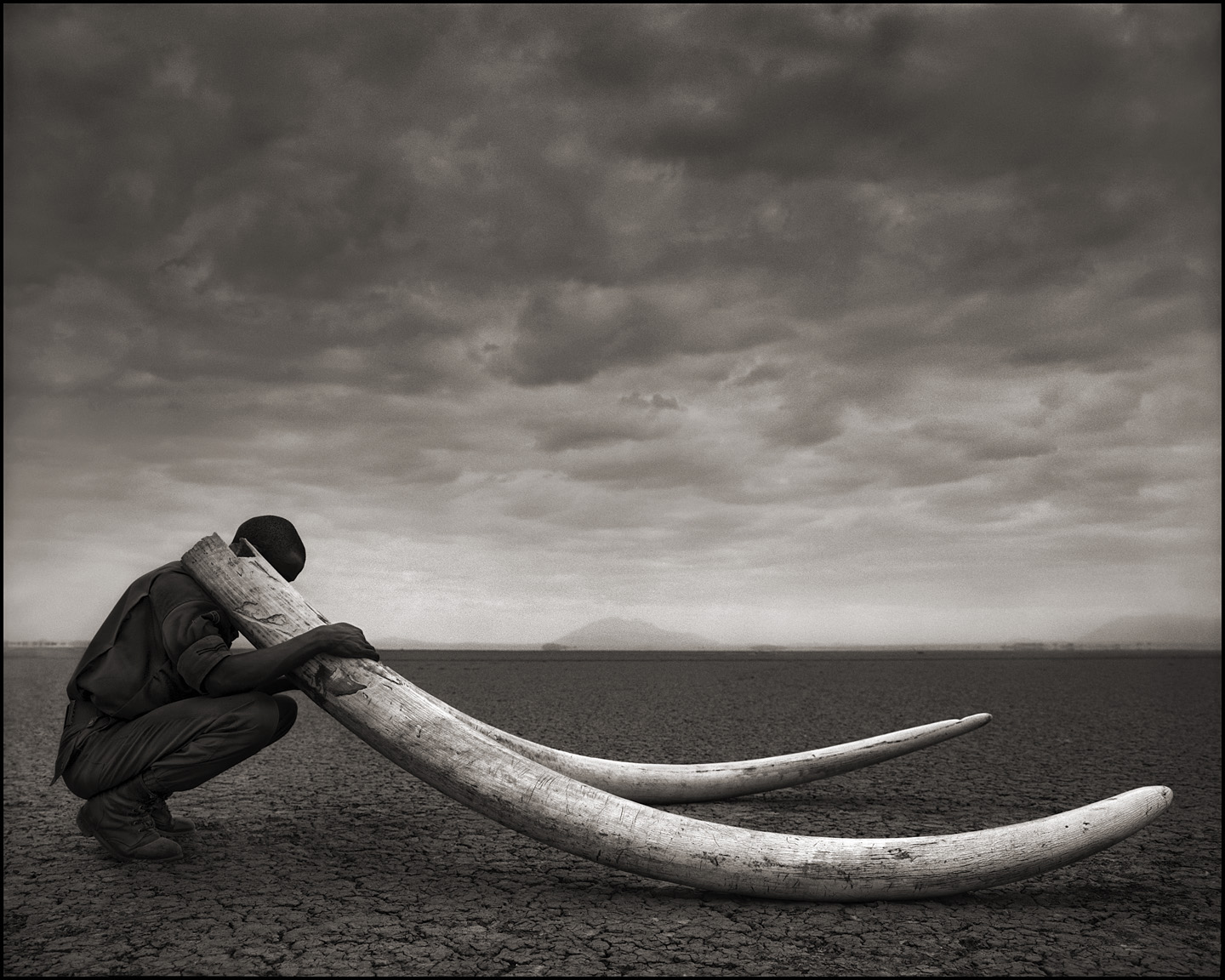
Ranger with Tusks of Elephant Killed at the Hands of Man by Nick Brandt


Ranger with Tusks of Elephant Killed at the Hands of Man, Ambrosselli, 2011 by Nick Brandt
'I find it hard to imagine the living elephant that possessed these tusks. I’ve never seen elephants with tusks anything like this size, and now, I never will. They are all gone, dead, mostly killed by man.  Even with one part of each tusk embedded in his skull, this elephant would still surely have had to lift his monumental head to prevent them from dragging like excavators through the earth.

The elephant was killed by poachers in Tsavo in southern Kenya in 2004. His tusks were stored in Kenya Wildlife Service’s ivory strongroom. In July 2011, they permitted me to borrow these and many other tusks of killed elephants for the ranger series.

This photo features one of 200 rangers employed by Big Life Foundation, the nonprofit organisation that I co-founded with conservationist Richard Bonham in 2010 to help protect and preserve the wild animals of a critically important 1.6m acre area of East Africa.

Photographed on medium format black and white film, I waited several days for the normal clear blue skies to disappear, waiting for the right sombre cloud cover to take the photos.' NB

ALLEGIANCE

One of the main reasons people don't want to see, to wake up, is to feel the emptiness that the violence of civilisation leaves behind. We live in a world that promises freedom from suffering with its tinsel politics and cheap distractions. But you never get a relationship with the living Earth that way, the feeling that you are connected. The relationship with the Earth - whichever way you learn to love it - through a land, creature, plant, or ocean - is a relationship that never falters and will never, unlike civilisation, let you down.

However, there is a bargain you make when you forge that relationship, an ancient bargain human beings have made over millennia. Our allegiance goes both ways.

Dark Mountain Issue 7 featured Silent Spring by Chris Jordan and Rebecca Clark (detail above, see full picture here) which depicts 183,000 birds, the estimated number of birds that die in the United States every day from exposure to agricultural pesticides. It forms part of his series Running the Numbers: An American Self-Portrait which looks at consumer culture through the austere lens of statistics. However, the photographer is most well known for his close-up portraits of dead albatross chicks on the remote island of Midway in the Pacific Ocean, their stomachs full of discarded plastic.

The recent documentary about his experiences is a searing gaze at the extraordinary beauty of a bird and its fate as it encounters the debris of our fossil-fuelled world.

Albatross by Chris Jordan


Chris Jordan's ALBATROSS film trailer from chris jordan photographic arts on Vimeo.

'The biologists here are finding that the birds all have plastic inside them. Each time I opened one up was like a gallery of horrors. But I believe in facing the dark realities of our time, summoning the courage to not turn away. Not as an exercise in pain, or punishment, or to make us feel bad about ourselves, but because in this act of witnessing a door opens.

'The most difficult thing to bear, for me, was what I knew but they couldn't know about why they were dying. In this experience, the true nature of grief revealed itself. I saw that grief is not the same as sadness or despair. Grief is the same as love. Grief is a felt experience of love for something we're losing, or have lost. When we surrender to grief it carries us down to our deepest connection with life.

I didn't know I could care about an albatross.' CJ

Thursday, 1 November 2018

Varanasi


Last month in a rainswept and flooded Cumbria we launched Dark Mountain: Issue 14 - TERRA into the world, a co-production between three editors - Nick Hunt, Nancy Campbell and myself - three 'scouts' from different regions and over 60 writers and artists. It's  a travel edition collection that looks at journeys, place and belonging in times of diaspora and descent. You can read the introduction and several extracts from TERRA over on the Dark Mountain website, meanwhile here is a piece I wrote for the book on giving up flying and a life on the road, and a return to my 'native' land.


It is hard to know that this magic carpet exists and that one will no longer fly on it.
– Jean Cocteau (Opium)

‘The way these people are living is not what I had in mind’
– Sun Father, Zuni creation myth


I’m sitting under the peepal tree in the deer park in Sarnath. Dark-tuniced Tibetan students, white-clad nuns, orange-robed monks, many-coloured tourists move around the tree, and contemplate the statues of the Buddha and his five disciples with their piled-up Aryan locks. It was here the Buddha delivered his first teaching. His words are carved in slabs of stone in different gold-scripted languages. The inscription reads that after declaring the Four Noble Truths and the Eightfold Path, the devas in all the invisible circles above the Earth shook with fear.

Nirvana is sometimes translated as a ‘return to the shining void’ or ‘extinction’, in the sense of blowing out a flame, no longer fuelling the fire. By ending the anguish and desires of the ego, the Buddha’s path to extinction introduced death into the eternal world of the devas. It meant their realms would cease to exist, because human beings would not be clothing and feeding them any more. If people could liberate themselves from the wheel of karma, the devas’ shows would come to an end. They would lose all their hiding places.

Afterwards I go to Varanasi, leaving the calm of Sarnath for the crowded streets of India’s oldest city. Rachel told me: ‘If you don’t go now, you will never go.’ It is 2006 and I have just received the last of the inheritance from my dead father. I don’t know it yet but a whole way of life is about to come to an end.

In Varanasi I get out of the tuk-tuk and walk towards the river. Suddenly the narrow street opens out to the vast opal-coloured stretch of the Ganges – the pitted ochre buildings of the teeming ghats and the emptiness of the shore on the further side. It is shining in the morning light and the light suffuses everything. ‘Here I am!’ I say, half to myself, half to the river and feel, in that moment, complete.

‘You are thinking too much,’ says a tall young man behind me. ‘A man will approach,’ Rachel instructed. ‘Go with him.’ I smile and agree to follow his guided path, down the steps, towards the burning ghats, to his friend the astrologer, up to the towers where he points out the view down the river with its steps full of devotees, boats, bullocks, monkeys and the morning.

At the ashram of Kali, we sit in the shade of a mango tree and smoke hemp flowers.
‘When I saw you, I was dazzled! How beautiful,’ he whispers, and runs his hand up my back, as if I were a horse. ‘You are tired and I am a young man. You need some of my Shiva power.’

‘No, I don’t,’ I said, and laughed.

I might have gone with him in another time, for the adventure, to have lain in Kali’s rose garden in Shiva’s city. But something is coming to an end. The boy said, I will take you out onto the Ganges and sing to you. We took the boat into the middle of the river, and as he rowed towards the empty shore, his face grew suddenly sulky and dark, like all men who do not get what they desire. The City of Light hovered before me. The most beautiful city in the world. The shining hub of the wheel where all things began, and where all things come to an end.

Here I am, I thought. A great humming arose from the ancient city, three thousand years of human karma coming to an end, as the boat drifted past the shore on the further side. For years I had wanted to come to Varanasi. And here it was. Everything I had ever dreamed of. And then it was time to go home.

You will dream of me, the boy said, as we parted company on the bank. I smiled and wished him well, because I knew I would not. I would not even remember his name.

When we fly over London, the buildings below the plane appear grey and oppressive. No one smiles at the train station. It is silent, cold, hostile. My head fills with antagonistic thoughts. But wheeling our suitcases down the lane, the night wind stirs the ash and oak trees above us, I can smell the spring, the feel of the ground beneath my feet, a force pulling me towards the earth.

‘Almost there Charlie,’ says Mark.


SELVA

How did this begin? Lying in a hot leafy hut, frogs croaking in the Peruvian rainforest, a certain line comes to me: My circus life unclawed me.

I am ‘on location’ with a fashion team and the two models have gone on strike because they feel (as African-Americans) they are being exploited by the ‘indigenous is hip this season’ story. The German photographer is arguing with them. He is not pleased with our abundant backdrop. Selva is too green, he says. Tonight we drank a strange alluring brew the lodge owner had made and swam naked in the Amazon, heedless of piranha, crocodile and electric eel, and watched a slim boat go out and point its prows to the full moon. I am writing another line in my notebook that is not a caption:

Tonight there are no dreams because there are no dreamers.

I went to South America by mistake: Eric Newby was supposed to cover the story but he had fallen ill and so I went to Lima as the replacement travel writer. After that I was sent to New Mexico with the team and wrote a story about beans and adobe and Georgia O’Keefe – and somehow, between the forest and desert and mountains, those big spaces got inside me. Afterwards I could not fit back into my box-shaped London life.

When I left the city I found out how plants can open up your imagination in a way no book can ever do, how mountains can speak to you in your dreams. I encountered people I would never have met in the bars and offices of my own country. People who were learning about the indigenous spirit of things, who tussled with their nation’s karma, who walked an ancestral path in their own way.

Though we longed to be the people who could love the Earth with song and dance, with feather and prayer, we were not born those people. We had work to do in the places we least wanted to go. Turtle Island, Madre Tierra, Pachamama, pushed us all out like birds from the nest, into an unmapped territory that felt like a kind of Antarctica. Go back to where you came from, they said, and deal with your shit.

What I hadn’t realised was that the people in the canoe in the rainforest that night were on their way to an ayahuasca ceremony, and that when the planet makes contact with you and shows you its inner splendour it demands something in return that you are not sure you know how to give. That when Georgia O’Keefe said ‘New Mexico will itch you for the rest of your life’, she wasn’t talking about holidays.


TERRA

How did it stop?

‘Your carbon debt is massive,’ said Josiah. I am writing about a low-carbon group that has decided to cut its personal emissions by half the national average, which in 2008 is eight tonnes. Last night we gathered around the kitchen table with our transport bills. I can just about make the target if I use the car for short journeys but taking a plane anywhere blows it completely. We are eight people who have read the data, we know the facts about climate change. We know we are among the five per cent of the world who have stepped on a plane and that one return flight to New York would take up one of those four tonnes and then some. Across the sky, contrails from 100,000 planes leach out carbon monoxide, nitrogen oxides, sulphur oxides, lead and black carbon into the atmosphere each day and we know that no amount of creative accounting can reverse the planetary feedback loops that say what goes around comes around.

And yet in spite of this the dissonance is palpable in the room, as the prospect of NO HOLIDAYS ANYWHERE INTERESTING OR SUNNY is veering into view. When you realise that even travelling to that small island in the inky Aegean would take four days by train and boat. Even if you did have the money which, this being the kali yuga, you no longer do.

My carbon debt is massive. I have touched down in La Paz and New York, in Tokyo, Kingston, Santiago de Chile, Kauai, Hong Kong, Tokyo, Sydney, Delhi – but now in a small town in East Anglia I am learning to love the patterns of neighbourhood, of reed bed and market square, to build a culture of sharing and humble return. We meet to unpick our fossil-fuelled lives and find ourselves at the place that stops all our endeavours – a realm that hovers on every magazine page and screen, luring us into its world of turquoise seas and swimming pools, of white tablecloths and limousines. Come, fly here, a voice whispers in our ear.

I don’t know about Buddhism but I know all about devas. I am someone who used to drag huge Globe-trotter suitcases full of fairy frocks across the planet, I know what devas like to eat and what sparkly places they like to go, and exactly what it takes to blow out that flame. I know that illusions are the last thing you give up when you are up against it: your special moment, your little winter break, that romantic destination. What would life be without these treats?

It is the flying and not just the flying. It is the technology of flight, the ease, the speed, that fits the pace and dominion of the capitalist pleasuredome. But it is also the ancient illusion that we can treat the world like a plaything, as if we have a right to reward ourselves for our slavery to GDP with a visit to the market at Marrakesh, or a trek in Nepal, a quick trip to Iceland, or Bali, or Florida. A never-never land culture without ethical or spiritual constraint.

Industrialisation has made us restless and dissatisfied. We live in terror of missing out and finding ourselves in the wrong hotel. We want all our journeys to be outer ones, full of leisure and luxury; none of us wants to go inside, unlock the Pandora’s box of our small histories and suffer. We would rather sacrifice any number of wild creatures or trees than extinct our adolescent selves, let whole kingdoms of fish and people fall, so long as we can keep holding that boarding pass in our hands, our sense of entitlement, our five per cent exceptionalism, our trophy holiday.

The reality is we don’t want to land.


KARMA

In the backrooms of England some of us despair: we have become no-fly-zone outcasts, enemies of promise. The initiative that had once cut its teeth on radical energy descent has settled into a cosy community haven, where you can hold conversations about carbon reduction and still fly to Copenhagen for the day to go swimming.

The taboo-breaking marks us as ‘the difficult people’ in the room, the people who ask awkward questions. Sometimes we are unable even to ask the question, an invisible force preventing us from opening our mouths.

Silently we face our friends who justify ‘love miles’ (he was dying, she was getting married); artists who justify exhibitions (I have to share my work); climate scientists who justify conferences (I have to exchange ideas); yoga princesses who justify retreats (I have to be with my guru) in a civilisation where governments can hold conversations about emissions targets and still keep building runways and not taxing aviation fuel (we have to serve the economy). We did the offsetting, the flyers chorus, absolving themselves in the way medieval sinners once paid for indulgences. We’re not good like you.

Sometimes I want to say very loudly: YOU ARE ASLEEP AND YOU NEED SOME OF MY KALI POWERDOWN, and stick out my very long red tongue.


SELVA 2

Rachel no longer stays in the room on Dr Jain’s roof terrace that overlooks the deer park in Sarnath, among the drying sheets and pots of holy basil. She lives in a small wood on the edge of the neighbouring market town and runs her own guesthouse. I remembered the story she once told us about her friends who lived on an ancient pilgrimage route in India. The path ran by a river she said and it was the most beautiful setting you could imagine, full of trees and flowers and birds. One year however her friends moved to an ugly industrial city. ‘How could you leave?’ she asked them. ‘Our work is here,’ they replied simply. ‘This place needs us.’

Last summer our paths crossed after many years, and the three of us had an intense conversation in the way we used to when we could all afford to travel the world. She told me in India there are five ages, that begin with our youth and end with the time of ‘Going into the Forest’. ‘What happens before old age?’ I asked her. ‘Preparing to Go into the Forest,’ she said and we laughed.


CASA

I lived out of a suitcase for ten years. I gave up many things to be on that road – a house, a family, a career, some kind of reputation – and I regret none of it. I got to see the Earth in all of her loveliness. I went to break out of a restricted city life that hemmed in my real self like a Victorian dress. After I broke the stays I became like a lover who could never have enough of wide open spaces, of the pepper trees leaning towards the red sand of the Elqui valley (the boys riding horseback down the street), or the roar of the Pacific at Mazatlán, bus stations on a tropical morning, the volcano rising above the hot spring, hummingbird and cactus. It was in these places, those borrowed houses, I could empty myself, bring a silence and a space that had been full of ghosts and other people’s words.

But at some point you have to be in relationship, you have to settle down and give up your interesting freewheeling life. You don’t want to, but it is time, your time and the times you live in, the payback time, when all our small karmas come to roost and that joystick is no longer in our hands. To love a country that is Not-Home with all its breathtaking geography and sweet fruit costs nothing; to love this polluted, crowded island with all the responsibility of descent on your shoulders costs everything.

So you go home. And home is not a place you want to go, or that you like even. Here I am on the east coast of a country I spent a lifetime getting away from and have not moved for 16 years. In the seatown there are 1400 houses and only 500 of them are lived in: the rest serve wealthy weekenders who pay nothing for the roads or cash-strapped libraries, or the feudal history of place that weighs down invisibly on those who inhabit the region. The visitors are having a ‘Southwold’ experience with local beer and fish and chips, and £100,000 beach huts. A perfect backdrop. No strings attached. A hideaway where you can step out of the door and feel free.

Except you learn, when you come home and live in a place, that nothing is free. Some person, some bird, some plant, some insect is paying for that weekend, that fortnight, with their lives, and now that person is you. Yes you, renter, with your second-hand coat and low-income lifestyle, who cares for you anyway?

Nothing has ever said you belong here, or anywhere you have found yourself. You were always the wrong class, the wrong gender, too white, too privileged. You went to the wrong university, didn’t write enough books, wrote too many of the wrong sort. Never knew the right people, or maybe you did once, but then you missed the party and it was the wrong time. It’s always the wrong time. At some point you realise it’s not about belonging, it’s about being at home in your own skin, on this Earth, wherever you land, and deciding to pay the debt, your family’s debt, your culture’s debt, stretching back through the centuries. The buck stops here, you say. I’m not going anywhere.


NIRVANA

‘We could go to la Casa de los Azulejos,’ said Mark, as we both in that moment find ourselves in a dark-panelled dining room surrounded by businessmen in suits and chattering families. It was where we liked to go for breakfast in Mexico City in our travelling years. There are white tablecloths and waitresses with paper wings the colour of sugared almonds flying past with trays of huevos rancheros and pan dulce. A glass of maracuyá juice sits on the table in front of me and for one moment time stands still. Outside the blue sky arches above the Alameda, above the the megalopolis, stretching out towards the Sierra Madre, backbone of America, towards the forests of glowworms and jaguars, towards the ever-moving oceans of the world.

‘Ah, yes,’ I say. ‘But after breakfast, what would we do?’


Images: above 'Shrine at Varanasi' by Juhi Saklani from her story Rooted about defending the street trees of India. Left: A pocketbook for troubled times: Dark Mountain Issue 14 - TERRA is available from the online shop for £19.99; the London launch will take place at The Baldwin Gallery on 22nd November. Do come!