Wednesday, 12 June 2013

Flight of the Butterflies

As the IEA reports ever-increasing carbon emissions, and Britain's environment minister denies any change in the climate in the last 17 years, what is the response of the truly awake person in the current cultural dissonance? In the summer issue of the radical grassroots magazine,  STIR. I wrote a review of Barbara Kingsolver's novel, Flight Behaviour, the latest 'cli-fi' book that look squarely at our present crisis and whose main protagonist is one of the most extraordinary creatures on earth. 

In many ways dystopias are easier to write than a realist fiction that can look at the awesome forces that are out of kilter on the earth. Most books would rather put their imaginative attention on a post-collapse world, than face the gritty problems of a family or community living out the consequences of neo-liberalism and a globalised industrial culture. How can you create a plot when the conventional “bad guys” – those who wield corporate power - have become invisible? How can you find empathy for people who appear as ignorant victims of circumstance and stand in their home territories, witness to weird weather and species extinction. - subjects which seem better handled by the deeper and more metaphysical forms of poetry, or by non-fiction, unconstrained by a linear storyline?

Although the heroine of Flight Behaviour, Dellarobbia Turnbow, is a far cry from Madame Bovary and Anna Karenina, this is a classic tale of a trapped woman yearning to transform and break free from a near-impossible situation. What distinguishes it from these works and the thousands of romances built around the same theme is its mighty big subtext: climate change.

Barbara Kingsolver is known to tackle big subjects in her novels — sometimes successfully, sometimes not: women in the Arizona mine strike of 1983 in Holding the Line, sustainable food production in Animal, Vegetable, Mineral, Native American rights in Pigs in Heaven, Frida Kahlo and Leon Trotsky and the Mexican revolution in Lacuna, and, most famously, the impact of colonialism in the Congo told through the eyes of a missionary family in The Poisonwood Bible. All these themes, however, belong to the human and political realm.

Climate change is notoriously hard to talk about, belonging to what some call the 'supernarrative', the massive planetary shifts, that even though caused by human civilisation, we have limited capacity to control as individuals. Our sense of agency in our personal and social lives melts with the glaciers. History we can deal with, war, poverty, and even apocalypse, but eco-systems in feedback loops? These are non-human, non-linear realities normally assigned to science and to ecological campaigns. However human beings are not created from facts and figures, we are the creatures of story - the choices we make and the roads we take. Story is what makes meaning and gives value to our lives. 

Role of the Novel

I don’t think it is a coincidence that the novel rose to prominence along with industrial civilisation, when people felt their lives to be largely shaped by human forces and therefore responsive to acts of individual will (Askay Ahuja reviewing the short story collection, I’m with the Bears)
 In Flight Behaviour the central ecological dilemma takes place in a run-down sheep farm, in a run-down town where everyone has strange names, goes to church and every turn of the bad luck or weather is attributed to the Lord’s mysterious ways. The book is told from the point of view and in the language of 28 year-old Dellarobbia, who is stuck in a small house among the Southern Appalacian mountains with two small children and a husband she doesn’t love, dominated by harsh and judgemental in-laws. She has no money, no education and no prospects. Her neighbours’ son has cancer and all their peach trees and tomato plants have dissolved in the endless biblical rains. Small wonder you think she wants to throw it all away on an affair and run heedlessly up a mountain one day in ill-fitting boots.

Somewhere, after many long descriptions, the book takes a small flight of its own: the revelatory lake of fire Dellarobbia discovers on the mountain instead of her lover turns out to be millions of displaced overwintering Monarch butterflies. The hero of the book, a dusky well-mannered scientist, arrives from the Outside World with his assistants to live in a trailer on the Turnbow farm and record their destiny. His passion for these insects, his intelligence and grace, affects the smart but unschooled Dellarobbia and Preston, her son, and their world begins to open up. Will this encounter manifest into a relationship? Will the wooded hillside be logged? Will the butterflies survive the on-coming winter? Will redemption come to Feathertown? Will she herself take flight, like the flame-coloured butterflies in Spring? And then? So the old-fashioned devices of story telling kick in and you have to find out the outcome, though the prose does not get any easier for all that.

Kingsolver was originally a scientist and she applies her scientific eye not just to the insects undergoing numerous tests in Turnbow’s barn-laboratory —she puts their whole world under the microscope. Long drawn-out scenes in the local dollar and thrift stores tag every item on display; an exchange with an activist reveals that their “lifestyle” scores very low on the carbon ratings. Numerous rather creaky conversations between Ovid Byron, the entomologist, and his new assistant spell out the behaviour of this extraordinary butterfly and the ramifications of global warming. It’s a right-on subject and you cannot fault the author on facts, Yet this “left hemisphere” fixation on detail makes for a flat Puritanical prose-style, lacking lyricism or feeling. The beauty of the Appalachian mountains is absent, and even Dellarobia, cast as a red-headed Venus by the local TV company, does not come across as beautiful.

Story of our times

One reason we read, and need fiction is to understand how and why we are living now while imagining our way forward. (Adrian Ayres Fisher reviewing the post-apocalyptic novels, Arcadia and The Dog Stars)
 So this is a personal story and a story about our times. When I left my old city life I stopped reading novels; by the time I returned to England ten years later and joined the Transition movement I had stopped reading books almost completely, unless they were related to work. I realised reading books had become an escape, something that afforded a comfort at the end of the day. Novels belonged to a book club, literary festival culture, the books you took to the beach. They belonged to old ladies at the libraries who checked out ten thrillers at a time to occupy their minds and fill their days. They were not the challenging and inventive works I once studied.

Like many of my contemporaries, when I returned to writing the form I chose was not fiction. We rediscovered the essay, the pamphlet (often in the forms of blogs), creative non-fiction and citizen journalism. In an era where becoming rooted in time and place has become an imperative, many of us sought out the older and vaster forms of myth and fairy tale, radical prose of the commons that challenged the history of the Empire. The impromptu speaker of words on the streets and at festivals took our attention, and fiction receded to a remote drawing room and Sunday newspaper world that seemed increasingly old-fashioned, conformist and slow. Used to squeezing plot into 140 characters or a pithy caption these 437 pages stuck in the Appalachian mud now seemed way too lengthy. Who had the time to read this stuff?

The pursuit of a narrative that can speak of our collapsing times is a mantra of the day, and perhaps it’s worth asking: does this narrative belong to the people who see the future coming, or do we include, as Kingsolver does here, the people who deny it is happening and are most likely to lose out when it does? Who will log their voices and their experience? Can we step in each other’s shoes and imagine what is it like, how it could be different, without the fictive form?

One of the major tensions in Flight Behaviour is the lack of awareness the outsiders (in their designer boots) have about the restrictive and humiliating nature of being dirt poor – of not having the right house, or education. Or indeed shoes. “Most of us have to walk around in our sleep, accepting our underprivileged position,” Dellarobbia tells Ovid:
I’d argue that the teams get picked and then the beliefs get handed-out. Team Camo get the right to bear arms, and John Deere and the canning jars and tough love and taking care of our own. The other side wears I don’t know what, something expensive. They understand recycling and population control and lattes and as many second changes as anybody wants.
 I am not a climate denier and so cannot imagine what the doubters among Kingsolver’s readers might feel about Flight Behaviour. Looking out at equally waterlogged country (in East Anglia) I find myself thinking about that small imaginary house in Tennessee and realise that the book’s strength is linked to its ability to see what is, without any ought to be in the way. And that responding to nature in crisis might just bring things out of us we never thought were there.

When I opened the book I felt I would rather spend two hours watching Jennifer Lawrence in similar bleak conditions in Winter’s Bone. But in the end the novel had greater staying power. Roots, and not screen stars, are what we need right now, wherever we are, if we want to hold ourselves in place on the earth.

Images of monarch butterflies from 2012 documentary The Flight of the Butterflies; STIR is available at selected outlets and by subscription (see their website for details)

Thursday, 6 June 2013

ARCHIVE: The Sea Kale Project

Five years ago I began a walk down the Eastern Seaboard. It was called The Sea Kale Project.  

Originally the walk was going to be a springboard for a photographic exhibition and begin in Norfolk. In the end however it was the catalyst that drew me back into writing. First a small piece in a local magazine and then an abundance of journalistic blogs, principally about the Transition movement, during the following three years. Sea Kale also became the subject of the final chapter of 52 Flowers That Shook My World. 
 
Tomorrow, in another time of shift, I will go with Mark to Sizewell beach, as we do each year, to visit the extraordinary community of wild, robust cabbages that flourish strangely and beautifully beside the nuclear power station. Here is a piece I wrote on This Low Carbon Life in 2011 in celebration:
 
 Along the sandy dunes and shingle banks of the eastern seaboard there is a front line of wild plants, the ancestors of our allotments and fields - wild carrot, wild cabbage, sea beet, sea pea, sea kale, sea rocket, oraches, sorrel – and our medicine cabinets - wormwood and eyebright, sea buckthorn, sea holly, scurvy grass. Of all our ancient companions, the sea kale with its abundant flowers and rich detoxifying leaves is the largest and most impressive. Its tap root sinks deep into the shingle and holds fast in a rocky and uncertain time - the kind of plant that can weather a storm.

The plant marks a territory that runs along the shoreline from Norfolk to Kent. It’s a geographical, ecological territory, but also a place you can map in time, in the ways that make meaning of our presence on the planet since our forebears first ate those salty iron-rich leaves.

I came across the sea kale in Dungeness. I had gone there because of Derek Jarman. I had read his journals and noticed the flash of wild flowers in the text, as he struggled with the elements that howled through his shingle garden and to keep own tenuous thread to life. He had come in search of bluebells and found instead the bleak shore and the sea-kale that grew beside the nuclear power station. It was a singular territory that he made his own: wind-broken, austere, at the end of the line.

We had, like the artist, driven out of the city at bluebell time and found the crambe's crinkly purple leaves pushing through the stones. We had been travelling and were looking for a place to live. We walked past the black fisherman’s hut and its now-deserted garden, sat amongst the flowering dwarf blackthorn and crab apple. As we drove away, I looked back and the familiar mosaic of marsh and sky and sea sparked something in me. It was the memory of somewhere I used to know. A certain strand of my life that began when I was a child in Sandwich Bay and Felixstowe.

When we settled in Suffolk Mark and I began an open dialogue with the wild places along the coast, following a practice we had developed working with dreams and medicinal plants – visiting, holding a discourse within the territory, cohering our findings, keeping a creative log. It had become clear that for the future to happen we needed to be realigned with the natural systems and to recover our aboriginal ability to speak with the earth. How could we do this in our native land?

The dialogue began with a question: Who is this self in this territory? How can we communicate in an intelligent and vigorous way? What effect does the land, its moods, rhythms, creatures, weather, have on our imaginations, on our memories, on our realignment?

In 2008 we began a project that mapped the mosaic of eco-systems and their relationship with the human settlements along this shifting coastline. We named the project after the study seakale communities. Having this kind of dialogue means you don’t walk the track you choose. You encounter what is there. going out without a plan, meeting what crosses your path. Not just the beautiful, but also the difficult. We began just as the sea asters were setting seed n the marshes. On November 9 there was a massive storm surge. A powerful northeasterly wind ran against the high tide and the estuaries flooded their banks. We ran out of our houses and stood by the shore as the rivers merged with the sea and swamped the houses down at Blackshore harbour.

After the flood people everywhere began speaking about how to protect the land. Small bands collected together, stacked sandbags against the river wall, spoke out for the birds and the spirit of the place.

“Just a few cows”, we were told by the greysuited men from the Environment Agency in Reydon village hall. The agency were refusing to mend the broken banks of the Blyth as the government announced its retreat back to the metropolis.

"What about the fishermen?" I asked. "Fishing is not economic", he replied.
"What about the tourism?"
"They will go elsewhere".

The cows in the watermeadows didn’t count. The birds didn’t count. The land didn’t count. The people in the coastal seatowns didn’t count. Only the populations in the industrial towns would be secured. The oil prices began to rise. Suddenly I realised I was living in a different time. A time I did not know.

This was the time I found myself talking to Charles Clover, environment editor of the Daily Telegraph, our paths crossing after 25 years. He was telling me about the fish in the ocean he has spent his life defending, and a book he had written called The End of the Line. I told him what was happening down by the sea’s mouth. The agency was abandoning all the defences of the rivers and their harbours along the territory of the sea kale – the Blyth, the Ore, the Alde, the Deben. It was business as usual in the hotels in town, down at the pier, at the fish shop (The show must go on!) but some of us were beginning to ask why.

"They are going to take everything!" he said.

We walked the coast line from the statue of Neptune at Lowestoft, towards the Martello tower of Aldeburgh, from November to the following late summer. We stood on the beaches with 1700 others making a human SOS protest at Walberswick, watched an adder slither by through the sea peas as the police and activists outwitted each other at Sizewell power station, watched the sky burn as the reeds caught fire at Easton Bavents.

We swam in the ocean, with the seals, in the high waves, watched the sea become glass-green, pewter, azure, opal, bruised, mad with foam, tipped with fire. We swam in the wake of Roger Deakin, and walked in the footsteps of WG Sebald. Above us the sky raced with clouds, the wind blew sharp and salt, and warm, scented with heather, hail clattered on our heads. The sands shone silver, the cliffs flashed gold. The land pulsed with light, We pocketed treasures: sea coal, sea peat, a glass bead, a worn kitchen tile, an oyster shell, a deer skull from the tumulus at Dunwich at winter solstice. The sand martins departed their cliff dwellings, the barnacle geese arrived, the starlings rose like spectres over the marshes. Stags roared in the reeds. Seasons came and went. In the mornings standing at my window, I would see the sea like a shining band on the horizon, like a mirror. It’s a good day, I would say to Mark. Let’s go out.

Today is such a day. And I’m writing about this project, about the resilient sea kale, because you notice in a droughted spring, it’s the plants with strong tap roots that flourish. It’s the tap root that keeps us alive. To belong you need a story, and to have a story you need a territory. You need a strong tap root to keep you anchored in a hard time. Sometimes the territory you find yourself in is not the place where you think you belong. It is not the lovely bluebell wood, or the rose garden where you sit alone with your thoughts. It’s not a tropical ocean or an Aegean island cove. It’s a windy English beach with people and houses and oil tankers on the horizon, where you encounter a thousand difficult questions about power and nature and exploitation. And the story you need now is not the story you were born with; it’s a story you have to discover, that you are challenged to go walkabout and find.

Part of me when I began the project wanted to stay on that wild ecstatic shoreline with the flowers, with the birdsfoot trefoil and centaury and harebell, to put all my attention on birds and stones and light, to keep hold of the outsider position of the artist and dreamer, but that shoreline kept taking me to the people, to face those awkward questions: to the protesters at Sizewell, to the campaigners in the village halls. It took me back into journalism as I found myself writing an article on the project for a local community magazine, the first I had published in 2o years. It didn't take me to paradise, it took me straight into the heart of the struggle.

It took me back into society, into Transition, to the place where we all meet, the place at the end of the line, at the edge of the narrow land, England, at a point in time where we need to come to certain decisions about the future. Decisions and meeting places I'll be writing about this week with some of the people who have crossed my path.

Among the seakale on Sizewell Beach, 2011; Derek Jarman in Dungeness, 1992 (by Howard Sooley); Greenpeace protest at Sizewell A, 2003; SOS protest at Walberswick, 2008: Sea Lale Project notebook, 2009; Mark, seakale and Sizewell B, 2011.

Monday, 27 May 2013

Crossing tracks - a conversation with Jeppe Graugaard

Last winter I had a conversation with Jeppe Graugaard. We sat by the fire in my house and he switched on his tape recorder and though I felt bone-weary, bone-cold, exhausted by months of flu, I looked back at the track I had made over the last decades and found a kind of pattern there that made sense of things in a way I had not seen before. It sparked something alive. Although I have spent a great deal of my life interviewing people and hearing their stories, this was the first time anyone had sat down and asked me questions and was interested in the answers.This kind of attention is rare in our me-only, rush-rush world. About as rare as a ray of sun in that hard and difficult winter.

When Jeppe published our conversation in his blog a month later, just as Spring came, it was a revelation. In all honesty I can't remember saying any of this! I told him. He was now in a summerhouse in his native Denmark, writing up his Phd thesis about grassroots innovation, based on the Dark Mountain Project. I was amazed at how he had transcribed our talk almost verbatim, as he had with many other Dark Mountaineers, the thinkers, artists and activists who have helped shape this cultural network. Because I know exactly how many long painstaking hours that takes to do.

I had first met Jeppe briefly in 2009 at the first (and only) Arts and Culture meeting held by the Heart and Soul group upstairs at Take 5. We had decided to hold our first midsummer Transition party up at the Ranger's House on Mousehold Heath. He was about to research alternative currencies in Lewes and so never made it up there among the tents and trees.

But somehow our tracks crossed again: we met two years later at the Uncivilisation Festival and decided to start our own Dark Mountain Norwich group. When Rob Hopkins came to Norwich Jeppe wrote a piece about Transition for This Low Carbon Life called Reimagining the Future. He had come that winter weekend with Vanessa (who I had originally met at Occupy Norwich and asked to write for OneWorldcolumn) and we had all spoken at our Sustainable Bungay Give and Take Day about the Gift Economy. We had recently taught Trade classes - about time, about flowers, about communications and making - at the second prototype day for The Common Room at St Lawrence's Church (the third is happening today as I write). Tracks that were making a certain pattern in time and space.

Recently I took part in an on-line conversation about grassroots groups and I found myself realising that what I valued about Transition, what I valued about Dark Mountain, and all the groups I have connected with or written about were the networks of people and the shape and sense they made of my own life. Not necessarily my personal life, but a communal passage through the world that is part of an invisible pattern we can't always see. Those seemed to be more powerful and interesting than any other connections I could think if. And what I was saying in the thread was that the desire to belong to community of people in the way it is commonly understood, was not really my own desire, which is always to contribute to a radical cultural shift on this planet.

Sometimes the "communities" we think we are part of, those circles and clubs, don't necessarily make the meaningful shape that a network does. And some of the difficulties we encounter in such groups are caused by our wanting them to be our people, our family, our friends, when the kinds of people that are part of a network are not configured to provide that kind of emotional or material security. It's a freer and more dynamic exchange. We pop up in different places, in different guises over time. And when we meet, those meetings are treasured at a deep level, knowing they will not last for long. Those intense and focused conversations that happen at the edges in Transition are perhaps the most fruitful and enjoyable parts of our shared human experience. Certainly mine.

Today Jeppe is writing by a lake in Denmark and I am walking in a bluebell wood in England. We're meeting again in August at the fourth (and final) Uncivilisation Festival where Jeppe will be talking about Time Culture and I'll be talking about Rewilding the Self. I'm looking forward to that and all the conversations we'll be having around the fire under the stars.

Anyway here is the opening of our winter conversation. You can read the whole thing here.
 

Medicine Stories, Liberation and Shifting Allegience

JDG: I thought maybe a place to start was with something which you say in the beginning of your book 52 Flowers That Shook My World. Early on in the book you talk about ‘shifting allegiance’ away from civilisation towards the planet and this is something that has stuck with me. You say it happens on two levels: one is in the imagination, that’s the first step, and then it happens in the physical world when you start rearranging yourself in a way that can express that shift of allegiance. I thought maybe we could start with this, how that has turned out for you, going from living in London and being a fashion editor a long time ago to being here now. And I know that’s a very long journey and a big jump but maybe you can lay out what you think has been most important or what has been some of the most valuable stuff you learned from that process?

CDC: I am not a very linear person and I live in a very linear culture of the beginning-middle-and-end kind of stories that one is brought up with. But the stories that would grab me when I was young were the fairytales and the myths. I learnt myths very early on, the classical myths and Greek-Roman myths, which are the ones I know the best. Right from the age of seven or eight those were the things that really profoundly affected my imagination. And they don’t operate in beginning-middle-and-end. Although in some ways they use that sequence that’s not the world they operate in. They operate in this mythic, archaic dreamtime imagination, which is where I feel very much at home and which is the guiding principle of everything I write . . . .

This decade has been all about making myself at home in my own native land, which is a big practice and very hard to do in England. And part of that has been joining Transition where I’ve had to learn how to work with people and as a group in a different way. Talking about things we have been talking about today [in Sustainable Bungay] about the gift economy, about learning how to share, about learning how to give up individualism, which is a process in itself. Because even though you go travelling, you’re not necessarily working in a group. It’s still all about you. It could be about you and the great humanity or you and the great universe, you and the great planet, but it is not you and a bunch of people. Knowing the land as a people. That’s very different. That’s how we used to be.

For example, in Mexico when the Huichols walk to the mountain, they walk with the people. They are not walking as little, individual people trying to get their moment of enlightenment before they go back to the city. It’s a totally different thing: they are walking as a people. And most tribal and archaic people do this as a people, they don’t do it as individuals. You know, you might go and have your vision quest to find your name but you are coming back to the tribe, you are coming back to be one of the people, to be an integral part of it. So we’ve lost that. We’re trying to relearn it, I think. It’s on quite a humble level. Like doing things like ‘give and take’ today, community meals for fifty, it’s trying to get back to understanding what that’s like. That’s a much harder practice, I think . . . .

It has to be about heart. If you live a life governed by heart that is a different world to if you live a life governed by the rational mind. They are just different universes. So something that heart can feel and intuit, and intention being part of it, that has a currency and an agency that the rational doesn’t even recognise. It doesn’t know what you are talking about.

So, of course, if you sit down and do something with good intent - and you know that in your heart whether you have good intent or not – that has a power and agency that you cannot see but it will make all the difference. You can sit down with no intent and tick all the boxes and nothing will happen because you’ve got no good intent. Because it is not locked into what I would call the fabric of this world which we can’t see. The fabric of the world which we can’t see understands intention. That’s why some people do these strategic acts because they’re learning how to work with intention, so it makes sense within the fabric of the world.

So when they do one thing that echoes in all places… it’s like a hologram. You know, you do one thing in one tiny place and it goes in all places. That’s what I mean by making an intentional act. And that means everything, but the rational mind doesn’t understand that. It's a right [brain] hemisphere thing. We can’t even talk about it, really, but we know it. We understand it. We get a feeling for it. Transition sits down and goes “we need workshops, we need to get stats on that”. It’s all information. But that only goes so far. The point we are at is that we’ve got as far as facts and information can take us. And now something else has to kick in.


You can tell people “the Earth is coming to an end unless you do something”, well yeah, ok, that’s a piece of information. That’s not awareness. If you were aware of it you’d be going: “Right OK, what needs to be done?" That’s awareness. At least you are there, you’re going “OK, so now I know. So now I live in a different place”. That’s where Dark Mountain is. Which is why I like it. It doesn’t go in all guns blazing to try and sort everybody out. It sits on that very uncomfortable edge. It’s enough to be aware right now. Then we’ll see."

Text and photos from Remembering - Pattern Which Connects; Jeppe (left) at The Common Room, Norwich, February 2013; Dark Mountain Norwich crew in Kevin's camper van, Suffolk, July 2012; Uncivilisation Festival will take place on 15-18 August at the Sustainability Centre, Hampshire.

Friday, 17 May 2013

EARTHLINES: holding a door open for the ancestors

"We stand for a land ethic: for real and deep connections to the land and to places, their inhabitants (human and nonhuman) and their stories. And so we stand for a culture which respects and values place and a sense of belonging to place— for digging in, and digging deep." This is one of the tenets of Earthlines a magazine that explores the complex relationships with nature. Now in its fifth Spring edition, this is the Life in Transition column I wrote for their winter issue as the year turned:
I am in a car, a European estate from the 1960’s in a grass-covered car park. The car won’t start - it  doesn’t “click”. “Oh, it’s still in gear.” I say out loud. When I shift out of gear it starts. Then I realise there are no brakes and I am skedaddling around the car park, out of control..
It’s at that point I notice there is a full moon in the sky about ten times the size of an ordinary moon. I manage to stop the car to look at it. As I stare at the sky a huge black woman comes out from the bushes. She stands before me: “What about your obligations?” she demands “The dog and the cockroach."
This was a dream I once had many years ago, when I was working on a project called The Earth Dreaming Bank. We asked questions in the dialogue practice that followed the dream, as we always did each morning: why was she not red? Why was the moon so large? What did it mean that I had to get into neutral to start the car? And why on awakening, did I feel so light, after months of feeling drained and disturbed?

The ancestor dream was a reminder: it was personal but it was also collective. A vocative dream that told us: you are in charge of the gears but you are not driving the car. Fossil fuel is driving the car, millions and millions of ancestral trees; millions and millions of lives lived on earth. The energy that is coming through time, that runs through your body, through your intelligence, is from the millions and millions of beings who have lived through time: the ones who went before. Your obligations are to them. You need to remember what you are doing here. 

Second Spring - Arizona 2002

In the late summer the fierce heat of the desert brings huge towering clouds from the south. Animals and plants endure the heat and wait for the rain to replenish them. The clouds advance like great beasts, throwing down curtains of water. At night rainbow lightning dances across the skies and dry washes roar suddenly in the darkness. This second spring is where the regenerative power of this desert land lies. These are the months when the Pima and Tohono O’Odham and Hopi people plant their seeds and sing to them and to the clouds. These rains bring forth the pumpkins, the beans and squash that feed their people. Sometimes the seeds of a new time lie deep buried within us, in the secret places, in the sacred places, where the ancestors planted them, and we are just waiting for a certain kind of song and right condition for them to break open. 

The dreaming practice gave us keys about living in time - big time, deep time - a present in which all past and all future is contained. The desert house was our crucible, in the rainy season, in a big land, in the year 2001. What is our obligation? I found working with this dream that my obligation was to the ancestral earth. It was not to hold the unbearable heaviness of human history, but to remember how it had been originally, to live in these mud and straw places, in these round houses, with the storms all around, with this intensity, with these growing plants. To live in the rhythm of time, to love the place though I never owned it. 

It’s a common assumption that only indigenous people have access to the ancestors. That somehow, our link to them has gone - indeed if civilised people had them at all. We scrabble self-importantly looking up our family trees, trying to find a link to the powerful of the land through our violent history, a castle, battlefields, our properties. But none of this helps us belong to the earth, or find meaning in a world held to ransom by a ticking clock. 

What brings meaning are “the ones who have gone before” the primordial beings that form the bones and breath of the earth, its rocks and rivers and sky

Our bones, your bones, our sky, your mind, our trees, your fingers, our water, your blood. 

What the dream reminded us was there is a primal place inside us that remembers a time where feeling was instructive to our beings. It’s a sense you sometimes get by rivers, with the desert rains advancing, or walking down the lane in moonlight. That big moon was a doorway. When you go through the ancestor moon you remember everything. It is the doorway of memory. You are no longer fixed in clock time. You get to a sense of belonging that doesn’t square with civilisation, or calendars. 

Nobody likes to go through this memory moon, because it demands your feeling and losing control, all of which terrifies the rational mind. You have to face the personal and collective forgetting that is kept in the moon’s gravity. Because you realise we have put the best of ourselves out with the trash, and what we have now is the life of a dog and a cockroach. A subservient and a scavenger existence in a technological cityworld. 

Playing for Time - London 2012 

 In a dark room a voice is telling me about the caves at Lascaux and about the menhirs, markers of prehistoric time, that stand on a windy cliff in Corsica. This is an exhibition based on the work of John Berger and these recordings are from a performance conducted underground in Strand Station in 1999. It’s called The Vertical Line.  

Outside in the corridor I sit down at a typewriter he used to use, which was also my first typewriter. I type: “it is a long time since I used a Lettera 22” and a young man walks past with a bunch of dried stalks in his backpack.  

“Isn’t that wormwood?” I ask him. “Yes,” he laughs. “It’s from the Imperial War Musuem. They don’t used pesticides in their grounds and you can find all kinds of plants there." 

Afterwards I stand at dusk outside Somerset House, a building which once housed all our records, our births and our deaths, and heard the dark river flowing past under Waterloo Bridge. For a moment it was all I was aware of.  A sense of vast and complex time opened: wormwood time, tree time, river time, flint time, in which all the rushing traffic and scurrying 24/7 city world , seemed to disappear. 

The Earth Dreaming Bank was a practice that began in Australia, with a story about a goanna, and it ended in England in 2003. For five years now, I have lived horizontally in time, in this narrow land, and placed my attention on the Transition movement. I’ve focussed on forging a community practice, working in groups, finding ways to be resilient in the face of an uncertain future, in which resources are scarce and an unstable climate challenges us to change our ways dramatically, or face some kind of apocalypse.  

Last autumn I began working with fellow Transitioner, Lucy Neal, on her book about collaborative and transitional arts practice. As we sat in her kitchen, discussing the people who would help shape it, Lucy handed me a ceremonial bowl an Aboriginal woman had given her and something clicked. Remember your obligations. This is where the book begins, I said. The bowl contained chunks of chalk from the downs, some empty honeycomb, and stones from the river bed of the Thames.  

To seek the origin, the ancestor, is to know how to proceed. To go forwards is first to go backwards, which is to know why the ancestors have to be in charge of the car. We want always to go forwards and leave everything behind. But to make changes you have to negotiate with them first. All native people know this, just as they know that all life begins in the dark. But we came into our brave new world, without any such knowledge, or obligation. We devoured millions of ancient trees, buffalo, lakeland birds, arctic creatures, seas of cod, we hounded scores of native peoples, skedaddled over the prairie grasslands and still we have not stopped.  

In the desert you can know how people once lived for thousands of years, with their vast intelligence, their vibrant imaginations, respecting the primal forces that break open the seeds. They waited for the rain, they looked to the moon, because without water they could not live. They knew how to listen for water underneath the ground in a place that was once the sea. They learned the songs of the water and sung them to their seeds, to the clouds that each year banked up around the sky islands. Around their fires they told the stories of the watery ones who came before, who lay down and made the mountains, the rivers, the bones of ourselves, who knew where the water was hidden and who had been here when the moon was ten times the size it is now.  

They knew the black ancestor drives the car.  

 Driving the car 

 I am not a driver, but I am always dreaming of cars. Sometimes I am waiting in a car park, or going very fast down a highway. Often I am blind and have no real control. I have to trust I can see without my eyes. In the dream, nothing is working except the gears. Things only get on track when I listen to the ancestors, then I know what I am doing here and now.   

The ancestors make it all right. They begin everything again, The ancestors don’t live in modern geography, with passports. They are not in this time. They have always been here and will always be. Once they were here when the moon was near and the world was a watery place. We were close once, but then we broke away and became restless, sun-worshippers, in a logos ruled world. We liked to have our adolescent hands on the steering wheel and go where we wanted, come what may. We could get it right, if we just stopped, for a moment and waited. If we held a door open they would come, as they have for thousands of years, in our dreams, in the flickering firelight, in the sound of the rain arriving from the south. We’ll know what to do when we get out of gear. It’s a large debt but it can be repaid.   

This year, as I began working for Playing for Time and the Dark Mountain Project, I remembered the time of waiting a decade ago. I recognised that no matter how smart we were about climate change and peak oil and management systems, only the arts of ourselves, the music and the poetry, connects with the part of our being that knows how to speak with the planet. Only the mythos can break us from our servitude to industrialised time, get into the tempo of our beating heart and find a future that is worth living in. 

Inside each artist is the dancing and storytelling ancestor, the one who sits by the fire and tells us how it once was and must always be. The ancestors are everywhere singing for everyone, in every land, so long as we have the courage to face the moon and remember. They are reminding us of the seed we carry for the future, waiting for the right conditions to break open and flower. A seed for all our relations. They are singing a song that comes through the timelines, through our bones, they are singing the land anew. In the flinty pathways we walk along the coastline, in the gorse-covered sandbanks that were once rivers. In the wind in the leaves, in the starlings gathering above the marshland. The lines on our faces. The hands that type these words. 

For life one is obliged, as I know now, to give back. I am obliged to remember, to write the dream down that I once had in the desert of Arizona. Once there were dances and songs that showed us our obligations to the ancestors, to the animals, to the trees, to the mountains, to the sea. We saw them in the elders’ faces, in their painted limbs, the connection that came down to us though time.  

We haven’t paid for a long time and the debt is long, stretching back through history. Our dreams tell us this. What we have forgotten, what we have thrown away, what we have become. A pack of English hounds thirsting for the wild red fox, a thousand cockroaches ravening in a New York larder.  

No one has said thank you for a very long time. 

Rewilding the Self - Earth Dreaming Bank - a discussion and workshop about the relationship between ancestral dreaming and art will take place at this year's Uncivilisation Festival 

Cars in Arizona (CDC); image from The Vertical Line by John Berger and Simon Burley; 

Wednesday, 8 May 2013

ROOTS, SHOOTS AND SEEDS: The Spear Carriers

Roots, Shoots and Seeds is a book about the local community food movement, set around the wide arable fields of East Anglia, following the tracks of the crops that grow in these clay and sandy soils, from barley to flax, from rapeseed to potatoes. I began to write this book with my friend and fellow Transitioner, Josiah Meldrum in 2009, and although we were unable to complete and publish the work, our attention set the scene for other food projects, such as the Low Carbon Cookbook and Happy Mondays at the Community Kitchen. Now May has arrived in full force, so has one of Suffolk's most cherished vegetables. In celebration here is a section in praise of the great green spears . . .
 
"There she is," said my father, "Boudicca! Look at her! Formidable!" Craning our necks we looked upwards toward the statue in the darkening sky. A woman on a chariot flew into the night sky above the arch. Boudicca was sacking London, trampling invaders under her spiky wheels. We were travelling back along the red road that runs between the Palace and the Park.

For years the statue at Hyde Park Corner signalled the return to the city, after days and sometimes weeks spent in the countryside. We had, alas, come back, but Boudicca was holding the fort and pointing us in the right direction. Just in case we forgot our way.

In spite of his admiration for barbarians my father was not one of Boudicca’s men. He worked for another woman entirely, a Roman matron who stood blindfold on top of the dome of the Old Bailey. She was a hard taskmistress: the folds of her gown unyielding, her sword exacting, and for all the advocacy he performed in her service there was none of the jubilation he expressed for the warrior Queen of East Anglia. But then my father’s heart was not in the work he did for Justice, it belonged to the country we had just left behind. To a large ragged garden that lay by a marsh, a plot of earth with a wheelbarrow and a spade beside it, apple trees all around and a bare mound that signalled the presence of the greatest of British vegetables, white crowns that lay hidden in the earth: asparagus.

Asparagus is a lily and like all lilies, otherworldly, and keeps its strength in reserves underground. From these rich stores, it bolts through the earth in straight green shoots with purplish heads known as spears in Spring, when it is harvested until midsummer before it branches into its stiff and feathery form and flowers. Like all lilies it is ruled by the moon, the planet of memory, and, in spite of its overtly masculine form, unequivocally the queen of the field. The crowns take years to mature and the spears are time-consuming to pick both in the wild and domesticated state and consequently, though eaten with barbarian fingers, they are always treated with a certain reverence.

When the asparagus arrived my father would appear triumphant in the door and stride towards the kitchen, carrying the spears. The Moment had arrived. At supper we would watch for the signal that meant everyone was allowed to begin eating. He took up position at the end of the table. The napkin flicked. The glass was filled. The asparagus lay steaming on our plates. A spear was lifted dripping with creamy butter, held aloft for dramatic effect, and then, in it went.

Dear God, dear God! exclaimed our father, rolling his eyes upward. Dear god, dear god! we chorused, laughing between our own slippery green mouthfuls.

We did not question why our father always called upon the Almighty when he ate something he loved since he was a devout atheist, however it was how all great foods were addressed. Ordinary foods were quietly and effortlessly dispensed at the other end of the table by my mother, all manner of stews and pies and puddings, but the roast meats of Sunday, game fish, smoked fish, French cheese and most assuredly his own garden vegetables belonged to my father’s end. The ritual and mythology of food belonged to him, all foods that required ceremony, a careful handling of carving knife and fork, a judicious serving, came under his dispensation.

I spent a life-time excusing myself from this dining table, liberating myself from the constraints of its form and hierarchy, forgoing manners, dramatic gesture, napkins and claret, and yet when it comes to asparagus, I still exult.

To gain a true relationship with food, we have to regain a relationship with place, remember the part of ourselves that knows about seeds and earth and rain. Sometimes this memory is secreted in a place we don’t want to go, in the deep earth, down an ancestral path that leads back through time towards a battalion of asparagus marching over the East Anglia fields in the month of May. Our buried treasure.

Ru Litherland, Hackney-born, might have run along Boudicca’s chariot. He is a radical man who grows all manner of vegetables in renovated land in Walthamstow. He says that many who come to enlist in his volunteer army of seed sowers and leaf pickers, fall in with its movements and requirements easily because their old man once had an allotment and grew his own veg. When they come to the land they just know what to do. They have listened to a rhythm and it has somehow got into their bones. I have listened to that rhythm: the chink of spade as it scraped the eastern flint, the shake of grass, the rattle of bean poles in the wind. I once climbed an apple tree and watched the East wind as it ran through the blond marsh grasses of Kent, my eyes scanning the horizon for the distant sea. And below me I listened to the sounds of the garden: tack tack tack.

You could get nostalgic remembering those sounds, but I have learned not to trust nostalgia especially when it comes to fathers and gardens and going back in time. I want to go forwards, taking this sound in my ears, this feeling in my bones, this pungent taste in my mouth, a taste of blood and iron.

* * * *

I stand at the chopping board in the kitchen in the spring evening. Outside the window the apple tree is heavy with blossom. My hands hold a knife, my attention focussed on cutting the woody ends from the asparagus. My left index finger feels for the place to cut and then the right hand slices the spears sharply: tack tack tack. The hands know things the mind does not. You pick up an axe and know without knowing how to chop wood, bake bread, wrap the dead, hoist a sail. When I was 29 a gardener put an egg in my hand. It was warm and smooth. Listen! he said. Tap tap tap: a chick was pecking its way out of its shell into the unimagined vastness of the world. I had been wrapped up in myself, far away from earth and suddenly I was looking into his eyes. “I wanted to get through to you,” he said.

Something stifled in us needs to come alive, break out, remember. We need an encounter with life to do this. My old friend Carol went into the desert when she was 40 years old. Everyone had left her and she had to start again. She sat down in the middle of nowhere and cried for a long time. Then she put her hands into the earth and her hands formed bricks out of the red mud. She built a house with those adobe bricks and then she lived there. Some people put their hands back into the earth and they find themselves weeping or laughing, flooded with feelings they have no names for. Then their hands start searching out roots, pushing seeds, pulling weeds, throwing out flints. Something happens in this moment when your hands take charge of your life: something quiet, unsusceptible to the eye, that thunders inside you and breaks. You think it is your heart. But it’s not. It’s your isolation.

The root to the real world is cut quickly. The forgetting of how to be in nature happens quickly.The diseases that come with the Western diet come quickly. They come to indigenous people and to girls who live too long in cities. Everyone blows up like a balloon, gets diabetes, their hearts fail and their stomach knots. The world of factory food goes too fast for the natural systems of human beings. To survive on this food you have to eat too much and not think about what you are eating. You have to forgo your common sense and the knowledge of your ancestors and fit the requirements of industry in the same unnatural ways that food is processed and homogenised. Somewhere deep inside you shut down. You find yourself gazing up at the actors, the kings and queens at their high tables, and forgetting you are among spear carriers without whom the play is not the play.

I stand at the chopping board, green spears in my hand. Outside the blackbird begin his evening carol. I do not make Victoria sponge or marmalade like my mother. I don’t give dinner parties and sit bejewelled amongst guests, or lay down claret, or cross the Channel to eat raie au beurre noire and Camembert. I don’t dine like a king, like my father, on smoked eel and partridge, I eat like a spear carrier. I know things about food and history my parents’ generation never knew. I know that Boudicca is not Boudicca, but a boy in a war chariot overwhelmed by the angel crowned with olive leaves. A statue to peace erected in 1912 just before the bloodiest battle ever fought began. I know that what we need is not peace but life in our hands, a year filled with great moments. Dear god, dear god! holy food for unbelievers, who don’t worship or go down on their knees but declare their happiness out loud for the fruit of the season: for greengage and rhubarb, for samphire and blackberry, for purple sprouting broccoli and leek.

Image3898
I don’t take out a cookery book to cook this bundle of asparagus, picked this day in Jack’s fields in Middleton. I will not cover them in hollandaise or adorn them with shavings of truffle or Parmesan. I will not hide my spears inside risottos or a quirky nest of noodles, nor in any manner of grandiloquent dish I once learned to make in my working city kitchen, surrounded by pans and knives and cookery books, my apron hanging on a hook behind the door. Tonight the spears shall take their place on the plate as they emerged from the earth. Naked and green, beside a cut lemon, a small pool of olive oil, sea salt, black pepper. I will serve them in the glasshouse on the blue table. It’s the Moment of the first summer vegetables: new potatoes, broad beans, spinach. A humble dish of vegetables on a great day in May.

Can you sing praises to broad beans and spinach? To a blue kitchen table?

The Israeli poet Aharon Shabtai sings praises to cucumber and scallions:

Times are bad. I take an oath of loyalty to the table

coated with white Formica.

His fellow countryman, the Palestinian poet, Mourid Bougati, instructs us in these times to speak of real things, to hold everything dear. In a world dominated by abstract theorems, by the high-flown rhetoric of empire, by eternal war, to cherish the concrete and the real with words is the radical act of writers and chroniclers. To acknowledge time and place, to engage in the physicial breathing and growing world is radical. Cooking is radical. Tasting the fruit of the earth, knowing where it comes from and whose hands grew it, the name of the grocer and the flower. Holding the spear and walking away from the play, in the opposite direction to Rome.

* * * *

Eventually the stern taskmistress demanded my father work harder and harder, the piles of paper in the study grew higher and higher, and the vegetables in the garden slipped away; my mother got tired and started to buy readymade food. The pies and the stews slipped away. And then they both slipped away. I was alone in a world without the ritual of carving knife and fork. The garden was paved over, earmarked for development. The kitchen fell silent. The wooden spoons lay unused in the drawer. Reluctantly I came down from my apple tree hideout, where I had been observing the wild world for twenty years, keeping a log.

Now what do we do? I said.

Frankenstein has loosed his monster on the world, an industrial chain of hubs and tankers, factories and refineries that devours every living thing in its path, spews out poisons and bad air. He stands in the laboratory mixing cocktails of enzymes and chemicals, cheating time, killing the soil, outside his juggernauts ceaselessly thunder up and down the roads of everywhere, perpetually, silently, the shelves and freezers are filled with food so cheap, so convenient, that the people forget that it is the stuff of life and comes from the earth, emerges in Spring, like the asparagus with the bluebells and the nightingale.

How can anything we do make a difference? How can knowing these facts about food serve us, knowing that Frankenstein has every base covered, is busily stripping the living systems bare, stalking the countryside, spraying the barley field beyond the hedge even now so I have to close the kitchen window not to inhale its noxious drift?

Because when the tractor with its long arms has left the field there is the blackbird singing as dusk falls, because you are still standing by the chopping board and the asparagus is still in your hands. Because you remember the feel of the land in May. The greening of everything. Something went in deep those years ago in the garden and though you are living in a different time you haven’t forgotten the lily crowns that lie for years underneath the soil. Frankenstein tries to make the world forget the deep and slow things, the plants that move according to sun and moon and alchemise life in their root and stem and leaf. He runs on clock time, 24/7 time, on high-drive, in the fast lane, where one day is the same as another and everyone is interchangeable, replaceable, only worthwhile for their ability to feed his monster’s maw.

Under his tutelage whole legions of us fall asleep, lose our minds, forget our names, who we are, what we are doing. But some of us are remembering, singing hymns in praise of radishes and olive trees, not moving from where we live, on deliberate go-slow. Growing lettuces in windowboxes and barrels, on rooftops, reclaiming land, regenerating soil, in the hinterlands and back country, in the cracks of the streets of cities, behind railway stations. Meeting up in halls and backrooms, baking our own bread, stirring the pot. Speaking to each other across tables.

Some of us are returning, carrying our spears. Coming home.

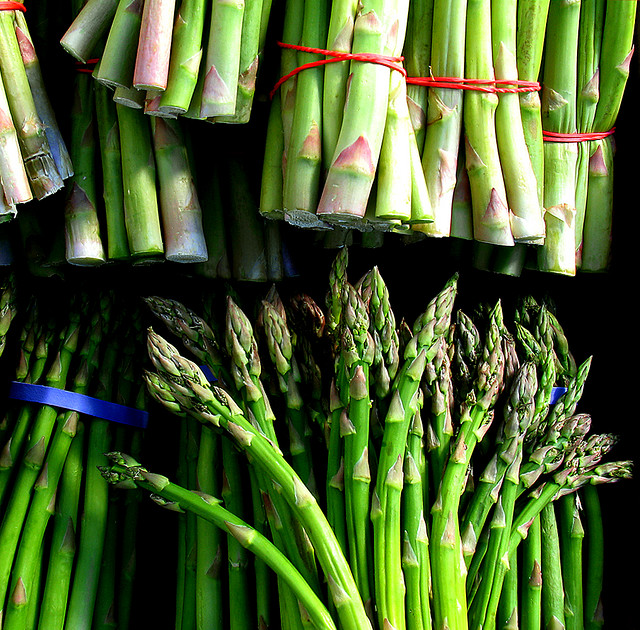
Images: Organic Lea community veg bed; asparagus from local farmer's market (Creative Commons); Jack's Suffolk asparagus with Maple Farm radishes, 2013 (CDC)

Wednesday, 1 May 2013

Welcome to the new summer edition!

TFP_Issue2_Summer2013_Frontcover
On Wednesday, May 1, the new national Transition Free Press published its on-line summer edition  - 24 pages of full-on, full colour news and views. Great photographs, great articles, contributed by Transitioners and community activists working in the field.

These are stories about ordinary people doing extraordinary stuff in all kinds of places: in the city, in the wild, in books, housing co-ops, small businesses, in the park, down the pub, on the (solar- panelled) roof, underwater, even on the netball court. We're in Greece, Spain, France and Portugal; we're in Sheffield, Louth, Crystal Palace and Lostwithiel. We're also in Norwich, on sale at The Greenhouse and at events and hubs including Norwich FarmShare and this weekend's May Day Fair in Chapelfield Gardens.

twodamselsOur on-line version, of course, goes everywhere and anywhere, but we feel there is nothing quite like the real thing. So if you can't put your hands on the physical paper locally, you can always subscribe for a year and receive your copy through the post.

???????????????????
During the next few weeks we will be publishing some of this edition's highlights on theTransition Free Press website. Meanwhile here is the introduction to give you a taste.

Welcome to issue two

Energy underpins everything we do in our industrialised societies. The high demand for gas, oil, coal or bio-fuels, as our front page story shows, is now costing the earth on which we depend for life. How we face this dilemma and reduce our need for power is the work of the Transition movement and thousands of community activists around the world.

Most of us are invisible. But, like mycorrhizzal fungi in the living soil, we are connecting and communicating across the globe, working to bring about a future where people can live fairly within ecological limits. In our summer edition we publish stories you might not ordinarily see – actions communities undertake to bring back life into neighbourhoods, to activate soils that have been deadened and contaminated, to create new networks that can hold us together in challenging times. An infrastructure you can feel but not always see.

944493_648593525166742_1174153410_nThe proposed Keystone XL pipeline threatens to bring toxic crude oil through the heartland of America. Ancient trees fall to make a by-pass in a peaceful valley in Sussex. In response people rise up and take on mighty corporations and rapacious stakeholders. Sometimes that might is challenged. We won! wrote TFP columnist, Shaun Chamberlin, as the Ecological Land Co-operative finally secured planning permission for a smallholding in Devon. For a Goliath culture whose top-down business-as-usual worldview requires everyone’s assent, this may appear a small victory. But  each time we voice our dissent, each time we reclaim our fields, we realise we are not alone in our task.

Why to do we tell these stories? Because they are sparks that light a great fire inside us. Because another culture is being forged under our feet. In an abandoned warehouse in Doncaster people gather on a freezing night by a furnace to listen to a new narrative being told, along the River Dart  a group of children and elders go on a story walk in search of the future. A sunflower garden appears in a neighbourhood in Portalegre. An artist plants 100 fruit trees in a university in Loughborough. In the cities everywhere, leaves appear through the cracks and are gathered by foragers. A dominant worldview does not mean we do not have agency.

girassolWhat we are not told is that there is an emergent world inside us. You can find it everywhere where there is warmth and generosity and a co-operative spirit: in community cafes, park libraries, pop-up shops, trade schools, abundance projects, repair cafes, people’s kitchens. It comes in all the colours of the rainbow, it sounds like the nightingale singing in the dark in May. For all people who sing in the dark, who stand by the land, the bird and the tree, who hold the fire until the dawn comes, this paper is for you.

Charlotte Du Cann, Editor


936933_10151603564244935_833123159_nImages: artist and activist, Anne-Marie Culhane (People); Bee-friendly plants from the Honeyscribe project by Amy Shelton (Living Earth); Oil Change International poster (News); sunflower from neighbourhood garden in Portalegre  (Profile); TFP button by Trucie Mitchell and Chris Wells

To subscribe for a year click here   

To order a bundle of Transition Free Press contact mark@transitionfreepress.org.uk

Wednesday, 24 April 2013

52 FLOWERS; Japanese Cherry

south kensington, london 02 

The cherry trees are in bloom all over Kensington. It is a London spring moment, when the city’s ornamental trees burst into flower before anywhere else: golden forsythia, waxy magnolia,  sugary pink almonds. In the parks and private gardens, the bushes and trees hold a grand ball, throwing their gorgeous colours against the white painted houses in the sharp spring air, as the lowly daffodils and narcissi dance beneath their grand Oriental display.

On one of these glorious days I go walking across the parks of London and find myself in South Kensington at a dress shop. I am standing in a changing room wearing an outfit I once beheld in a dream: an elegant jump-suit made of crinkly dark grey material. It is the kind of dress a fashionable extraterrestrial might wear, or a modern Joan of Arc. It fits like a glove. I am amazed by the coincidence. I have always wanted to wear a dress like this. But as I stare into the mirror I am shocked I cannot find myself. “I” have disappeared.  It feels as though the dress is wearing me, and not the other way round. I suddenly feel very uncomfortable.

This warrior outfit has been designed by the visionary Japanese fashion designer, Issey Miyake. Years ago I was invited by Issey Miyake to visit Japan as a honoured guest, with several other  fashion editors from around the world. We were entertained like royalty. I had never been treated so well in the whole of my life. Everything was paid for: our hotel bills, our expenses. When we walked into clothes shops we were told to help ourselves. Beautiful meals were constructed in our honour, elaborate courses based on the theme of autumn, adorned with small maple leaves and twigs. We were chauffeured everywhere, put on luxury trains that took us to all the major cities. We  slept in mountain lodges with paper windows, sat in cedarwood baths, visited red and gold temples.

Meanwhile, as the purpose of the visit, we attended the conference on the future of fashion where Miyake talked eloquently about the earth and the fabrics that demanded such a high price from the natural world - things which at that time I had never considered. The fabrics of Japan are unique, as are their designs. The Japanese attitude towards the material of life is quite different from that of Europe. It has a rigorous abstract aesthetic that Miyake felt was being undermined by the coarser narrative and glamour of the West. This aesthetic is expressed in a myriad ways - from the simplicity of their Zen gardens, to the innovative and elegant way parcels are wrapped, the reverence with which everyone sits underneath the cherry blossom at Springtime. The Japanese are also phenomenal consumers of rainforest wood. Rayon is their principle fashion fabric, so it was apposite that these things were being discussed.

One night in Kyoto we went to a traditional restaurant with various business men.  We sat on the floor and behind each of us kneeled a geisha girl in rigorous attire. Occasionally they would serve us food and pour out sake in perfect silence. Their stiff clothes and their painted faces and submissiveness made me feel quite uncomfortable. All the visitors exchanged glances at each other, not knowing quite how to respond to this part of our show. I am remembering this moment as I stand here in South Kensington in my fashion suit.

No one except a Japanese craftsmen could have created this kind of suit. It is made from the fabric that made Miyake famous in the West. Only Mario Fortuny in the 1920’s had worked with this crinklecut before. Evening dresses that could be squeezed into a small shape in your hand, that never need ironing, that always make you look like a million dollars. The material hugs the body instantly and lends your whole physical being a certain elegance and shape, making you shimmer in the metallic hues of gold, silver, copper, bronze, like a classical statue.

My dress was pewter-coloured, just like my dream. It fitted perfectly. It was not even very expensive. But as I looked at myself, I suddenly felt overcome with something I could not name. When would I wear such a garment? I thought.

It was then that I saw myself in a vision. I was paused on a stair, held in a certain moment. It was the stairway of a grand hotel, and there was a dark man on the dining floor below. There was a place set for me, and he was waiting. It was the moment when he saw me, would then rise, greet me and allow me to sit down.

But I am not that woman. I was never that woman and moreover, I had never wanted to be that woman. This dress was designed for someone who would serve a man, and whom a man would formally make a place for, as she descended the stair, shimmering in all her metallic colours, in all her jewels. There was an ancient agreement between them, except that I have never made it.

“It’s beautiful,” I said to the shop assistant. “But I am going to leave it.”
“It looked good on you,” she said simply.
“Yes,” I said, “I know. But I don’t have any occasion to wear it.”

That was the last time I considered fashion. For years I had worked in this world and known it in so many ways. And now it had suddenly lost all its meaning, all its alllure.

Later I walked home through Holland Park.  There was a peacock amongst the cherries and camellias and as I walked by, he opened his glorious tail. There is such beauty in the world! I thought and was filled with all the excitement of Spring. The cherry tree is an ecstatic tree. Like all the rose trees – apple, hawthorn, almond, plum and all the soft fruit trees - it has a profound effect on the way you feel. Its masses of pink blossom and its autumn-red leaves, give you, as you stand beneath its branches, a great soaring hope and inspiration for life. I have made a tincture of wild cherries, and found that one sip can give you this feeling as well. Its scented bark is a traditional remedy for the lungs, helping you to breathe more freely. Everything about this tree lifts you up, opens things up. When the peacock unfurls his tail of rainbow colour, the blossom of a tree appears at the end of a street, and as you put on a new dress, you feel for a moment transcended. And it is at that moment you find yourself on that imaginal stair.

There is a lot of power in that moment. It is a moment that millons of women fantasise about. That one moment of blossom, where the man is waiting, beholding you, finding you beautiful.
Millions of dresses pour out of the factories all over the East to fulfil that one moment. The geisha moment. It is repeated again and again. Never quite reached, never lived out. Then the tail descends, the bloom fades, the dress doesn’t fit, and you search for another, and then another. 

I am not going to be in that moment.

If we could be beautiful like the peacock, with simplicity. If we could unfold ourselves, each with our own natural beauty. Not just for this one Spring but always. Because our beauty in a cage is not real beauty. It is a glamour, a moment wherein we are stuck and doomed eternally to repeat; beheld by another, but possessing no qualities of our own, except that we adorn and serve some business that is not ours to question. Real beauty is something inner, something deeper, something more lasting. It is in the whole tree, its roots, its branches. And that whole tree has its own mystery. It is intact.

Somewhere miles from here there stands a wild cherry tree in a wood and the tincture I will make from its fruit one year later is delicious, rather like sloe or damson gin. Except I put no sugar in it, so it has an aftertaste of bitter almonds that all roses posses, a taste that lingers on your tongue, long after the fragrance has gone, that is not covered over with artificial sweetness. That taste is prussic acid. It is the poison of the rose.

This poison says that no matter how beautiful you are on the outside, no matter how many dresses you wear, or how many times the man does, or does not wait for you at the bottom of the stair, there is a price to pay, and some day you will have to pay it. That if you are smart you will pay this now. While you can. You will put your dress aside and think about the inside of your being, what treasures lie in your bones, what kind of wild beautiful hope you carry in your cells, what kind of rosy fire that will exalt us all - not just to illuminate a private fantasy, but for real.

from 52 Flowers That Shook My World - A Radical Return to Earth