Showing posts with label food. Show all posts

Tuesday, 6 February 2018

Dark Kitchen: Uncivilising the Table

This week I introduced a new Dark  Mountain series that explores food and eating in times of collapse. Follow us during this Lenten month as we travel through different kingdoms and terrains, sharpening our appetites and cooking knives, in the company of artists, filmmakers, writers and activists.

Medlars-wider,symm.v.2+30439

We are looking at a plate. Tiny translucent slices of fish are artfully arranged around its rim. It is 1990 and we are in a Japanese restaurant in downtown Manhattan. 'Who is going first?' we wonder and laugh nervously. I am with Hamilton and Steve. We'll all go at once we decide and put the poisonous raw fugu in our mouths, declaring that a tingling was definitely happening. The dish costs $50.

We are looking at a plate. On it piled in chunky layers are home-baked sourdough bread, crispy seaweed and a poached egg. It is 2017 and we are outside in the lee of the Dorset cliffs, cooking on a camping stove. Everyone wants to go first. I am with Caroline, Jack and Mark and yesterday we cut the bright green fronds from the rocks, as the aquamarine sea swirled about our feet. We declare this is possibly the best breakfast we have ever had and laugh.

This is a story about food and powerdown. It could seem like a personal story except that it is not: it is a social story about how everything changes when you break the illusions your civilisation is wrapped in. In 1990 I am staying in the Algonquin Hotel, covering the US fashion collections, and I know nothing about the industrial food system; in 2017 I am staying in a hut on a beach, talking about Dark Mountain, and I know all its dark secrets. Decades later the Spring collections will still send beige raincoats down the catwalk and the forests of kelp will continue to wave their ancestral arms in the currents of the English channel - but the world I am documenting, like the food I now cook, is radically different.

This is a series called Dark Kitchen: a set of pieces that will look at and question the culture of food in times of fall. It's not a subject Dark Mountain has focused on before, even though writing and cooking share a creative terroir, not least in their ability to bring things to the table, to alchemise raw material into food for the mind, heart and body. Up to now any focus on food has been practical: the Uncivilisation festivals hosted foraging walks, we've published pieces on mead making, bread baking in Australia and a recipe for a very rooty, roadkill pheasant stew; this series aims to bring a writer's and artist's particular attention to food from a Dark Mountain perspective.

Our focus will not be on the labyrinth, the whirlygig of distribution centres and trucks that thunder along our roads, all the data and polemic, but on finding the dancing floor beneath it. Around all our sentences lie the deforested lands, the denuded and poisoned oceans, the lost soil, the vast herds of creatures living and dying invisibly in dark sheds. We know what is going down. Our core question is, once you have railed at the machine that holds us in its palm-oiled maw, what do you do as an artist, as a storytelling human being, knowing that every time you venture out with a shopping basket, you return with blood on your hands?

Dark Kitchen aims to gather some of the stories about food that go untold at the edge of our civilisation. All civilisations flourish and flounder according to their ability to feed themselves. All of us, as human animals, no matter where we exist, on what social and political map, need to eat to live. Like death, this is a fact of our existence here. How we can we do that sustainably, with kindness, with fairness, is a question many grassroots organisations and activists ask themselves.

One they do not necessarily ask however is: how do we change the story of our lives, built as it is on millions of years of living in hunter/gatherer bodies, thousands of years living in wheat and barley-fed civilisations, in nomadic milk-herding geographies? Food is not a matter of intellectual debate: it is physical and feeling memory, deep time memory, cultural and personal history. It is people and relationships with domestic and wild creatures, conviviality, tradition, hunger, belonging, snobbery. Roast dinners, fish and chips by the sea. It is hunting deer and keeping chickens, curry on a Friday night when you were a student. It is visiting the markets of Morocco, or France, or your gran who cooked the best lemon meringue pie ever.

How do you come up with a new way of interacting with the world that means all that culture stored inside of you and everyone you know, constantly reflected from shiny magazine pages, on TV screens, on your best friend's Instagram, has to go?

Roland Barthes observed in his seminal work Mythologies how the modern left faltered before the sheer power and sexiness of the capitalist advertising industry. How can you match the pull it has on your most basic desire: to eat delicious food, tasting of fat and salt and sweet, ready made without effort, without thinking of where it has come from, a food without consequence, untainted by guilt. Every day feast food, seeped in the lure of luxury, convenience, pleasure, control - the defining signature of a corporate lifestyle.

A humble recipe for vegan nut roast is not going to cut the mustard, any more than modern socialism has been able to counter market fundamentalism. The glamour and snobbery of high culture, and the physical desires and  habits of most people, are too strong. Something else has to pull you more powerfully in another direction: something that has its roots in the land, in a deeper culture that also looks prophetically to the future,  that has intelligence, meaning and ethics and still tastes good.

One thing corporate dining, for all its cheffy fancies and huge glasses of wine, does not have and never will: the relationship with the non-human, with the earth, with the plants and creatures who stand to go down with us if we don't dismantle the labyrinth. This relationship is above all things a matter of the heart. Dark Kitchen is about remembering one of the oldest and simplest stories ever told: a love affair with the fabric of life.

Powerdown

Bread b7w
Where did the shift away from that plate of fugu begin? I read a cookbook by Colin Spencer with a no-holds-barred description of slaughterhouses. I gave up eating meat. I read End of the Line by Charles Clover. I gave up eating fish. I read Eat Your Heart Out, Felicity Lawrence's document about corporate control and the fate of African workers in the glasshouses of Spain and Italy. I gave up buying out-of-season tomatoes. I stopped going to supermarkets. Then I went to a documentary hosted by a local Transition initiative where Derrick Jensen spoke about the agricultural revolution and how it had decimated the wild world. Somewhere a restaurant door slammed shut and an allotment gate clicked open.

In Transition I bumped into everything that the advertising and supermarkets keep in the dark: land grabs, slavery, GM, pesticides decimating insect and bird populations, slurry from pig farms killing the rivers and oceans. I started to look at the barley and beet fields outside my window in a new light and shudder.

In those grassroots community activism years, food growing connected us all: we knew that growing radishes would not change the world but it would radically change our relationships with the earth and with each other. I became a serial food blogger charting the downshifting moves within food production: growing co-ops, box schemes, gleaning networks, apple-pressing weekends, potato days, community bakers, seed swaps, the plight of the honey bees, and the ex-Agriculture minister John Gummer telling us at a farmers' conference on Climate Change and Food Security:
This is the biggest issue agriculture has faced, and unlike the Depression in the 1930s and the Black Death we are not facing this in ignorance. And because we know we are responsible. People don't want to know of course, because once you know it changes you and you are ashamed.
It was a time where people on panels said these kinds of things and prophesied that bio-tech loaves and fishes would feed the 9 billion. It was a time of bringing potatoes to Occupy camps and wild weed salads to low-carbon meetings, of rescuing a whole side of salmon and punnets of strawberries from the Latitude festival recycling bins, cooking Mexican and raw food feasts for community diners. It was a time where The Monitor in the kitchen told me exactly how much power was eking out of the fridge and the kettle. When some women wept and struggled with their Tesco habit, and others implored me not to tell them exactly what their shrimp habit was doing to the seabed or the coastal mangroves of South East Asia.

But something was missing. Everything I wrote had this evangelical tone. We need to reduce our energy use! Get in season! Make your store cupboard resilient! Wake up to the real price of consumerism! I realised neither knowledge nor social justice gives enough heft for people to change tracks. To be in synch with the living systems, to restore the land, to eat beautifully with conscience, to find meaning in an everyday humble meal, an imaginative relationship with the physical world had to be created. Our hearts had to be rekindled by something stronger, more alluring, than any feel-bad information. Something you never thought of before  like seaweed for breakfast on a limestone beach in September.


A short story about beans

Beans 2
I am standing on Dark Mountain's Base Camp stage, holding a handful of field beans. These beans are what this weekend is all about, I am telling the gathering. Field beans have been grown here in Britain since the Iron Age and embody one of the uncivilised principles of the manifesto  being rooted in time and place.

The beans are produced by my friend Josiah, who started a small business in a nearby Suffolk market town with Nick and William five years ago. The beans were all about shortening the supply chain, encouraging farmers to grow a crop that was either given to cattle or sold to the Middle East, and that was nutritious not only for an eat-less-meat-and-dairy-cook-from-scratch culture, but also for the soil that is being rapidly depleted by fossil-fuelled farming.

But most of all the beans were about telling a different story. A Jack in the Beanstalk story about a boy who sells his mother's cow for a handful of beans that totally changes their luck. The beans were followed by peas of many colours, and then quinoa (grown not in Bolivia but in Essex), and now lentils, naked barley and oats, and a host of other grains and pulses, grown with the same kind of attention to place and provenance that has made local craft beers rocket in popularity in the face of corporate brewing. In short, a whole shelf of basic goods that would normally be imported, in fields that would normally host monocultural commodity crops grown for the global market. Last year Hodmedods won BBC Producer of the Year and had to move warehouses, as everyone else began to agree those beans just took you to places that Mr Heinz never could.

One of the successes of the fava bean is that it is a beloved ingredient in the fragrant and spicy cuisines of  the Middle East and other countries. To end each of our Dark Kitchen posts we'll be cooking up a recipe that will capture the flavour of some of the story we're telling, that shows though we may live in more austere restricted times, there need be no limit to our imaginations and flair and generosity. This is a classic North African dish made with fava beans instead of chickpeas and served with quinoa instead of couscous. It can serve two to four people  just add less or more veg.

Seven vegetable tagine

Soak a big handful of fava beans overnight and then cook until soft (approx 40 minutes). Keep to one side. Whole beans keep their shape but split fava is OK too if you don't mind a bit of collapse in your cooking (no need to soak).

Chop one onion and fry gently in olive oil in a largish saucepan. When softened add 2 cloves of garlic, a teaspoon of ras el hanout spice (or a mix of cumin, coriander, mixed spice and chilli pepper) and fresh green chilli if you like it hot. Stir and then add your roughly chopped seven veg which will depend on season: swede, leeks and parsnips in winter for example, courgettes, green pepper and turnips in the summer. You're looking for a strong taste and a chunky texture, so celery and carrots are good. Cabbage however is key and can be added half way through the main cooking so it keeps its form.

Stir in the spicy oil for a minute or two then add 2 tomatoes and a squeeze of tomato puree, or the equivalent in tinned tomatoes, and water to just below the level of the veg. Throw in a handful of sultanas and half a preserved lemon (or a couple of slices and the juice of half a fresh squeezed lemon). Stir, pop on the lid and cook until the veg starts to soften (about 15 minutes). Add the beans for a further five.

Before serving add salt and black pepper to taste, plus a big handful of chopped coriander and/or parsley. Served with quinoa, flavoured with orange zest, cinnamon and toasted sunflower seeds, a bowl of slaw or salad, and some feisty harissa.

Next course:

The Dark Kitchen series will run throughout February, but will continue as an occasional series when the new-look Dark Mountain website is launched in April. If you would like to contribute in the future, do get in touch with a short description of your piece to charlotte@dark-mountain.net. Thanks all and bon appetit!
--
Images: Medlars in a Sieve by Food/ Still life photography: Sue Atkinson www.sueatkinson.co.uk; loaves from a co-operative oven, Can Piella, Catalonia by Phillip Evans ; a handful of (field) beans by Mark Watson

Wednesday, 8 May 2013

ROOTS, SHOOTS AND SEEDS: The Spear Carriers

Roots, Shoots and Seeds is a book about the local community food movement, set around the wide arable fields of East Anglia, following the tracks of the crops that grow in these clay and sandy soils, from barley to flax, from rapeseed to potatoes. I began to write this book with my friend and fellow Transitioner, Josiah Meldrum in 2009, and although we were unable to complete and publish the work, our attention set the scene for other food projects, such as the Low Carbon Cookbook and Happy Mondays at the Community Kitchen. Now May has arrived in full force, so has one of Suffolk's most cherished vegetables. In celebration here is a section in praise of the great green spears . . .
 
"There she is," said my father, "Boudicca! Look at her! Formidable!" Craning our necks we looked upwards toward the statue in the darkening sky. A woman on a chariot flew into the night sky above the arch. Boudicca was sacking London, trampling invaders under her spiky wheels. We were travelling back along the red road that runs between the Palace and the Park.

For years the statue at Hyde Park Corner signalled the return to the city, after days and sometimes weeks spent in the countryside. We had, alas, come back, but Boudicca was holding the fort and pointing us in the right direction. Just in case we forgot our way.

In spite of his admiration for barbarians my father was not one of Boudicca’s men. He worked for another woman entirely, a Roman matron who stood blindfold on top of the dome of the Old Bailey. She was a hard taskmistress: the folds of her gown unyielding, her sword exacting, and for all the advocacy he performed in her service there was none of the jubilation he expressed for the warrior Queen of East Anglia. But then my father’s heart was not in the work he did for Justice, it belonged to the country we had just left behind. To a large ragged garden that lay by a marsh, a plot of earth with a wheelbarrow and a spade beside it, apple trees all around and a bare mound that signalled the presence of the greatest of British vegetables, white crowns that lay hidden in the earth: asparagus.

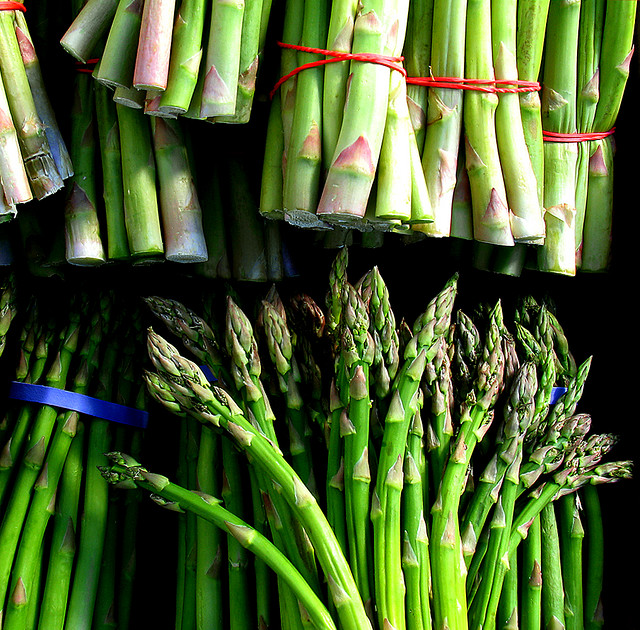
Asparagus is a lily and like all lilies, otherworldly, and keeps its strength in reserves underground. From these rich stores, it bolts through the earth in straight green shoots with purplish heads known as spears in Spring, when it is harvested until midsummer before it branches into its stiff and feathery form and flowers. Like all lilies it is ruled by the moon, the planet of memory, and, in spite of its overtly masculine form, unequivocally the queen of the field. The crowns take years to mature and the spears are time-consuming to pick both in the wild and domesticated state and consequently, though eaten with barbarian fingers, they are always treated with a certain reverence.

When the asparagus arrived my father would appear triumphant in the door and stride towards the kitchen, carrying the spears. The Moment had arrived. At supper we would watch for the signal that meant everyone was allowed to begin eating. He took up position at the end of the table. The napkin flicked. The glass was filled. The asparagus lay steaming on our plates. A spear was lifted dripping with creamy butter, held aloft for dramatic effect, and then, in it went.

Dear God, dear God! exclaimed our father, rolling his eyes upward. Dear god, dear god! we chorused, laughing between our own slippery green mouthfuls.

We did not question why our father always called upon the Almighty when he ate something he loved since he was a devout atheist, however it was how all great foods were addressed. Ordinary foods were quietly and effortlessly dispensed at the other end of the table by my mother, all manner of stews and pies and puddings, but the roast meats of Sunday, game fish, smoked fish, French cheese and most assuredly his own garden vegetables belonged to my father’s end. The ritual and mythology of food belonged to him, all foods that required ceremony, a careful handling of carving knife and fork, a judicious serving, came under his dispensation.

I spent a life-time excusing myself from this dining table, liberating myself from the constraints of its form and hierarchy, forgoing manners, dramatic gesture, napkins and claret, and yet when it comes to asparagus, I still exult.

To gain a true relationship with food, we have to regain a relationship with place, remember the part of ourselves that knows about seeds and earth and rain. Sometimes this memory is secreted in a place we don’t want to go, in the deep earth, down an ancestral path that leads back through time towards a battalion of asparagus marching over the East Anglia fields in the month of May. Our buried treasure.

Ru Litherland, Hackney-born, might have run along Boudicca’s chariot. He is a radical man who grows all manner of vegetables in renovated land in Walthamstow. He says that many who come to enlist in his volunteer army of seed sowers and leaf pickers, fall in with its movements and requirements easily because their old man once had an allotment and grew his own veg. When they come to the land they just know what to do. They have listened to a rhythm and it has somehow got into their bones. I have listened to that rhythm: the chink of spade as it scraped the eastern flint, the shake of grass, the rattle of bean poles in the wind. I once climbed an apple tree and watched the East wind as it ran through the blond marsh grasses of Kent, my eyes scanning the horizon for the distant sea. And below me I listened to the sounds of the garden: tack tack tack.

You could get nostalgic remembering those sounds, but I have learned not to trust nostalgia especially when it comes to fathers and gardens and going back in time. I want to go forwards, taking this sound in my ears, this feeling in my bones, this pungent taste in my mouth, a taste of blood and iron.

* * * *

I stand at the chopping board in the kitchen in the spring evening. Outside the window the apple tree is heavy with blossom. My hands hold a knife, my attention focussed on cutting the woody ends from the asparagus. My left index finger feels for the place to cut and then the right hand slices the spears sharply: tack tack tack. The hands know things the mind does not. You pick up an axe and know without knowing how to chop wood, bake bread, wrap the dead, hoist a sail. When I was 29 a gardener put an egg in my hand. It was warm and smooth. Listen! he said. Tap tap tap: a chick was pecking its way out of its shell into the unimagined vastness of the world. I had been wrapped up in myself, far away from earth and suddenly I was looking into his eyes. “I wanted to get through to you,” he said.

Something stifled in us needs to come alive, break out, remember. We need an encounter with life to do this. My old friend Carol went into the desert when she was 40 years old. Everyone had left her and she had to start again. She sat down in the middle of nowhere and cried for a long time. Then she put her hands into the earth and her hands formed bricks out of the red mud. She built a house with those adobe bricks and then she lived there. Some people put their hands back into the earth and they find themselves weeping or laughing, flooded with feelings they have no names for. Then their hands start searching out roots, pushing seeds, pulling weeds, throwing out flints. Something happens in this moment when your hands take charge of your life: something quiet, unsusceptible to the eye, that thunders inside you and breaks. You think it is your heart. But it’s not. It’s your isolation.

The root to the real world is cut quickly. The forgetting of how to be in nature happens quickly.The diseases that come with the Western diet come quickly. They come to indigenous people and to girls who live too long in cities. Everyone blows up like a balloon, gets diabetes, their hearts fail and their stomach knots. The world of factory food goes too fast for the natural systems of human beings. To survive on this food you have to eat too much and not think about what you are eating. You have to forgo your common sense and the knowledge of your ancestors and fit the requirements of industry in the same unnatural ways that food is processed and homogenised. Somewhere deep inside you shut down. You find yourself gazing up at the actors, the kings and queens at their high tables, and forgetting you are among spear carriers without whom the play is not the play.

I stand at the chopping board, green spears in my hand. Outside the blackbird begin his evening carol. I do not make Victoria sponge or marmalade like my mother. I don’t give dinner parties and sit bejewelled amongst guests, or lay down claret, or cross the Channel to eat raie au beurre noire and Camembert. I don’t dine like a king, like my father, on smoked eel and partridge, I eat like a spear carrier. I know things about food and history my parents’ generation never knew. I know that Boudicca is not Boudicca, but a boy in a war chariot overwhelmed by the angel crowned with olive leaves. A statue to peace erected in 1912 just before the bloodiest battle ever fought began. I know that what we need is not peace but life in our hands, a year filled with great moments. Dear god, dear god! holy food for unbelievers, who don’t worship or go down on their knees but declare their happiness out loud for the fruit of the season: for greengage and rhubarb, for samphire and blackberry, for purple sprouting broccoli and leek.

Image3898
I don’t take out a cookery book to cook this bundle of asparagus, picked this day in Jack’s fields in Middleton. I will not cover them in hollandaise or adorn them with shavings of truffle or Parmesan. I will not hide my spears inside risottos or a quirky nest of noodles, nor in any manner of grandiloquent dish I once learned to make in my working city kitchen, surrounded by pans and knives and cookery books, my apron hanging on a hook behind the door. Tonight the spears shall take their place on the plate as they emerged from the earth. Naked and green, beside a cut lemon, a small pool of olive oil, sea salt, black pepper. I will serve them in the glasshouse on the blue table. It’s the Moment of the first summer vegetables: new potatoes, broad beans, spinach. A humble dish of vegetables on a great day in May.

Can you sing praises to broad beans and spinach? To a blue kitchen table?

The Israeli poet Aharon Shabtai sings praises to cucumber and scallions:

Times are bad. I take an oath of loyalty to the table

coated with white Formica.

His fellow countryman, the Palestinian poet, Mourid Bougati, instructs us in these times to speak of real things, to hold everything dear. In a world dominated by abstract theorems, by the high-flown rhetoric of empire, by eternal war, to cherish the concrete and the real with words is the radical act of writers and chroniclers. To acknowledge time and place, to engage in the physicial breathing and growing world is radical. Cooking is radical. Tasting the fruit of the earth, knowing where it comes from and whose hands grew it, the name of the grocer and the flower. Holding the spear and walking away from the play, in the opposite direction to Rome.

* * * *

Eventually the stern taskmistress demanded my father work harder and harder, the piles of paper in the study grew higher and higher, and the vegetables in the garden slipped away; my mother got tired and started to buy readymade food. The pies and the stews slipped away. And then they both slipped away. I was alone in a world without the ritual of carving knife and fork. The garden was paved over, earmarked for development. The kitchen fell silent. The wooden spoons lay unused in the drawer. Reluctantly I came down from my apple tree hideout, where I had been observing the wild world for twenty years, keeping a log.

Now what do we do? I said.

Frankenstein has loosed his monster on the world, an industrial chain of hubs and tankers, factories and refineries that devours every living thing in its path, spews out poisons and bad air. He stands in the laboratory mixing cocktails of enzymes and chemicals, cheating time, killing the soil, outside his juggernauts ceaselessly thunder up and down the roads of everywhere, perpetually, silently, the shelves and freezers are filled with food so cheap, so convenient, that the people forget that it is the stuff of life and comes from the earth, emerges in Spring, like the asparagus with the bluebells and the nightingale.

How can anything we do make a difference? How can knowing these facts about food serve us, knowing that Frankenstein has every base covered, is busily stripping the living systems bare, stalking the countryside, spraying the barley field beyond the hedge even now so I have to close the kitchen window not to inhale its noxious drift?

Because when the tractor with its long arms has left the field there is the blackbird singing as dusk falls, because you are still standing by the chopping board and the asparagus is still in your hands. Because you remember the feel of the land in May. The greening of everything. Something went in deep those years ago in the garden and though you are living in a different time you haven’t forgotten the lily crowns that lie for years underneath the soil. Frankenstein tries to make the world forget the deep and slow things, the plants that move according to sun and moon and alchemise life in their root and stem and leaf. He runs on clock time, 24/7 time, on high-drive, in the fast lane, where one day is the same as another and everyone is interchangeable, replaceable, only worthwhile for their ability to feed his monster’s maw.

Under his tutelage whole legions of us fall asleep, lose our minds, forget our names, who we are, what we are doing. But some of us are remembering, singing hymns in praise of radishes and olive trees, not moving from where we live, on deliberate go-slow. Growing lettuces in windowboxes and barrels, on rooftops, reclaiming land, regenerating soil, in the hinterlands and back country, in the cracks of the streets of cities, behind railway stations. Meeting up in halls and backrooms, baking our own bread, stirring the pot. Speaking to each other across tables.

Some of us are returning, carrying our spears. Coming home.

Images: Organic Lea community veg bed; asparagus from local farmer's market (Creative Commons); Jack's Suffolk asparagus with Maple Farm radishes, 2013 (CDC)

Saturday, 17 November 2012

Mr Moyse and the Green Tomatoes

Years ago when I first came to the lane, I joined a neighbourhood action group to protest the development of a tourist railway. It was going to cut through the network of lanes that run along the marsh in the back country of the parish. I offered what I could do as a newcomer. I wrote flyers and press releases and stood up in the village hall, speaking on behalf of the badgers and the blackthorn and the people who love to come down these "commons" on foot, or bicycle, or pony trap. After that (very successful) campaign, I felt I had finally put down roots. Everyone waved cheerily as I walked by their houses. And none more so than David Moyse (75) ex-engineer, steeple- and record keeper, who has lived on the corner of the lane all his life and his family for generations before him.

When I joined Transition the following year, I began to write again, after many years silence, and one of the very first stories I wrote was about the little roadside stall I found with neat bunches of leeks for sale and the man who grew them in his wedge-shaped garden.

It was the beginning of the Low Carbon Cookbook. 

 "Near me at the corner of the lane, Mr Moyse puts out his excellent tomatoes at the end of the season on a roadside stall in the manner of Suffolk cottagers, with a tin or jar for coins.They come in three sizes, but all of them are intense. Last year as we walked by we would say how much we were enjoying the tomatoes over the hedge. Just as October was coming to an end I found Mr Moyse walking towards me in a most determined manner:

"I’ve got to have a word with you," he said.

I had been talking about green tomatoes, how they are so delicious fried and make such good chutney. And now I found myself with several kilos of green fruit and a challenge on my hands. We had got talking when I went round to collect them and I had found out that Mr Moyse’s grandmother once lived in my house. She was the best cook in the lane he said.

So this is a small sustainable tale about honouring the elders and finding your roots wherever you are. Start talking over the hedge and you will make contact with another generation who knew how to live in synch with the land. Talking to the greengrocer in the market town I found he used to deliver milk by horse and cart as a boy (still works two horses), that the man who owns the local organic store originally comes from a dairy farm in Galicia where they still milk their 70 cows by hand. After the evening milking he says the family sit round together in the barn and talk until midnight. The key to human sustainability is communication; and not being afraid to open your mouth and make a fool of yourself. That way you find out that making chutney is dead easy (just don’t burn the pan).

Because I had of course never made chutney in my life. I liked the idea of making chutney which is not the same thing at all. I searched for a recipe from the library, picked a few windfalls from the apple tree and brought out the biggest pan I had. (Well actually it’s the only decent pan I have). Several hours of chopping, stirring and bubbling later the house was redolent with vinegar and mace and raisins and I had ten shiny dark-gold jars in the larder.The largest one I reserved. Six weeks maturing time later, I burst into the Moyses' bungalow and wished them a Happy New Year! I wasn’t ever quite sure whether they liked it, or were just being polite when they accepted the jar quietly with a smile.


This year on All Souls Day Mr Moise called out down the road after me. 
 
"Would you like some more of those tomatoes?" he said.
"You liked it the chutney then?" I asked.
"It were beautiful," he laughed. "Come round tomorrow."
 

So now we have a deal. Last year I found out about the history of the lane (his grandfather was head horseman of the neighbouring farm, his father the blacksmith), this year I learned about making wine from the fruits of the hedgerows and the local gardens, from rosehips, grapes, whitecurrants, blackberries, and now I’m having a rethink about all those windfalls I see lying around. Couldn’t we get an apple press and starting making our own juice?

It’s is not an official Transition initiative this lane I live in, but it is a transition lane in spirit, with all the right ingredients for resilience: market garden and barley fields, horses and rabbits, allotments and ancient coppice, wild cherry hedges and oak trees. There’s a good diversity of people too – dwellers of grand houses and humble cottages, newcomers and natives who have been here for generations. The lane brings everything and everyone together. Sometimes we meet and get talking about what the sloes and the mushrooms are doing this season. The plants are always a bridge. That’s when you get to feel you are living in the same place, in the same land, on the same planet. It’s the most extraordinary thing about transition. It makes you feel you belong in a time when you never thought it was possible."


So now, years later, Mr Moyse is definitely David. Now I know he doesn't like being called Mr., and is happy for Mark and I to swing by, talk over the gate, and ask for things if we need them. He has lent us his old lawnmower (which we eventually bought), and we have been enjoying his cucumbers and beans and delicious ripe tomatoes for several summers long.

 Now I always make my own jam and chutneys from local fruit - yellow cherry plums, damsons, apples, blackberries, and of course green tomatoes. This year I've used large unripe marmandes donated by Mr Pinder aka Malcolm, and several tiny Columbiana cherries we grew arounnd the tent in company with their fellow Solanacea cousins, Hopi Tobacco. I've had to move quickly because Mark is Very Partial to fried green tomatoes for breakfast. Those gorgeous slow-growing marmandes are a big treat too to have amongst a good pan of roast vegetables (right now sweet potatoes, last of the peppers, parsnip and pumpkin). I used a recipe from Elizabeth David's Spices, Salt and Aromatics in the English Kitchen, a very old Penguin I found in a junk store. I added a chilli and used mace and cloves (as there was no allspice in the cupboard), apple cider vinegar and less sugar and salt.

Green Tomato Chutney
2lb green tomatoes, skinned and chopped
2lb cooking apples, peeled and sliced
1/2 lb onions, sliced
1 1/2 lb brown sugar
1lb raisins or sultanas
2 tsp each of ground ginger, all spice and black pepper
2 cloves garliic
2 tbsp salt
1 1/2 pints of white wine or Orleans or white wine vinegar

Put all the ingredients in a pan, except the vinegar. Moisten them with some of it and cook gently for appromiximately an hour. Keep adding the vinegar as it bubbles down. When it reaches a jam like consistency it's ready. Allow to cool for a while then then pour into warmed jars. Keep for six weeks at least before using.

ED says it is "a long-keeping chutney"  . . .  just not in our house! 

Images: green tomato chutney (CDC) photographs from David Moyse's book The Village Where I Went to School, published by Southwold Press and available from Wells of Southwold or Boyden Stores, Reydon, £7; tent garden wtih Lesley from Sustainable Bungay, 2012 (Mark Watson).

Tuesday, 16 October 2012

Low Carbon Cookbook - the foragers

One of the greatest gifts of Transition is rediscovering the simple joys of doing seasonal things together - cooking, cycling, swimming in the sea, having a picnic. They bring sense and meaning into everything we do. Nothing though is quite as delightful and satisfying as foraging - going out into the wild territories and finding stuff to bring home and eat. This Spring the cookbook was all about leaves and energising wild salads, the Summer about flowers and refreshing drinks, but as Autumn stormed in our focus switched to the fruits of the hedgerows. We set out into the lanes and commons collecting berries, nuts and roots.

In Sustainable Bungay we served foraged blackberries at our Happy Mondays Mexican fiesta and talked about Autumn Berry tonics made with sea buckthorn, elderberries and rosehips at our September Plants for Life workshop.


Our wild kitchen discovery of 2012 has been hawthorn leather. Here is Mark's first sculptural attempt. The second batch sweetened with apple worked a treat. Medicine for the heart and stomach.

Nothing, however, beats mushrooming.

This Sunday Josiah, Nick, Janet, Mark and I set out at sunrise to Outney Common in search of breakfast. It was fairly slim pickings but a great morning's foray. We found oak milk caps under the trees and parasols along the path, alongside ghosts of the summer meadowsweet and a bright blue patch of devils' scabious. The river Waveney winds through the dry and wet territory of the common, like a slow and friendly snake. One of the best swimming holes in the valley is down here.

"Usually you find the best mushrooms at the last minute," said Josiah as we crossed the footbridge home by the massive distribution centre of Clay's printing works. And true to form we did. There on the green under the lime trees were several fairy rings and two cracked boletes. Oh, and a sign saying Help Yourself to windfall cox apples. Janet filled her basket.

This weekend Nick will be showing Low Carbon cooks from Norwich and Bungay how to make fruit wines and root beers. He's planning to demonstrate his famous late raspberry wine in three stages and also how to start off a dandelion and burdock beer. Stay tuned for the write up next week.

Meanwhile if you would like to join the TN blog team, or come and celebrate our third birthday tomorrow with us and discuss the future, do swing by the Bicycle Cafe at 6.30pm. Come and have a dance too at the Keir Hardie Hall, starting at 8pm. Hope to see you there!

Wednesday, 15 August 2012

Low Carbon Cookbook goes to Italy

Last night I cooked risotto. I hadn't cooked a risotto in years, but then swinging into Louisa's deli on my way to the beach my eye caught the box of arborio rice. I'll make it with spinach I thought and some of the white wine we have right now. "Good with a stock made with dried mushrooms," advised Mary, who was a cook before she worked in this friendly neighbourhood corner store.

So that's what I did. I soaked some shitake mushrooms (organic sun-dried), cooked up some of Basil's spinach, chopped up one of Malcolm's onions and began the process of making risotto, which as you know is the very opposite of fast food. The key to risotto is not the ingredients - though those matter too of course - good olive oil and stock. The key is attention: risotto demands you stand and stir by the stove for half an hour, focusing on the gradual absorption of stock by those fat glistening grains of rice, so that by the end you have a rich and creamy dish, perhaps one of the most satisfying you can serve.

It's all about being there. Or here as the case may be.

In my travelling meat and fish-eating days I would have made risotto with clams or squid (known as risotto nero due to its inky-black colour), or with a chicken stock and butter and served with a good sprinkling of Parmesan. But last night I found this is truly a great vegan and low carbon dish, and goes beautifully with spinach on the side, served with lemon and olive oil. (Arborio is also a "dry" rice - which unlike "wet" rice does not leak methane into the atmosphere).

It wouldn't of course make a great Bring-to-Share dish, which is the main theme of the Cookbook recipes. In fact many of the classic Italian dishes, due to their immediate cooking and eating styles, are not well suited to our ad hoc gatherings (though pasta does make a resilient salad base). However in this great season of basil and tomatoes, something Italian is definitely in order. So here is a quick pizza recipe I learned from the Sunrise Festival, along with other summer festival favourites, chai and elderflower champagne. We cooked these pizzas in individual round tins in the wood-fired earth ovens (made from scratch on site with a tank that used the heat from the ovens to warm the water for washing up afterwards). You can bake these in an ordinary oven however in a big rectangular tin. Cut into squares and eat warm.

Oh, and if you are heading down to Sunrise Off-grid this month, don't forget to call in to the Tin Village and make one yourself!

Sunrise Pizza
All ingredients are organic and as local as possible

Dough
2 cups wholewheat flour
2 cups spelt flour
1 tsp yeast
1 tsp sugar
1/2 tsp salt
2-3 cups of warm water

Filling
Tomatoes (tinned or fresh), chopped
Black olives, chopped
Onions, sliced
Basil and parsley, chopped
Red, green and yellow peppers, sliced
Mushrooms, sliced
Cheese (we used local Cheddar but traditionally this would mozzarella), grated
Sunflower oil, for basting tin

Make the dough one hour before you need to cook the pizza. Put yeast and sugar into a cup of warm water. Leave at least five minutes to activate. Mix flours and salt in a basin, add yeast and sugar mix and the rest of the warm water and mix in with hands until dough is of "birds nest" consistency.

Put on a floured surface. Don't worry if it feels a bit rough and dry at first as working the dough makes it sticky and you will be adding more flour as you go. There is a lot of mystique about kneading dough, but when you get down to it and your hands are pushing and pulling crossways, you somehow know how to make all the moves instinctively. Human beings have been making bread for thousands of years and somehow our ancestral hands know just what to do. After about ten minutes, or when the dough is elastic and smooth, place back into basin and cover with a damp cloth and put in a warm place for an hour.

Assemble ingredients. You can be really inventive with these - as any trip to a pizzeria will tell you. One thing we learned from the earth ovens, those delicious thin pizzas don't need great heavy toppings or the dough doesn't cook through. So resist piling up your plate!

When the dough has risen, take out and "knock back" the dough for a couple of minutes. Roll out with a rolling pin (an empty bottle will do if you haven't got one - though traditionally you would stretch the dough by hand). Grease your baking dish with sunflower oil. Place dough into the dish and add ingredients as evenly as possible, with tomato at the base and grated cheese at the top. Put into a hot oven for 2o minutes.

Buon appetito!

Tin Village will be running pizza workshops at Sunrise Off-grid Festival this month, 23-27 August. Check out the series of great Transition talks running there too.

Images: pasta al fresco with local spinach and tomatoes and home-grown basil from Introduction to Food Patterns; lighting the earth ovens; pizza waiting to go into the oven; rolling dough and making pizzas all at Tin village, Sunrise Festival, 2012.

Wednesday, 14 December 2011

the spark that lights the stove

i
"People don't want to be told about those things anymore," said Diana. We're at a Dark Mountain meeting on a dark December night in a small house in Pottergate. Nine of us, arts and science PhD students mostly, are sitting in a circle. We're working out a way we can create an event, based on Iain McGilchrist's work on the left and right hemispheres of the brain.

One of the characteristics of the left hemisphere is that it gets overloaded with too much information. It can only cope with one problem at a time, segregated into boxes with right and wrong, yes and no solutions. Phil, a marine biologist, who also helps run Norwich's weekly FoodCycle Cafe, has suggested we show what lies behind the industrialised food machine.

To face that kind of reality and make complect, consensus decisions you need to enter the right hemisphere and see everything it takes - plants, animals, people, land, systems, water - to bring our daily bread on to the table. You need imagination, feeling, connection and right relation. To understand all-things-at-once and undergo a complete change of heart is what sages once called illumination - the light bulb moment when everything becomes clear. It's the fire-brand that all creators steal to bring warmth and nourishment to the people.


ii
At The Nectar Cafe off the Unthank Road a small circle of people, Transitioners mostly, are sitting before a midwinter meal of spicy dahl, chickpea stew, millet, buckwheat, pumpkins, sprouts, parsnips, almond cheese, wild mushrooms and red bean hummus. We're closing up the year and discussing how to proceed with our Low Carbon Cookbook. I'm eating something I have never tasted in my life. It's dried curly kale that tastes of cheddar. Chewy, strange and very very more-ish*.

Jo's shelves are stacked with local herb teas and hedgerow cordials and jars and jars of lacto-fermented vegetables, chutney and salsas. A tall jar of sliced preserved carrots stands on the side, next to our brewing chai from redbush and home-made almond milk. Jo has been preparing all autumn for next year's hungry gap. Her cafe, like our Low Carbon Cookbook, is seasonal to the max. To live within these kind of constraints happily, as we have discovered, requires a whole different approach to cooking and living life. It's something that all cooks and creators find as they bridge the gap between the left and the right ways of seeing the world - the spark that lights the stove.

The spark is what you look for when you write a book, a creative way to mix that left-side heavy-duty information and the right-side possibilities of living lightly in synch with the planet. None of us wants to write an entertainment, or a text book. What makes you pick up a cookbook? we are asking each other around the table. To proceed towards a low-carbon future an imaginative relationship with the physical world is necessary, which certain key commitments have already been made. What wastes time is convincing people you think don't want to know. What we need is an encounter that illuminates the dilemma our industrialised culture is in. What we need is to be rekindled by something stronger, more alluring than any feel-bad information. Something you never thought of before, like curly kale tasting of cheese.

What you need is a practice. A spark that lights up your mind.

Field kitchen
In Japan a sixty year old farmer decided to write a book about farming and food. It is called The One Straw Revolution. For forty years, contrary to all modern Japanese agricultural practices after the war, the ex-scientist Masanobu Fukuoka tended his small fields of rice and wheat and orchards of tangerines without any pesticides or technology. He did not till or weed the soil or use machines and his fields yielded as much grain as the monoculture that surrounded his traditional hillside farm. When pests swept through the land his crops survived. He called his way of interacting with the land natural farming and maintained (until his death in 2008 aged ninety five) that a healthy body came out of a healthy environment. To keep sane and sound you needed to eat according to nature and the territory in which you live. Food that needed to be struggled for to obtain was the least beneficial. Nature or the body itself was the guide you needed to follow,“but this subtle guidance goes unheard by most people because of the clamour caused by desire and the discriminating mind.”

To restore the body requires a readaption to nature. To renovate exhausted soil or soil rendered sterile with pesticides and herbicides and artificial fertilizer requires perseverance. It takes time for the body, revved up by an exotic, highly processed, high-fat Western diet, to reorganise and recover its natural appetite. It takes time to learn how to absorb the kind of food Fukuoka (and several contemporary Western writers on food) are talking about: plenty of plants, not much meat, not much. It takes time to break habits and to let go of the complexity of diets and science in one’s mind and the emotional reactions caused by an unnatural way of life. To engage in a way of being where food is naturally limited by place and time.

Once engaged in this process however your body self-organises in a revolutionary way: you don’t suffer from depression, anger or restlessness, you are not filled with the desires and cravings of the modern snack-and-go culture, the hostility that comes as a consequence of eating unnaturally formed plants and caged animals. However this transformative re-naturalisation process is rarely discussed. Our present Western diet, with its glamour, its comforts and its treats, fully backed by a corporate food industry, is the elephant in the room. And no one wants to go there.

Except that we have to go there, because it’s killing us and everything else in the room. The industrial food machine has substituted lifestyle for life, a way of thinking that convinces us we have a choice and that the choices we take have no consequence. But this does not mean that consequences do not exist. To continue to uphold our lifestyle, to choose cheap and convenient food, means we choose to compromise not only the natural life of eco-systems and the livelihoods of farmers everywhere (including those in East Anglia) but also the very nature of our own bodies and minds. For the future to happen we don’t need choice in the kitchen, we need to make decisions.

This decision starts as we stand at the chopping board and by the stove. It doesn’t mean facing another direction so we don’t see the elephant, it means facing reality and undergoing a radical shift of values. Reality is what we are doing everyday with our hands, our ability to ask intelligent questions: What does it mean to eat and cook in connection with the living systems, ecologically, to take account of the consequences of our actions? What does it take to live and eat within our means?

Our book is about growing food and about eating food. As well as the bring-to-share recipes, resources and carbon calculations, we look at the decisions people are making not only to re-establish links with the living world but also with each other. The industrial food machine, powered by cheap fossil fuel, has enabled some of us to dine like Roman emperors. Eating for resilience means we will eat a lot more like peasants, more simply and more often together.

This book looks at what it takes to make these kinds of practical decisions, what happens in an energy descent kitchen, what kind of food you cook in downshift cuisine. How you go about putting life back into plants, into the pot, what Hopi farmers call navoti, the life in the seed, and Mexican cooks call chispa, the spark that fires up human beings.

The pilot light that fires us all from within.

*CRISPY CURLY KALE: Marinate small pieces of curly kale in olive oil, garlic, ginger and tamari overnight. Dry in dehydrator or low oven for a couple of hours. Store in an air tight container. The key with processing any raw food is not to cook it over 39 degrees, the point at which the enzymes are destroyed. The Nectar Cafe is at 16 Onley Street, Tue-Sat, 10am-5pm.

Photos: Gwyl y Golau or the Festival of Light in Machynlleth from Ann Owen's Social Reporting post on Arts and Creativity in Transition; Masanobu Fukuoka in the field; wheel of the local food year from One Straw Revolution; chia, food plant of the future by Mark Watson

Wednesday, 2 November 2011

what is going down in my kitchen is going down in the world

When I am born my first act of civil disobedience is to reject my mother’s milk. I am the child of a bourgeois household, who brings the dreaming of a wild kitchen with her, and my body, I discover, is a tool to overthrow the patriarchial and matriarchal tyranny of the dining room. While my mother orchestrates polite and delightful parties and my father pours claret, I seek out apples in a marshland garden in Kent and my friend Polly’s hippy breakfast oats. My education years are spent eating at boarding school tables and slumland curryhouses. Everywhere I am hemmed in by anorexic girls and women on diets.

By a strange quirk of destiny I later earn my living in London partly by working as a waitress, styling food photographs, interviewing chefs and writing articles about food fashion and society. My first book is called Offal and the New Brutalism. Everyone I know is obsessed by restaurants, by their collections of global groceries, by the small snobberies of knife and fork, season and brand. I document our every move.

But the hands that write also stir, chop, mix and fold. They have learned in these cooking and eating out years to touch and feel and memorise the living fabric of the earth, the vibrancy of fish and fowl, the rough coats of seeds and bark, the soft down of peaches. These hands know what to do with sea urchins and dead hares. They have shopped in the markets of the world - Greek islands, South American cities, desert and mountain towns. They are smart, gentle, ruthless. Like everyone’s hands.

So when I say what goes down in my kitchen goes down in the world what I mean is that when you stand beside the chopping board with a knife the fate of a thousand things are in your hands – energy, water, people, soil, oil, all living systems. How you approach your meal is a microcosm of how the world is treated. Do you hold this creature with contempt or with love? Are you connected to the invisible people who work the land when you chop vegetables, slice bread, dream of chocolate? How many journeys did everything take to get here? Do I really care? About the trees, these facts, about my own creaturehood?

When you come into Transition you bring your intelligent hands with you, your small seemingly insignificant biography. By 2008 when I stood at the back of the Emmanuel Church Hall in Bungay, I had already gone through a radical downshift, foregone my swanky city ways and reconnected with the planet. I had become vegetarian, given up supermarkets and learned to live on rice and beans, I knew what kind of process your body needs to undergo to adjust to eating local food, to go cold turkey on all the addictive high-protein substances a lifetime of pleasure and convenience affords most people in the Western world. What you sacrifice in terms of nostalgia – all those picnics, feasts and treats, those holiday destinations.

What I hadn’t learned was how to make myself at home in my native land, with my neighbours, how that early rebellion was not just a personal act but something that connects us all.

Entering the collective

I am standing with a giant tea pot in my hands on a cold November day, listening to Tully Wakeman from East Anglia Food Link at Sustainable Bungay’s Growing Local! conference. He's telling a packed hall how 70% of grains grown in East Anglia are for animal feed, how “local” pigs are fed on rainforest soya. He’s talking about peak oil and modern agriculture, how in the future we will have to learn to eat less meat and less dairy, a far simpler fare. This is it, I am thinking. This is The Project.

The Low Carbon Cookbook did not start straightaway. It began after a meeting between bakers, farmers, researchers and Transitioners to discuss how to create the Norwich loaf. It began after working with my friend in Transition, Josiah Meldrum, on three issues of Food Inspiring Changeabout local food projects and then on a treatment for a book called One Planet Community Kitchen (now roots shoots & seeds). It began after Tully inaugurated Transition Norwich’s second phase – the start up of the innovative Transition Circles, neighbourhood groups which looked at personal carbon reduction in all aspects of our lives - home energy, transport, food, “stuff” and waste.

It began after many of us had catalogued and recorded our downshift experiences in the TN blog, This Low Carbon Life, from baking bread to the Norwich livestock market, from eating roadkill to the health hazards of the global food business. It began in September 2010 after a fortnight on Transition Food Patterns that catalogued many of the local outlets, market traders andcommunity gardens that make up a Transition food infrastructure, including the CSA that has now become Norwich FarmShare.

The Low Carbon Cookbook group have been meeting for over a year now, paying attention to dishes and produce in the way Mark was describing in respect to land and medicine plants on Monday. Most of us on the project have been part of the Transition Circles and trained as Carbon Conversation facilitators. We're cooks and growers, writers and academics, vegans and meat eaters, some of us constrained by chronic illness and allergies. All of us are highly aware of the ethical and political choices we are faced with everyday and vote with our forks, as Michael Pollan famously advised in the documentary, Vanishing of the Bees.

Josiah introduced our first Low Carbon Cookbook meeting at The Greenhouse with a talk on the history of co-operatives. We began the project by conducting a mapping exercise known as Deconstructing the Dish, speaking about its provenance, energy use and our memories around the different ingredients. My own was the humble dish of fava, first eaten on a Cycladic island in Greece, aged 19.

We have held kitchen conversations over a seasonal, local, organic, freegan, fair-traded, foraged meal each month since then. We have met in each other’s houses, in Jo's raw food neighbourhood café,The Nectar, at Norwich’s weekly FoodCycle, looked at key ingredients and tools, recorded and photographed all our sessions. We have considered all aspects of the industrial food system and how we can break out of it, how we can restructure, relocalise and most of all radically change our relationship with food.

The aim of the project is to compile (and publish) an A-Z on all subjects you need to know to eat as sustainably as possible within our present distribution systems. Here is a small taster:
Allotments, Beehives, CSAs, Dairy, Eggs, Foraging, Germination, Hungry gap, Industrial food systems, Jam, Kitchen Conversations, Land Grabs, Milling, Nourishment, Organic, Palm oil, Quinces, Rocket stoves, Storage, Tortilla, Umi plums, Veg boxes, Water, Xylitol, Yellow peas, Zero Waste.
It is built around a collection of Bring-to-Share recipes we have been cooking up for the last year and also a growing list of vegetables, wild and foraged plants. It contains resources: documentaries such as Food Inc andThe End of the Line, books like Felicity Lawrence's Eat Your Heart Out! and Masanobu Fukuoka's One Straw Revolution, as well as local food sources. In short it helps create the atmosphere, conviviality, intelligence and connection that is intregral to a low-carbon culture. It is our hope that by providing this kind of practical and philosophic blueprint, other Transition initiatives might compile their own regional cookbooks with local resources and dissmeninate them eventually via the new Project Sharing Engine on the Network.


Looking forward to linking up!

Photos from This Low Carbon Life: Indian spices in a Mexican molcajete; deconstructed dishes by Elena of Norwich FarmShare and Gemma of Ripple Food Co-op and Transition Ipswich; dandelion tea and toss it in 24 leaves salad; anti-GM potato demonstration in Norwich; roadside stall; Food Inc poster and still; remembering sunflower and marigold seeds (CDC and MW)

Video link

Watch video
Suddenly my body by Eve Ensler