Showing posts with label earth. Show all posts

Monday, 10 December 2018

Disappearing Acts


We are living in an age of loss: the sixth mass extinction. Following this year's shocking report that the planet has lost half its wildlife in the past 40 years, and the 2018 Remembrance Day for Lost Species, I wrote this piece on art and disappearance for Dark Mountain's 'The Vanishing' section. Here we look not only to extinction – the deaths of entire species – but to the quieter extirpations and losses that are steadily stripping our world of its complexity and beauty. How do we, as writers and artists, stay human during such times? .


What does it mean to disappear? It's a cold night and I am shivering outside the Café de Paris in London. I'm standing behind Trevor, hoping that his TV producer status will get me in, when Karen Binns, doorkeeper to this hippest of '90s dance nights, lets me through. It's over for you, she laughs, which in her Brooklyn back-to-front street talk, means it's happening for me. As it turns out it was prophetic both ways. Because the last time I saw her was at a family gathering a year later, as I was about to leave the city.

She's out of here, she announced to the chattering table. Everyone just carried on talking.
It's two minutes to twelve, she said.

What does any of this have to do with extinction you might ask? Bear with me. To know how to deal with disappearance, you have to know about your own. To know that when you go, there is a world of difference between being ignored and being seen.


For a few weeks now. I've been wondering what to write about extinction. Does the world need another elegant essay on nature in peril, another rant about palm oil deforestation? Is there a way to look at the disappearance of species without descending into melancholy and apocalyptic data? Could I get that annoying wistfulness out of my voice, avoid the righteous tragic tone of the activist, or repeat the litany of scientific facts about ecological catastrophe which you and I already know?

The Witch of St Kilda by Kaite Tume,
embroidery on linen from 'Extinct Icons
and Ritual Burials' (Issue 13)
I am not a biologist, or a conservationist, an undercover agent on the front line of wildlife destruction, but I have witnessed The Vanishing in my own way: I have stood by my window overlooking a ragged Suffolk garden and marshland for over a decade now and seen the insects disappear, the old hawthorns and ashes cut down, how the thrush and little owl no longer call from the hedge, how the green woodpecker no longer comes to forage for ants, the hedgehog to sleep in the woodpile, or the hares and lapwings appear in the fields. Each departure has registered in my body, in a place it is hard to name, like listening to an orchestra with the wind section missing.

Loss of species is one of the key strands within the work of Dark Mountain: from Nick Hunt's story Loss Soup (in Issue 1) to Michael Cipra's Who  Cries for the Archduke? (in Issue 13), from Feral Theatre's performance about the Tasmanian tiger to Andreas Kornwall's 'Life Cairn for Lost Species'. But perhaps its most significant act has been the curation of a space in which writers and artists, readers and participants can communicate this collapse without fighting their corner: we all know something is going down. That the clock stands before midnight.

That if a vanishing is required it is our civilisation's story of human centrality.


'Extinction Cabinet' by Nicholas Kahn
& Richard Selesnick. From ‘Truppe Fledermaus:
100 Stories of the Drowning World' (Issue 9)

WHAT HAPPENS WHEN THE CRYING STOPS?

You are supposed to feel grief, but grief is not what I feel when I hear a chainsaw outside, or read about Icelandic fishermen killing a blue whale. I do not mourn non-violently when I hear about the Chinese trading jaguar teeth, rhino horns and pangolin scales, or the British slaughtering mountain hares and golden eagles (in order to slaughter more grouse), or Maltese and Cypriot hunters killing millions of migrating songbirds - all those men with knives and guns and axes proving their 'masculinity' (and the women who stand by them and beget their children). In spite of knowing better, I find myself shouting, It's over for you! - and not in the way Karen Binns once meant it.

When the fury subsides, or I return home having argued with the tree cutters, what is left is a retraction, a lessening in the core of my self, countered by a refusal to feel dispirited, or to fuel the darkness of our civilisation, to let the Empire take my heart. But I do not grieve. Grief takes you inward to your own bereavement, to project the loss of small edens or family upon a beleaguered Earth. There is a power in grief, as all writers, particularly those who write about nature, know (where would Helen Macdonald's H is for Hawk have been without her dead father, or Robert Macfarlane's Wild Places without Roger Deakin?). Absence has as strong a pull as presence. Your capacity to see straight and communicate directly with the non-human world however is impaired. Our great sorrow is not what the Earth wants from us, any more than a dying person ever wants our tears. They want you to show it mattered they were here. It's not about us after all. Human beings are not becoming extinct.
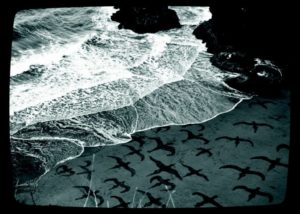
Remembrance Day for Lost Species; Memorial to
the Passenger Pigeon by Emily Laurens,
Photo Keely Clark: (Issue 7)
Once the fury subsides, I stand in front of the window with a conflicted heart. You have to temper that anger into words and keep beholding the beauty of the world that is still here. You know it's not the whole story. You know that for each terrible action against life, for all the numbness and indifference of millions, there are thousands who are standing up for the wild things, defying hunts, investigating the trade of shark fins and elephant tusks, defending the redwoods and the common lands, restoring the Californian condor and the African deserts.

I see I am left with a nervousness, a nervousness that senses the decline in some part of the web, a weakening in the links between insect and bird, plankton and fish, between plant and the human imagination. And so I act in whatever way I can to bridge the gap: I put my hand on the severed trunk of the tree; I carry the dead otter from the road and bury her in the marsh; I write in defence of the feeding grounds for the red-listed curlew on neighbouring AONB farmland now threatened with extraction. But most of all I try to find out how to shift our logger-headed perception, our ways of seeing and imagining the world from where we all stand, seemingly stuck in a parasitic culture that refuses to become symbiotic.

In many ways artists fulfil the function of the old medicine people and storytellers: they keep the bridge open to the living Earth and show how we can give back to a planet that has given us everything we know. Their act is to see and not falter, to reflect what is happening and speak to those inchoate places inside us. It is not an easy position to hold, because destruction is not easy to watch. But through their work we can look without turning away, because they themselves faced the disappearance and did not escape in their minds, or give in to rage or powerlessness. They bore witness and let the walls that separate us from the fate of the planet fall down inside them.

We follow their track.

HOLDING THE BASE LINE

When the world shifts and we don't notice, something happens: we move away from what is known as the ancestral or original instruction, our way of keeping the Earth intact. We don't notice that hills that were once forested become bare scrubland, or that it's become normal to see a handful of butterflies when only a decade ago there were hundreds. The writer, George Monbiot's response to this 'shifting baseline syndrome' in his book Feral  was to imagine a reinvigorated Earth and foster a culture of rewilding, the restoration of territories in which wild animals and plants could thrive again and flourish.

So what if, instead of drifting with the tide, we resist it? What happens if we remember how it was at one time and refuse to forget? That we hold what is and was dear in our neighbourhoods in connection with the forests and oceans everywhere?

David Ellingsen is a Canadian artist whose photographic work centres on the loss of the natural world and the reintegration of the 'intricate relationships between land, ocean, flora, fauna and atmosphere ... back into our technological, urbanised culture'. His sharp graphic eye ranges from observing the changing sky over a year, to the body of an orca cut up on the British Columbian shore. to a juxtapostion of a human skull filled with the skulls of other creatures. 'At The Edge of the Answer No 2' (see above) was the opening image in our latest issue TERRA, from his series Solastagia.

The Last Stand by David Ellingsen
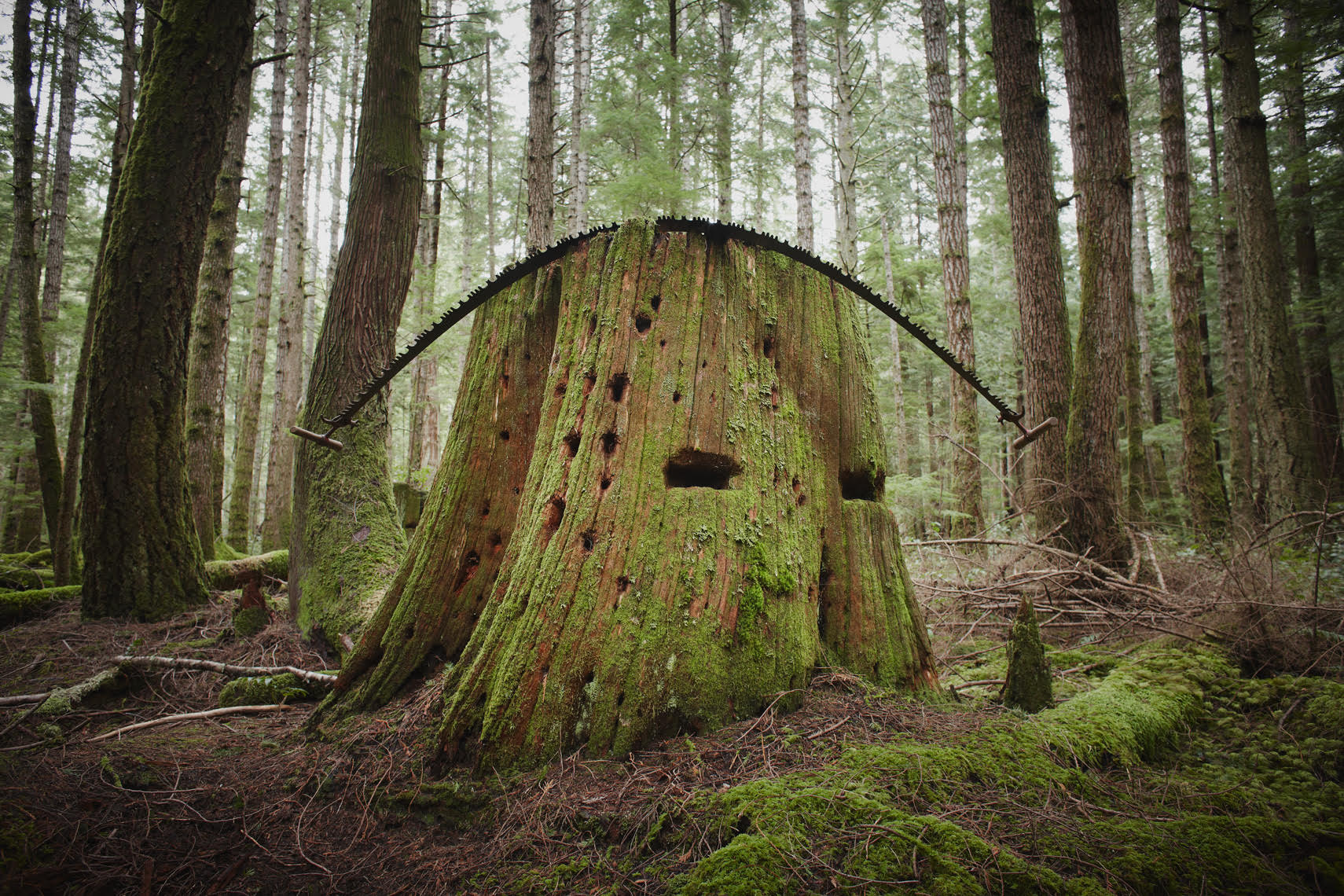
Installation 3, Lance-tooth Crosscut Saw by David Ellingsen.
Western Red Cedar, Pigment ink on cotton rag

'This project, The Last Stand, was photographed on my family’s land here in Canada – in fact it was my great grandfather and great uncle who cut down these very trees over 80 years ago. The vast old growth forests of British Columbia have mostly vanished, with only 1% remaining, a situation reflected in the great forests around the globe. Disappearance and loss are a consistent theme running through my work and I remain compelled by an unrelenting, creative urgency as the ecological crisis deepens. In fact, after decades of warning from our civilisations’ brightest minds, I feel it my duty to do so.

It is my hope that creative work which encourages emotional connection with the issues and engagement with the grieving process (that rightfully accompanies this diminishment of life) will help us move through the seemingly ‘frozen’ state our civilisation is in and into a period of rapid acceptance and mobilisation to repair what we still can.' DE

SEEING THOUGH THE DARK GLASS

There is a point at which you get 'woke'. It is a terrifying moment, as the cocooned world you knew cracks open. But it is also a moment of kinship - not only with our fellow creatures, but with our ancestors who left depictions of this relationship on the walls of Neolithic caves, or shards of ancient Pueblo pottery.

The current intellectual discussion about ecosystems and carbon emissions speaks to our rational minds but does not connect with our physical, kinetic intelligence, our creaturehood, the places where we feel kin with the rest of life. For that we need physical encounter in order to engage and act.

The sculptor Stephen Melton brings a visceral attention to the fate of the natural world at our hands: to native sharks mutilated for their fins (see above in 'Thanet Fish') to the illegal pet trade to the destruction of the Indonesian rainforest, with carved and often entwined and adorned figures of animals, birds and fish.

Dreamland by Stephen Melton
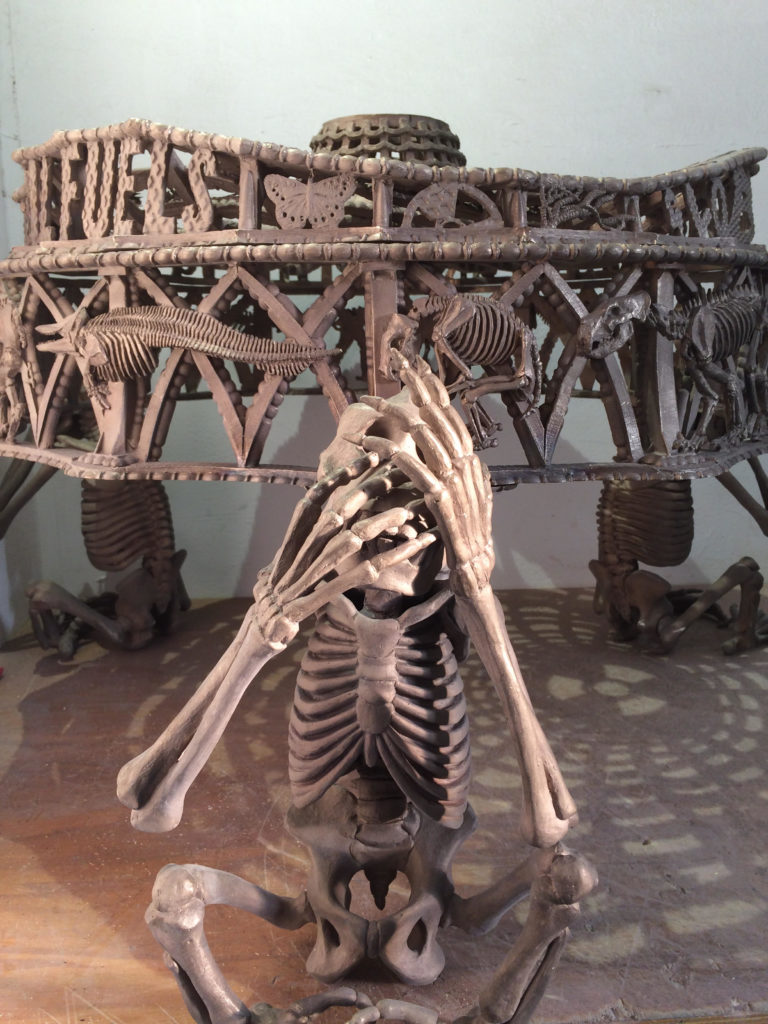
Dreamland by Stephen Melton. Work in progress that contains the forms of lost or disappeared creatures including orangutans, hedgehog, killer whale, rhino, cane toad, polar bear, sperm whale, tiger, sea turtles, coral, giant anteater, orange bellied parrot, carrier pigeon, pangolin and moths, Below: detail with bat.


'We live in such a visual world today; a world in which we are bombarded by images through digital and social media. Often, if the image hasn’t been constructed using the "click-bait" brief, it is often overlooked.

Sometimes I choose to work with an aesthetic that is beautiful, familiar and fun, which can be seen in my current work in progress ‘Dreamland’ – an intricately cast carousel in bronze. However, I then subvert the aesthetic by presenting my concerns about social behaviour and our attitudes towards our natural world.

I hope that using beauty to attract the audience will then engage them in the visual paradox the work presents. Using global fonts, the headlines of our most prominent socio-ecological problems today adorn the whole structure, in a similar manner of the carousels of the past. Hand-carved and subsequently cast skeletons of animals weave around the attraction, in an ominous manner. Each species has been chosen because of their current fragile existence due to humanity's impact on the world.

Like sheep, many of us follow unquestionably patterns of human behaviour without any understanding of the consequences, repeating mistakes of our past. A decaying ride that we are unable to alight.' SM

HONOURING

In 2001, the UK filmmaker Nick Brandt went to Kenya and began a photographic odyssey: to capture on film the disappearing great fauna of southern Kenya. The elephants stand as giant billboards in a broken landscape, under a flyover in the 2014 series Inherit The Dust; in This Empty World – his latest book to be released next February – they are juxtaposed amongst the industrial infrastructure, machines and human presence that threaten them on all sides.

Elephants (killed at a rate of 100 a day for their ivory), lions, giraffes and hyenas, are all photographed with a medium lens camera, as black and white portraits, closeup, still, without drama, or special effects.

'What I am interested in is showing the animals simply in the state of Being,' he writes in the first of his trilogy of books, On This Earth. 'In the state of Being before they are no longer are. Before, in the wild at least, they cease to exist. This world is under terrible threat, all of it caused by us. To me, every creature, human or non-human, has an equal right to live, and this feeling, this belief that every animal and I are equal, affects me every time I frame an animal in my camera. The photos are my elegy to these beautiful creatures, to this wrenchingly beautiful world that is steadily, tragically vanishing before our eyes.'

Ranger with Tusks of Elephant Killed at the Hands of Man by Nick Brandt
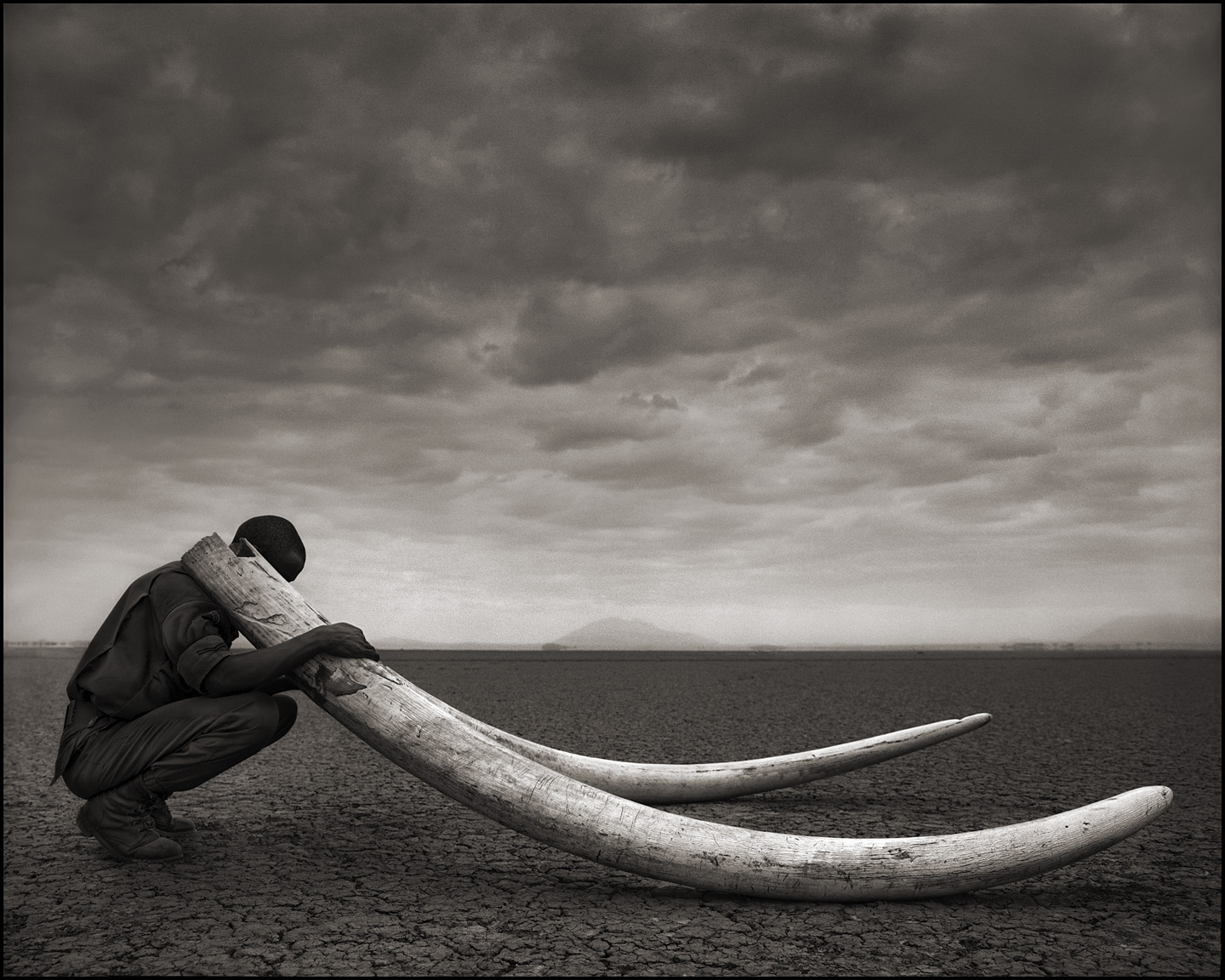

Ranger with Tusks of Elephant Killed at the Hands of Man, Ambrosselli, 2011 by Nick Brandt
'I find it hard to imagine the living elephant that possessed these tusks. I’ve never seen elephants with tusks anything like this size, and now, I never will. They are all gone, dead, mostly killed by man.  Even with one part of each tusk embedded in his skull, this elephant would still surely have had to lift his monumental head to prevent them from dragging like excavators through the earth.

The elephant was killed by poachers in Tsavo in southern Kenya in 2004. His tusks were stored in Kenya Wildlife Service’s ivory strongroom. In July 2011, they permitted me to borrow these and many other tusks of killed elephants for the ranger series.

This photo features one of 200 rangers employed by Big Life Foundation, the nonprofit organisation that I co-founded with conservationist Richard Bonham in 2010 to help protect and preserve the wild animals of a critically important 1.6m acre area of East Africa.

Photographed on medium format black and white film, I waited several days for the normal clear blue skies to disappear, waiting for the right sombre cloud cover to take the photos.' NB

ALLEGIANCE

One of the main reasons people don't want to see, to wake up, is to feel the emptiness that the violence of civilisation leaves behind. We live in a world that promises freedom from suffering with its tinsel politics and cheap distractions. But you never get a relationship with the living Earth that way, the feeling that you are connected. The relationship with the Earth - whichever way you learn to love it - through a land, creature, plant, or ocean - is a relationship that never falters and will never, unlike civilisation, let you down.

However, there is a bargain you make when you forge that relationship, an ancient bargain human beings have made over millennia. Our allegiance goes both ways.

Dark Mountain Issue 7 featured Silent Spring by Chris Jordan and Rebecca Clark (detail above, see full picture here) which depicts 183,000 birds, the estimated number of birds that die in the United States every day from exposure to agricultural pesticides. It forms part of his series Running the Numbers: An American Self-Portrait which looks at consumer culture through the austere lens of statistics. However, the photographer is most well known for his close-up portraits of dead albatross chicks on the remote island of Midway in the Pacific Ocean, their stomachs full of discarded plastic.

The recent documentary about his experiences is a searing gaze at the extraordinary beauty of a bird and its fate as it encounters the debris of our fossil-fuelled world.

Albatross by Chris Jordan


Chris Jordan's ALBATROSS film trailer from chris jordan photographic arts on Vimeo.

'The biologists here are finding that the birds all have plastic inside them. Each time I opened one up was like a gallery of horrors. But I believe in facing the dark realities of our time, summoning the courage to not turn away. Not as an exercise in pain, or punishment, or to make us feel bad about ourselves, but because in this act of witnessing a door opens.

'The most difficult thing to bear, for me, was what I knew but they couldn't know about why they were dying. In this experience, the true nature of grief revealed itself. I saw that grief is not the same as sadness or despair. Grief is the same as love. Grief is a felt experience of love for something we're losing, or have lost. When we surrender to grief it carries us down to our deepest connection with life.

I didn't know I could care about an albatross.' CJ

Sunday, 16 August 2015

Holding fire

Last month I travelled up the East Coast to the Scottish Sculture Workshop in Aberdeenshire, where my fellow editor Nick Hunt and I told the story of Dark Mountain around the fire and later gave a workshop on the 8 Principles of Uncivilisation in a field. We were part of the Breakdown Break Down camp where cultural workers, artists and activists were engaged in an 11-day exploration of 'deindustrialising our sense of self'. 

One of the evening talks was by the centre's director, Nuno Sacramento, on taking oil out of our relationships with the land. He was beginning to document different ways of interacting with the surrounding lush terrain with its estate-dominated larch woods and grouse moors and mammoth cattle. He called it the Lumsden Method (after the village where the centre is situated). Already on his list of methodologies was the work of some of the camp's speakers and teachers - from soil sampling and animal communication to land rights and bio-remediation. 

'Have you got a land dreaming?' I asked him. 'It's a way to directly perceive a place with others.' He hadn't. So I resolved to send him a method I used to use years ago. It was called Earth Dialogues.

For a long time now I have been  focused on the social aspects of downshifting, engaged in the methodologies of community activism. Now when I look at the land I see it in terms of geology mythology and history. I see roads and fossil fuel extraction, I see crops and the industrial food system; I see clouds and think of climate change. But I didn't always see like this.

'The land is always political,' said John Jordan at the Breakdown Break Down Workshop in London that preceded the Camp. Steve Wheeler, another of the DM ed team, and I were holding a discussion after our presentation called 'Finding Your Way in the Dark'. A lot of people were getting hot under the collar about the word 'rewilding'. It seemed that social justice and climate activism were being sidelined.

'Sure,' I replied. 'I go out foraging and meet a fence and that tells me the land is someone else's property and straightaway I bump into history and hierarchy. Rewilding is about taking down that fence - literally and metaphorically - and seeing the land and yourself in a different way. 

'You can see a mountain being exploited for its forests or minerals or tourism. But the mountain also exists in and of itself. It is Mountain in the way you are Human and that's an uncivilised relationship I think Dark Mountain explores.'

The Uncivilisation Principles caused a similar disquiet in the field at Lumsden. However the living systems of the planet are not 'Nature' that exists outside the metropolis for the benefit of tourists or 'privileged people' (as one participant called those of us who live in rural backwaters). Unless we have a relationship with the planet on its own terms, in its own language, through our own planetary beings, we cannot really speak on its behalf. We will only be talking in geo-political terms and pussyfooting around the needs of other human beings (our own 'tribes' or those we deem worthy, depending on our political persuasion). Or we will want to manage everything back to a pristine state of wilderness and so write ourselves (and 7 billion others) out of the story.

Either way this is a human-centric story, told by people looking through civilised eyes. Somewhere along the line you will hit a wall when you try to tell a new collective story that includes the planet and all its elements and beings. We hit that wall in those Breakdown discussion circles. Something needed to break us out of our mental straitjackets. That's when I remembered a small workbook Mark and I put together in 2007. It was in essence a manual of practices that explores what happens when you stop talking from your head and start using other parts of your intelligence to see and communicate with the Earth and each other.

The following 'recipe for action' is a skeleton key to the Earth Dialogue practice. In his talk Nuno poked fun at the nature writing of the 'lone, enraptured male' surveying the world from his mountaintop eyrie. What made me suggest our 'method' was because speaking practices are not individual endeavours. Having an expansive time on your own in nature is not hard if you have the resources and time; perceiving a landscape with others is work. 

The Dialogues were a kind of springboard for that work. 

Earth dialogues


When we travelled to America in the summer of 2000 we took the practice out of the room and started to dialogue under the cool shade of trees. We started to use the techniques we had found working with dreams and plants in order to locate ourselves in time and space. We would get a feel for the certain places we visited and find out what they were communicating to us. 

We had already begun to explore this with others in England. Four or five of us would meet in a place and then go and sit in different positions within it. Later we would regroup and relate out loud the impulses, directions, information and messages we had received. We’d make a tea of the leaves gathered there and put together a collective vision or dream map.

As the millennium turned we travelled to many different places in this spirit of enquiry: an old quarry floor, an ancient coppice, a burial mound surrounded by a circle of beech trees, a city scrubland, an ancestral mountain, a hot spring under the stars. Assisted by our communications with the Earth in our dreams - mountains, seas, animals, birds, flowers, insects and stones - we found we were able to behold a whole geography in 'reality'.

We called this way of seeing perceiving within the field. This meant beholding the planet as a participant, rather than from the separated control position of our minds. The group energetic readouts enabled everyone to speak freely from their hearts about the planet instead of being trapped into talking from any ecological or fix-it mindsets.

The Earth Dialogues allowed us to experience the Earth not as ‘landscape’ or ‘nature’ or ‘the environment’ but as a complex of dimensions, a vast meeting place of many kinds of being in which being human is only one strand. However we also saw that this strand has a vital meaning within this dimensional web that is linked with our native ability to perceive. 

Instead of looking inward to understand a plant medicine or dream, we found ourselves looking outwards, into the composite fabric of life. We were not just receiving information, we were also transmitting. 

Perception we realised was a two-way process.

conditions for an earth dialogue

Earth dialogues are essentially communications between the natural world outside your front door and your own physical beings. You go forth with a small group in a particular attention. You need to be able to include everything you experience and hold many kinds of awareness at once. Unlike the hermetic space of a room, the outside world is full of distractions and invisible interferences. Your head can quickly become full of words that block your view and interrupt your engagement. 

The essential act of an Earth Dialogue therefore is tuning into and physically connecting with the place you are visiting. Perceiving within the field is best understood in terms of transmission and reception. To receive you need to become conscious of your body's ability to perceive, using your senses to become aware of temperature, light, sound, pattern, the direction of the wind and clouds. To transmit you need to become aware of your inner forces and relate them to the outer world: connecting with the air, for example, by breathing in its scent of salt or pine, and breathing out the warmth of your being; connecting your feet with the land, as your toes grip the rock or bare earth; your movement within the water, as you glide with the currents of the river.

To perceive with the body requires adjusting to the tempo of the Earth and the tempo of your heart which go at the same pace - the same wingspeed as the bird in the sky, the same rhythm as the sea wave rolling to the shore, the same stillness of the hill with the sun rising behind it.

In daily life we walk around with the talking heads of our mindsets fully switched on. As a result the Earth is rarely seen, never felt, never lived on. A never-never land you may dimly remember seeing as a child and in your heart privately long for. The Earth Dialogues were all about return, not to childhood but to the place that is always here.

How to frame a dialogue that takes place 'outside' and includes the outside 

1 Tuning into the time and place When you (the group) have arrived at the place you wish to visit, establish the conditions for a dynamic dialogue between everyone taking part. 
Agree upon a time-frame and meeting place for your readouts. 
Fan out.
Find your position within the territory (you may not find this straightaway). A spot where you feel at home. A plant or tree can act as a good anchor.
Greet the land in your own way.
Sit in a state of attentive stillness. Feel your feet and take a few deep breaths.
Connect with your inner core and the beat of your heart. 
Open your consciousness and become aware of the elements of the place and time - the quality of light, the weather, the season, atmosphere of place, the mood of the day. 
Now take note of the various beings that inhabit this place - animals, rocks, trees, plants, other people. You do not need to rush. A period of silence and patience is required for the whole picture to be revealed.
Listen to the sounds, notice how everything is moving - creatures, birds, the wind in the trees, yourself. 
Take note of any subtle feelings and realisations that arise, what ideas and sensations, memories or shifts of perception that come as you sit there, listening, observing, feeling.
Become aware of the correspondence between the elements of this place and your self.
See how everything connects, how this hill is all hills, how this ocean is all oceans.
Remember what you have experienced. 

2 Energetic readouts Return to your chosen place of dialogue.
Relate your findings to each other, taking turns to speak. 
Relate what happened and also any feelings that came up, what was going on around you, your communications with other beings during the time.
Your fellow visitors can then ask questions about your experience.
Listening to others is as key to this process as speaking, as you are forming a composite picture. One person might just report a shift of awareness, another relate a whole story. Note the correspondences between your accounts. Each person holds a part of the map.
When everyone is finished make an agreement to write or draw some kind of creative record and send it to everyone else.
Go out and celebrate together. 

* * *
At Lumsden one of the key post-
meeting places was the sauna built out of old whisky barrels (whisky production is a key local industry, due to the area's unusually pure water). No matter what happened during the day everyone could pile into the dark, scented warmth, or if they were lucky have a Finnish/Estonian 'energy whisk' with leaves of rowan and maple and sometimes nettles (ouch!). Sharing the physical elements of fire, water or earth takes you right into the heart of an Earth Dialogue. The mind is pushed out and you can get close with your fellows.

All Dark Mountain stories are told round a real or metaphorical fire with people listening. All Earth Dialogues happen outdoors with people immersing themselves in the fabric of the planet and then speaking. Or sometimes the other way round.

Here is how it started years ago in New South Wales at the end of our travelling and the beginning of the practice years, where we had rented a bungalow fringed with frangipani trees by the ocean, and met up with Sarah who we had crossed paths with in Colombia.

Tea tree lake

byron bay, australia 1998


We had been focusing on the dreaming practice all morning with Sarah. 'Let’s go to the tea tree lake,' she said. 'There’s something amazing that happens there.' So we walked down to a warm still pool behind the beach, where the roots of the tea tree go deep into the water and stain it red brown. We swam out to the middle. 

  ‘Now,’ said Sarah, ‘you have to dive down as deep as possible, then just let yourself float up. Keep your eyes open and look up. Whatever you do, remember the light!’

We all dived down together. I opened my eyes. Everywhere was dark-brown. Then I looked up and saw a dim golden colour above my head. As I floated up from the dive it got stronger and stronger, until it burst into a shower of diamonds as I surfaced with my two companions and burst into laughter. We were all laughing and splashing water around us. 

Amazing we all agreed. And immediately dived down again.

Nothing really ‘happened’ at the lake. It was an intense experience for a few moments. But in those moments, naked, diving into the brown and golden water, bursting through the surface of the glittering sunlight, we had become different beings. It was as if our modern European histories no longer existed, our city biographies. We were suddenly just three human beings in the middle of their lives, enjoying the Earth together, starting again at a certain point in time. Mark and I were beginning our dreaming practice in this ‘rainbow’ sea town where people from all parts of the world, like Sarah, were gathering to live in a more heart-based way.

The tea tree lake visit was the energetic basis for the practiice we would call the Earth Dialogues, though we didn’t know it at the time. It had the three key components: trees, water and human beings who had been speaking their dreams out loud together. The combination of these three energies provides a matrix for a subtle transformation. The oil of the tea tree has become the world’s most effective natural germicide. It can see off opportunist white fungal growth, in the same way speaking with heart deals with the monologue of the mind.

Swimming in wild water, as we would find found in the years that followed, instantly decrystallises rigid thinking; pettiness and anxiety dissolve in the flow of a river or in the vastness and fluidity of the sea. The dreaming practice, inspired by a lecture on Aboriginal dreamtime, had connected us with our archaic roots - the roots of common humanity - so that we could move forwards. We were feeling our bare feet on the red earth, walking along a track we had not taken before. Except perhaps in a dream. 

Here at the end of the twentieth century in these soft brown waters, infused by the great medicinal tree of Australia, a mind-dominated parasite culture we had held inside ourselves for aeons, was starting to be replaced by another way of life entirely.

We were remembering the Earth for our future.

(from Speaking with the Fire 2007) 


Making fire

When I looked back at this time among the medicine trees, I wrote that Australia was an ancestral place of fire where our old civilised lives could be burned away and we could begin again. It was also the place where we decided it was time to come back to England.

I did not realise then that fire is not just about burning away dross. Nor did I realise how many years it would take me to return to my homeland and find it as rich as the world I had travelled across for almost a decade. But I have found its treasures still lying in the deep places and the seeds of the future buried in the hearts of people. You just have to peel away the layers of history and look at the hills and the windy roads with different eyes. And sometimes with your fellows sitting around a fire.

Here I am with Nick as we introduce ourselves before a great metal fire-dish forged in the workshops behind us, among the foothills of the Grampian Mountains. I am talking about the mythical Saxon smith Wayland whose name-place was the site for one of the first Earth Dialogues Mark and I held in 1999. I am talking about forging the future, and how going into the material and finding its fiery spirit is the only way for humans to really understand their place on the planet which has sheltered us for so long. 

What does this have to do with a swan feather and writing? The answer will be in the next Dark Mountain journal, our first themed issue on technology and tools and now in full swing production. It will be published on 15th October, we will be launching it with readings, songs, performance and conversation at Iklectik Art Lab, Old Paradise Yard, London. Hope to see you there!

Jumping the midsummer fire, Suffolk (Josiah Meldrum); mountain, Vilcabamba, Ecuador (Mark Watson); sauna, Scottish Sculpture Workshop, Aberdeenshire (SSW);  speaking round the fire (SSW)

Saturday, 3 May 2014

The Fabric of This World

In celebration of the new Dark Mountain anthology, here is a quick peek into the artwork pages (16 in all) that intersect the texts. As well as a photographic record of the four Uncivilisation Festivals, there are two sections of work in various media, from gum arabic to found materials, digital montage to cyanotype.

Dark Mountain art is hard to qualify or put into a box, but what has shaped and defines this selection is the intense focus and relationship each artist has with the matter in hand — stuff that most of us in a 24/7 whirl of activity do not have eyes or time to notice.

Why do we need art? Because only when we pay this kind of attention can we see close up the extraordinary nature of earthly alchemy, or the movement of the heavens above us. That what science drily calls ‘eco-systems’ are in fact beautiful and meaningful patterns that intersect with our own intelligence and planetary presence in a way words cannot easily describe.

Like the Earth, these images are the work of collaborations, of projects — the results of waiting and watching and movements over time. Way marks and tracks, blueprints and shifts: a map of mountains soaked by the rain, the blue zigzags of a Patagonia glacier.

Each one tells a story caught in a glimpse: the story of a pilgrimage through Walthamstow, the story about a collection of plants made from abandoned technology, the story of the sun’s yearly trek across the sky in a grandmother’s house in the far north. The fabric of this world.

Here is one behind the book’s centrefold picture: the story of the man who follows the deer.

Roe Deer in May Birch by Thomas Keyes

Thomas Keyes first appeared in Dark Mountain 3 with a compelling recipe for black pheasant stew. He is a forager and artist who lives in the remote Highlands, with a wood behind his house. What inspires his art are the materials he comes across when he roams the land. Although he fashions works from a wide range of natural stuff — from mushrooms to wasps’ nests to oak galls — his signature canvas is parchment made from the hides of (mostly roadkilled) roe deer; his paints the tar and smoke made from the bark of the tree he loves more than any other: the birch.

‘I like the self-referential nature of the subject of birch and deer. The birch trees are endessly fascinating and so expressive, the more I see them the more I want to paint them. People from the city might see a forest with deer as an image, a pretty picture, but for me they are an important practical part of life. Some people get the paintings and some don’t.’

Keyes is one of the artists taking part in The Foraged Book Project with Fergus Drennan (an Uncivilistation regular) and James Wood, and like many others there is no separation between the stuff he uses and the subject of the painting itself. He uses the scars in the hides to form the kinks in the trees bark for example.

‘Foraging is a way of interacting in a rural environment and of noticing patterns: you start to see exciting things everywhere and have a reason to go places, to be on high alert. I wanted to make something artistic out of the material I foraged, but it didn’t go anywhere until I came across the deer and then I felt obliged in some way.’

The materials came together by chance. The parchment he found was the best way to preserve the deer skin. He had been making the birch tar (used traditionally as a sealant) by boiling it up on an open fire as an experiment. But his intense focus on these two lifeforms is not just because of their look and proximity:

‘Basically birch trees have always been there with people in Europe, as fuel, as medicine. They are one of the constants, which like roe deer, we’ll see into the future. Both have actually increased because of us and agriculture. They are two species that it’s safe and important to form a relationship with. So much of nature is in drama and disappearance, it is good to know there are some things we can count on.

‘What’s really interesting about Dark Mountain is that when you get people together to talk about the premise of collapse suddenly you are talking about what is actually there; whereas before when I was around people who did not accept that premise they were constantly fighting their corner, or arguing the point, with stats about peak oil etc and no one was looking at what lies beyond that. Whereas when you accept the premise you can have a look at the natural world, which hasn’t gone away. There’s quite a lot of it left, bad as things are.’

DM5 cover roe deer in may birch
The paintings beckon a way back into the land most people now feel divorced from. Deracination and lack of connection with the natural world is one of the ways a dominant city-based narrative keeps a hold on our imaginations. There’s nothing out there, it’s all gone! In a time of unravelling however, belonging and being anchored in a place become increasingly vital. In a piece written for the present volume, ‘Finding Common Ground’, Keyes looks back at a land where his own connection was severed:
The parish I reside in still has barely half the population it supported up until the mid 1800s. Incomers are a necessity. As an Ulster Scot I come from long line of incomers: Ulster Scots are professionsal incomers and have played no small part in the colonisation of most former British territories. Clan Hanna were made enemies of the crown and send from Argyll to County Monaghan, beyond the frontier of the Ulster plantation in 1640. My direct, soil-based experience of that land ended formally only a few years ago, when my great aunt Edna Hanna died and the small farm I had visited as child became out of bounds. One break in the chain in 370 years, and it’s over. My children will only ever enter that land as trespasssers, with no emotional connection to it. In fact, once I am not here anymore, they probably won’t bother; their children may never even hear of it. The home those people built, the fields they worked, they churchyard they’re buried in, the relationships built over generations: all gone. I’d be no more home there now than I am back in Scotland, walking through the fading traces of other families’ tragedies.
In many ways, Keyes writes for most of us who no longer live in places where generations of our clans, families or tribes, have interacted with the land. We have now to dig deeper, beyond history, beyond our familial circumstances, to get back to an Earth where we feel at home with all our relations — rocks, plants, animals, trees. An immersion in the shapes and patterns of the natural world frees us from the grids and enclosures set up by Empire, in our physical forms as much as in our imaginations.
When you look at the painting you find yourself following the deer, down the wild track through the trees, toward the mountain — as our ancestors have always done through time. It feels like the only path you want to take.

Thomas Keyes is an artist, gardener and parchmenter based on the Black Isle. He is currently working on the Wild Project and The Foraged Book Project and updates thomaskeyes.co.uk with foraged art.

PLANBee-emergeCalling all artists! We are still open for sub- missions for original work (pain -tings, drawing, photo -graphy) for Dark Mountain 6 as well as for our next cover. Please look at the submission guidelines for details and send to charlotte@dark-mountain.net. Deadline is 18th May.

Dark Mountain: Issue 5 is available through our online shop for £12.99 – or subscribe now to future issues and get this one for £8.99.

Art works: Following the Roe to Bennachie and Roe Deer in May Birch by Thomas Keyes; Jess X Chen with the diptych Collapse, Emerge (created with fellow artist, Noel’le Longhaul) which formed the cover of Dark Mountain 5. Bluestocking Bookshop, New York.

Post originally published on The Dark Mountain blog

Wednesday, 23 October 2013

EARTHLINES: Rewilding the Future

As the autumn issue of Earthlines (no 7) is about to appear, I am republishing my summer Life in Transition column, written in late Spring. Strange how my focus is entirely on gathering and storing fruit whereas this copy was written as the blossom was in full sway. The pictures are taken from a year of wellbeing walks I helped organise and lead around Bungay (to be mapped this November).

I’m reading George Monbiot’s Feral, flicking the pages and following his description of kayak trips over  seas full of jellyfish and rough waves. I’m reading it in one sitting under the apple trees in a day of rare sunshine, occasionally pausing, eyes closed to listen to the sounds all around me. It’s late May and the bittern is booming in the marsh, goldfinches chattering on the wire down the lane. Young jackdaws  squabbling in the chimney, almost ready for flight. Just above my head a crew of bees are working the apple blossom.  

Five years ago this apple tree fell over in a big wind and, inspired by Richard Mabey’s talk on Beechcombings, instead of cutting it for firewood, I left it to do its own thing. Now it has regenerated itself and become a small apple collective. Five years ago I would not be aware of the presence of these bees, or made the connection between their presence and the fruit that will appear this autumn.  I would not have treasured its apples, or gone around the neighbourhood, foraging  for other varieties,  or learned how to make cider from my neighbour. I would not have been grateful the sound of the now-rare cuckoo flying overhead, or the sunlight on this day, the land held in a haze of golden light, the sea a vibrant blue strip in the distance.

It’s a different time and requires a different sensibility - a mix of old knowledge, new awareness, and some  bold and unprecedented moves in uneasy waters. Not least in our own minds. 

I am reading Feral intensely today, because it questions a lot of assumptions about nature and has engaged my attention in the way scientific and literary books have been unable to for a long time now. It is making me rethink the land within a depth of time and see its received aesthetic  in terms of governmental policy, but most of all because it brings a totally new dimension into focus – a rewilded country for the future.  

We live in a time of loss and control. Over half of the wild things on these islands are now in decline, corporations have made the world’s seeds, lands and water their private property and no one seems to know how to respond to the increasingly alarming messages about the biosphere  .At times  it is easy to lose heart, or to feel as hemmed in as those fledgling birds in the chimney. The book talks big spaces, deep time, and makes room for something else to happen. It makes suggestions that spark an imagination dulled by too many facts and figures:  bringing the extinct creatures back into the hinterland,  making  the rivers  plentiful again, describes how it once was when the North Sea was pristine and clear and could be again.  

To be alive you have to make moves that go against the flow. You have to fight for wildness and freedom in a civilised world. But most of all you have awaken  the imagination, let your mind take flight into blue air: breaking out of what is perceived as normal, and widen our knowledge, seeing in deep time, archaic time, Palaeolithic time, and start building a culture around renewal  and getting back on track. All those Re words. Remember, regeneration, rewild. 

Return. 

Working with the fabric 
If you live a life governed by heart, you live in a different world than the one if you live governed by the rational mind. They are different universes. Something that the heart can feel and intuit has a currency and an agency that the rational doesn’t even recognise. It doesn’t even know what you are talking about. 
I am talking with fellow Dark Mountaineer, Jeppe Graugaard about working with the ‘fabric of the world’. It’s like an invisible matrix that informs everything that happens in this visible world. Writers and artists understand this fabric, even though they might not describe it in this way. When people make a strategic act with a good intent it has a power and an agency that we cannot see, but affects the whole picture. It echoes in all places, like a hologram, or a homeopathic dose in the body. It’s tiny move - a small trip in a kayak, a conversation by a fire -.but it speaks to the whole world. Everything is contained in that event when it is communicated. The rational tick-boxing ’left-hemisphere’ mind doesn’t understand these kinds of acts – instinctively distrusts them, fearing its own loss of control. Their meaning and value come directly from a creative’ right hemisphere’ intelligence that is almost impossible to articulate or commodify. Somewhere however we understand it. We get a feeling for it in the core of ourselves, in our bones. Somewhere we trust this feeling with our lives.  

That’s why when I sit down with Jeppe and we talk about time and dreaming and the old myths, I know it matters; why introducing the wolf and the lynx into the mountains, and letting trees regenerate themselves is key. Because these counter-intuitive acts can speak directly to the heart, and a people who have heart are capable of extraordinary things. The heart can turn everything around. Everyone knows that inside themselves. People light up when love and belonging is around. Imagine what that can do with a whole planet. The reason we have to imagine large wild things and do small strategic acts, is because we have got as far as facts and information can take us.  

And now something else, sometimes creative, has to kick in. 

Rewild the body, rewild the mind 
I am leading a walk around the castle in Bungay. It is the second Wellbeing walk in a series we’re running this summer, mapping the town and all its green spaces.  We are threading our way through the Garden Market, past the Punch and Judy show, past the historical ruins,  exploring  alleyways, backstreets and river paths  with fresh eyes. I say I am leading but in fact in front of me there are two small boys running ahead and I am following their track. Suddenly they disappear.” Come back now!” calls their father. “That’s someone’s garden.”  They jump out of a lilac hedge, laughing: 

“It’s not someone’s garden,” corrects the elder brother. “It’s a hedge.”  

We have become  a cautious people and  this does us no favours, nor the planet. I like to follow the feisty writer as he go fishing miles out to sea, I like to kick stones with Reuben and Tristram and climb trees, to talk about the deep North with Jeppe at the tail of winter, because these stories are not on the agenda, and yet are embedded in the fabric of life. I know we need to live the opposite of micro-managed life. We need to burst open like flowers,  leave home at dawn,  walk through the dark, trespass and reclaim our fields, connect with people on the wrong side of the tracks. Encounter the wild creature, stand up in front of strangers and share our story. Listen. Eat nettles and blackberries. build fires, sleep in rain, swim in wild places. Let ourselves go feral.   

So having followed the Transition ethos of relocalisation and community resilience in these five years,  I realise what I have really been doing within its well-managed civic remit is fostering a culture that cherishes all these  wayward,  earth-loving  actions.  Paying attention to things that civilisation has scant time for, or has forgotten in its pursuit of power. I have come to see that return and regeneration - of soil, neighbourhoods, people, places - is the wild card in the pack, the card all of us have up our sleeves.  

Because a mindset that only understand the value of life – including our own  - insofar as it makes money for the economy, that only understands water and plants as commodities, comes from a civilisation that has already outplayed itself. One that has run out of storylines.  And that a culture governed  by  good intention, that springs from  the vast savannah of our imagination, from the deep ocean of our memory,  from our ancestral  beings,  held intact by a long lineage of dreamers, poets and activists, indigenous wherever we live, will never run out, can constantly renew itself, because it holds the  future of the earth in its heart. 

Gazing into the long water reeds of the River Waveney on a bridge with ten people on a Spring day is a good place to start - bringing our feral imagination into play and loving where we really are. Bird by bird, flower by flower,  stream by stream, human being by human being. Truly, wildly, deeply.

Cover of new EarthLines; fruits of foraging along the Waveney (October); on the bridge to Falcon Meadow (April); en route to the Queen Head, Earsham (October); evening primrose behind Castle Meadow (July); collecting cherries on Bath Hills (August); on the bridge to Earsham (May).